
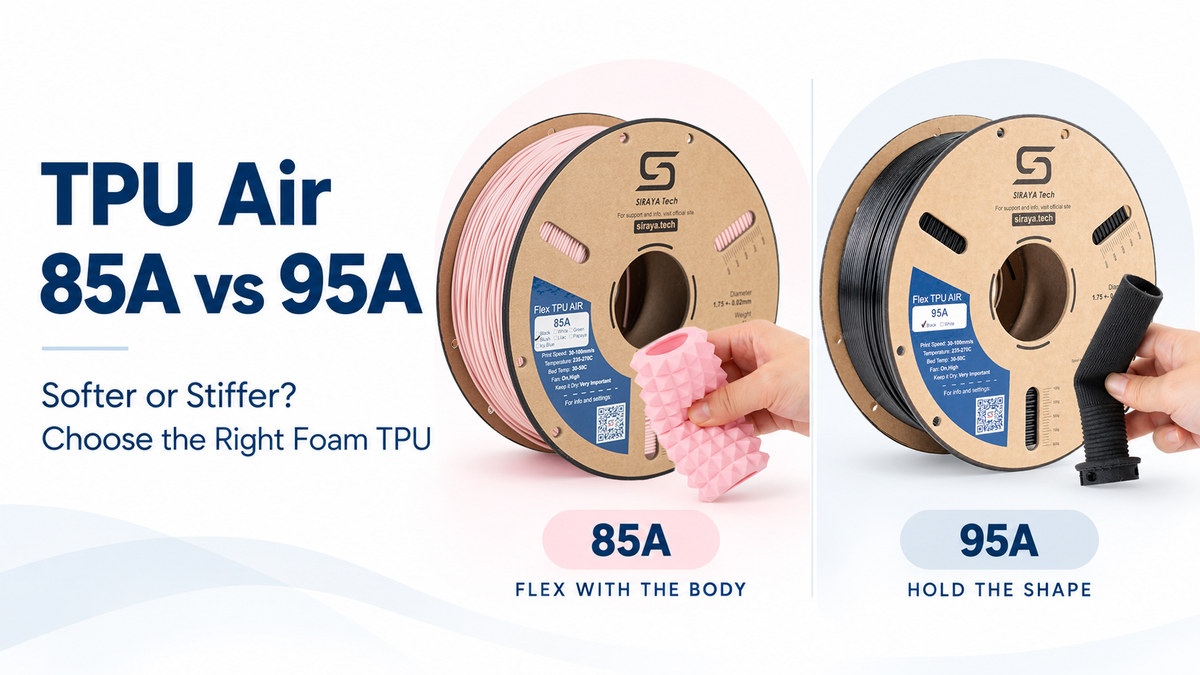
Same Foam Feel. Two Very Different Ways to Use It.
A recent print from Willow Creative captured exactly why we developed TPU Air 95A.
“The little bit of extra hardness makes sure that tricky designs prone to wobbling still print amazing, and the print time is much faster + half the weight. Still feels just like EVA foam.”
— Willow Creative
In a follow-up test, Willow printed a shoulder pauldron in the new TPU Air 95A and noted that it could print much faster because the material was stiffer, using 150 mm/s in that particular setup.
That gets to the real difference between TPU Air 85A and TPU Air 95A.
- 85A is for when softness and flexibility are the feature.
- 95A is for when you still want the lightweight, foam-like result — but with more structure, less wobble, and a filament that is easier to push faster.
Neither replaces the other. They are two different tools.
Why Make a 95A Version of TPU Air?
Flexible filament has always involved a tradeoff.
The softer the filament, the more it can bend and compress as it travels through the extruder. That softness is exactly what makes it useful in the finished part — but it can also make high-speed feeding more difficult.
TPU Air 95A shifts that balance.
It is still a foaming TPU designed to create a lightweight, soft-touch result, but the extra hardness gives the filament more structure during printing and gives the finished print more shape retention.
For users printing armor, props, larger shells, tall features, or designs that tend to move during printing, that can make a meaningful difference.
Willow Creative described it simply: the extra hardness helps tricky designs that are prone to wobbling print better.
TPU Air 85A vs 95A: The Simple Answer
| TPU Air 85A | TPU Air 95A |
|---|---|
|
Softer and more flexible Best when bending, compression, or comfort is part of the design. |
Firmer and more structured Best when the print needs to hold its shape while staying lightweight and foam-like. |
| Flexible costume components Padding Soft wearable parts Cushioned components Flexible straps and accessories Parts designed to conform to the body |
Cosplay armor Shoulder pauldrons Helmets Large lightweight props Thin-wall shells Tall geometry prone to movement |
85A = Flex With the Body
95A = Hold the Shape
If the part is supposed to flex, compress, or move with the wearer, start with 85A. If the part is supposed to keep a defined shape while still remaining lightweight and foam-like, 95A may be the better choice.
Shop TPU Air

TPU Air 85A
Softer, more flexible, and ideal for wearable parts that need to move with the body.
Shop TPU Air 85A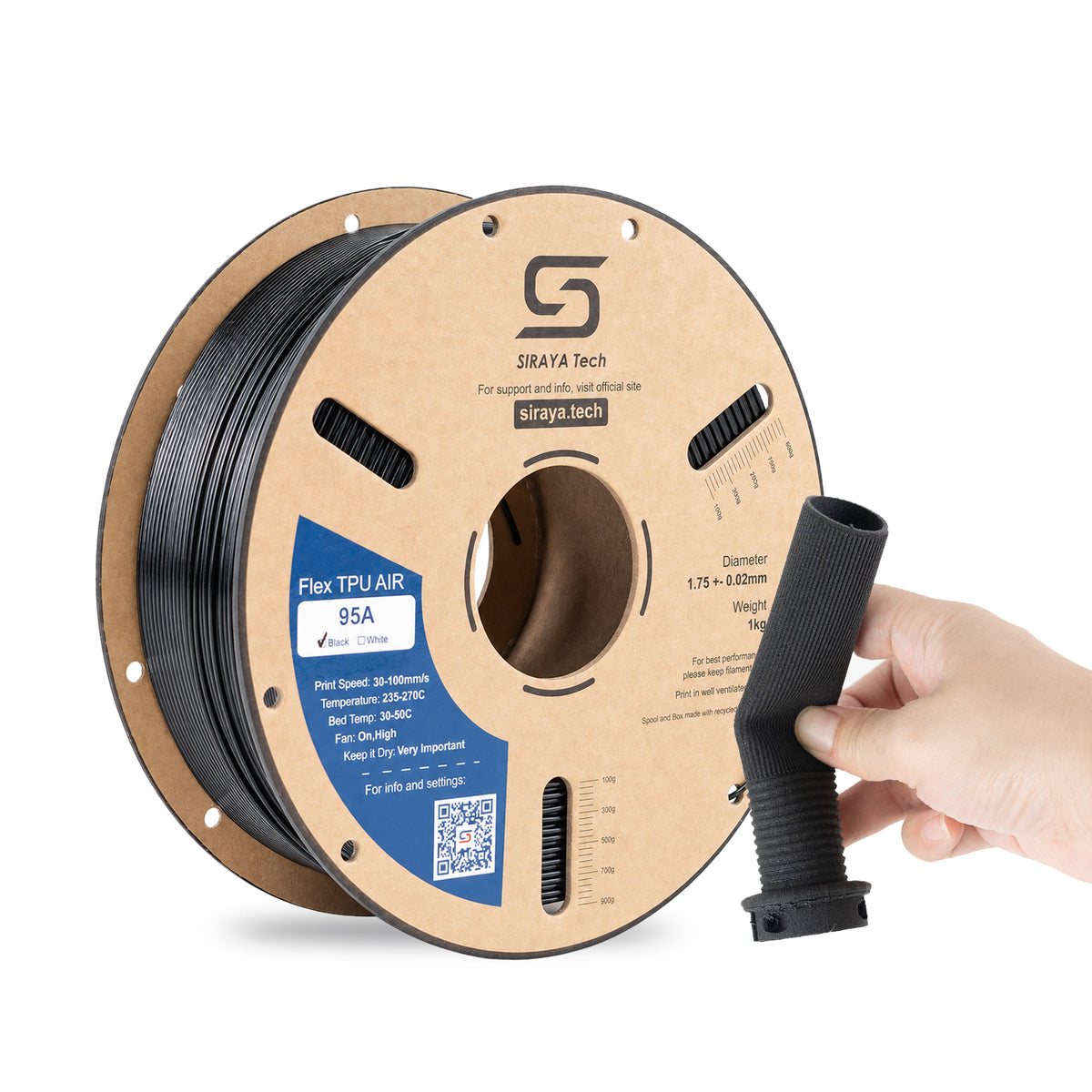
TPU Air 95A
More structured, more stable, and better suited for lightweight parts that need to hold their shape.
Shop TPU Air 95AWhy Can TPU Air 95A Print Faster?
The answer is not that 95A is magically “high-speed TPU.”
It is that stiffness helps.
A very soft filament can deform as the extruder tries to push it through the filament path. The faster the extrusion system tries to move it, the more important filament control becomes.
A stiffer TPU is less prone to that unwanted deformation. That gives the extruder a more stable filament to feed and can allow higher practical print speeds, depending on:
- Printer
- Extruder design
- Hotend
- Nozzle
- Temperature
- Model geometry
- Foaming settings
In Willow Creative’s test, TPU Air 95A was printed at 150 mm/s. That is a real-world example, not a universal guaranteed speed, but it shows why a stiffer foaming TPU can open up a different kind of workflow.
Why Stiffness Matters After the Filament Leaves the Nozzle
The benefit is not only inside the extruder. Once the part starts growing taller, flexible geometry can move.
Think about a thin armor edge, a tall costume feature, or a lightweight shell with limited support. Each new layer is being deposited onto a part that may flex slightly under nozzle motion.
That movement can show up as:
- Wobble
- Rougher surfaces
- Reduced consistency
- Less accurate geometry
The extra stiffness of TPU Air 95A helps the printed part resist that movement. That is especially useful when your goal is not to make a rubbery object.
Still Feels Like Foam
One of the most useful comments in Willow Creative’s test was not about speed. It was this:
“Still feels just like EVA foam.”
— Willow Creative
For cosplay builders, prop makers, and wearable designers, that comparison matters. EVA foam is widely used because it is lightweight, slightly compliant, comfortable to wear, and easy to shape into costume parts.
Foaming TPU offers a different route to that kind of result. Instead of cutting, shaping, gluing, and assembling sheet foam, the geometry can be created directly on the printer.
That means you can produce:
- Complex curves
- Internal structures
- Organic forms
- Detailed surfaces
- Shapes that would be difficult to build manually from sheet foam
TPU Air 95A does not try to turn that foam-like result into a rigid plastic. It simply moves the balance toward more structure.
85A: When Softness Is the Feature
There are many cases where the extra stiffness of 95A is not what you want.
For wearable parts that need to bend around the body, compress under pressure, or stay soft against the wearer, TPU Air 85A remains the better fit.
- Flexible costume sections
- Padding
- Soft straps
- Wearable accessories
- Cushioned parts
- Flexible shoe components
- Body-contact parts
- Prints where repeated bending is expected
The advantage of 85A is simple: It moves more. If that is what your design needs, that is a feature, not a limitation.
95A: When Structure Is the Feature
TPU Air 95A makes more sense when the object needs to behave like a lightweight structure.
- Shoulder armor
- Helmets
- Cosplay shells
- Large props
- Thin-wall lightweight parts
- Tall geometry
- Designs that tend to wobble during printing
- Parts where speed matters
- Parts that should feel soft compared with hard plastic but should not collapse easily
For these applications, slightly more hardness can improve both the printing process and the final part.
A Real-World Example: Willow Creative’s Shoulder Pauldron
Willow Creative’s shoulder pauldron is a particularly good example because it sits directly between two material categories.
It is wearable, so weight and comfort matter. But it is also armor, so it needs to hold a defined shape.
- A very soft material can work, but as the geometry gets taller or more complex, the part can move during printing.
- A hard plastic solves the structure problem, but gives up the soft, foam-like behavior.
TPU Air 95A is designed for that middle ground.
Willow’s early result highlighted three things at once:
- The added stiffness reduced unwanted wobble
- The material could be printed quickly in that setup
- The finished part remained lightweight and foam-like
That combination is the reason 95A exists.
Is 95A TPU Better Than 85A TPU?
No — and that is the wrong way to think about Shore hardness.
95A is not an upgraded 85A. It is a different balance.
- If your part needs maximum flexibility, 85A is the better tool.
- If your part needs more structure and you want more high-speed printing potential, 95A is the better tool.
Need it to FLEX?
TPU AIR 85A
Need it to HOLD SHAPE?
TPU AIR 95A
TPU Air 85A
Softer, more flexible, and ideal for wearable parts that need to move with the body.
Shop TPU Air 85A
TPU Air 95A
More structured, more stable, and better suited for lightweight parts that need to hold their shape.
Shop TPU Air 95A