
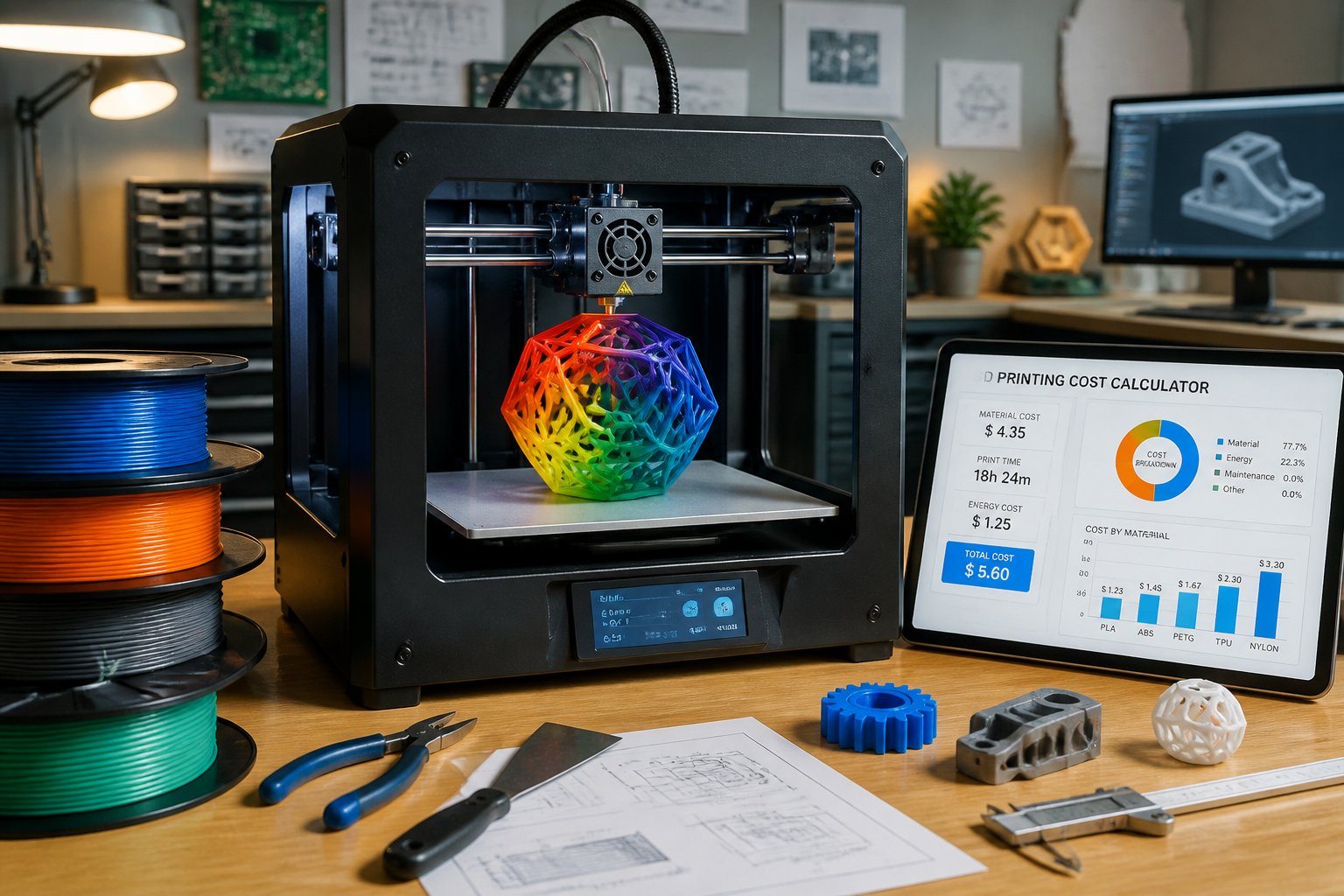
How much does 3D printing cost? It depends on a few key factors — the printer you use, the material you print with, and how often you run it. For most hobbyists, startup costs range from $200 to $500 for a basic FDM printer, plus the ongoing cost of filament or resin. Those numbers climb fast if you're printing regularly or moving into higher-end machines. In this guide, we break down every cost you need to know — from hardware and materials to electricity and maintenance — so you can budget smarter from day one.
- Main costs: filament, electricity, failed prints, printer wear, and your own time
- Material type and print size make the biggest difference in cost per print
- You can save money by picking cheaper materials, reducing failures, and tweaking your print settings
Ready to get started with resin printing? Browse our full range of 3D printing resins and find the right formula for your next project.
Factors Affecting 3D Printing Costs

3D printing costs break down into two big chunks: the equipment you use and the materials you feed into it. Printers can be cheap — under $200 for some models — or run into the thousands for pro machines. Material prices swing from $20 per kilogram for basic filament to $150+ per liter if you're into fancy resins.
Hardware and Printer Costs
Entry-level printers like the Bambu Lab A1 Mini or Creality Ender 3 V3 usually cost $200 to $500. They're solid picks for beginners or hobbyists who just want to print small stuff without dropping a fortune. If you want something more reliable or higher quality, mid-range options like the Bambu Lab A1 or Prusa MK4S cost $500 to $1,200.
Resin printers follow similar pricing. The Elegoo Mars or Anycubic Photon go for $200 to $300 and do a nice job with detailed prints. If you want pro-grade resin systems, expect to pay thousands.
Your printer choice really does affect your cost per print. Cheaper machines often need more maintenance and tend to fail more, so you might spend more in the long run.
Material and Filament Costs
PLA filament usually runs $15 to $25 per kilogram, and ABS sits at $20 to $30 per kilogram, so hobby projects stay pretty affordable. Standard resin costs more — $30 to $150 per liter — but you use less of it for small, detailed stuff.
Part size and volume change your material cost. A tiny keychain might use just $0.50 in filament, but something big like a vase could eat up $15 worth. Specialized resins (think engineering or dental) can easily top $150 per liter.
Don't forget about failed prints and support structures — they waste material and push up your cost per finished part.
Need a filament that bends without breaking? Check out our bendable 3D filament — built for flexible parts that need to flex and snap back.
Ongoing Expenses of 3D Printing

Once you've got your printer, you'll pay for electricity every time you print, plus software and maintenance along the way. These costs stack up differently depending on whether you use FDM or resin printing.
Electricity and Maintenance Costs
Most 3D printers pull between 50 and 200 watts while running. At the US average of $0.17 per kilowatt-hour, you're looking at $0.01 to $0.03 per hour. A standard 6-hour print costs roughly $0.10 to $0.20 in electricity depending on your printer's power draw — not much, really.
Maintenance is a bigger deal. FDM printers need new brass nozzles every 3–6 months ($2–15 each). If you print with abrasive stuff like carbon-fiber filament, you'll want a hardened steel nozzle ($20–60), which lasts longer. Build plates wear out after 6–18 months and replacing them costs $20–50.
Resin printers can be pricier to maintain. You'll swap FEP films every 100–200 prints for $10–15. LCD screens and UV LED arrays typically last 2,000–3,000 hours — budget $80–$150 for an LCD replacement and $30–$80 for a UV LED array.
Failed prints eat up both material and time. Good settings mean modern printers succeed about 95% of the time, but if you're new, plan for 10–20% extra material while you learn the ropes.
| Component | Replacement Frequency | Estimated Cost |
|---|---|---|
| Brass nozzle (FDM) | Every 3–6 months | $2–$15 |
| Hardened steel nozzle (FDM) | Every 12–18 months | $20–$60 |
| Build plate (FDM) | Every 6–18 months | $20–$50 |
| FEP film (resin) | Every 100–200 prints | $10–$15 |
| LCD screen (resin) | Every 2,000–3,000 hours | $80–$150 |
| UV LED array (resin) | Every 2,000–3,000 hours | $30–$80 |
Software and Hidden Costs
Slicer software like Cura or PrusaSlicer is free, which is a relief. Most model files are free too — sites like Thingiverse and Printables have loads to choose from.
The sneaky costs show up in consumables you probably didn't expect. Isopropyl alcohol for resin cleaning runs $30 a gallon and lasts half a year or so. Nitrile gloves for resin work cost $20 for a box of 100. FDM printers need new PTFE tubes every 6–12 months, usually $5–15 each.
For quality control, you'll want tools like digital calipers ($15–30) to check accuracy. A filament dryer ($30–100) helps keep nylon and PETG from soaking up moisture. You'll also occasionally replace worn belts, gears, or fans — budget $20–60 every year or two for repairs.
Strategies to Lower 3D Printing Expenses

You can trim your 3D printing bills by making smarter choices with materials and design. The trick is figuring out which changes save the most cash without wrecking your print quality.
Choosing the Right Material for Your Budget
Your material choice really shapes your costs. PLA is usually $15–25 per kilogram and works great for basic prototypes or decorative stuff. ABS is $20–30 per kilogram and gives you more strength for functional parts.
Nylon is pricier at $30–50 per kilogram but it's tough and lasts longer, so you might save in the long run by avoiding replacements.
Some budget-friendly moves:
- Standard filaments — Use PLA or PETG for non-critical prints instead of fancy stuff
- Powder recycling — With SLS and MJF, you can reuse up to half your leftover powder
- Generic brands — Third-party filaments often cost 30–40% less than name brands and work just as well
Buying in bulk helps too. If you print a lot, a 5–10 kilogram order can drop your per-kilo price by up to 25%.
Tips to Get More Prints for Less
Smart design tweaks can save you the most money. Try lowering your part's Z-height to cut print time and material use, no matter if you're doing FDM or resin.
Hollow out thick sections that don't need to be solid. Add drain holes so unused powder or resin can escape during cleanup.
Cut down on support structures by laying parts flat when you can. Supports waste material and make cleanup a pain. Try orienting overhangs at angles that don't need supports at all.
Combine several parts into one print when possible. That way, you skip assembly and don't need extra hardware.
Lowering your infill percentage from 100% to 20–30% for non-structural parts saves a ton of material with barely any strength loss. Printing multiple parts at once can also make better use of your build plate and lower your cost per part.
Printing functional parts that need to hold up? Shop our heavy duty 3D printer filament — engineered for strength, heat resistance, and long-term durability.
Conclusion: How Much Does 3D Printing Cost
3D printing costs vary widely depending on your printer, materials, and how often you run it. But with the right setup and a little planning, it's one of the most cost-effective ways to make custom parts, prototypes, and functional prints at home.
The biggest savings come from choosing the right material for the job and dialing in your settings to reduce failed prints.
Thinking about taking your printing further? Check out our guide on whether a 3D printing business is actually profitable and find out if it's worth turning your hobby into something more.
Frequently Asked Questions: How Much Does 3D Printing Cost
How much you'll pay for 3D printing really depends on your printer, material, and part size. Entry-level machines start at $150. Most hobby prints cost $0.50 to $3 in materials and electricity.
How much does it cost to 3D print?
Most hobby prints run $0.50 to $3 for materials and electricity combined — small items like miniatures use about $0.20 to $0.50 in filament, while medium prints like phone stands or brackets land at $1 to $3. Big prints like cosplay helmets can use $10 to $40 in filament alone. Size, material, and print time all drive the final number.
Is 3D printing getting cheaper?
Definitely — entry-level printers that cost $2,000 a few years ago now go for $300 to $600 and do a better job. PLA filament from big brands runs $15 to $30 per kilo, with budget options as low as $12 to $15. Modern printers also waste less material, with first-print success rates now above 95%.
How much does it cost per hour to 3D print?
Electricity costs $0.01 to $0.03 per hour for most FDM printers based on average US power rates. A 3.5-hour print uses about $0.12 in electricity, making material cost the bigger variable for most prints. Resin printers use similar power, but add $0.05 to $0.10 per print if you're running a wash and cure station.
How much does 3D printer filament typically cost per kilogram?
PLA runs $15 to $30 per kilogram from big brands, with budget options as low as $12 to $15. PETG lands at $20 to $30, ABS and ASA at $25 to $35, and nylon between $30 and $60 per kilogram. Specialty materials jump significantly — TPU and carbon fiber blends hit $30 to $50, while industrial PEEK can reach $300 to $500 per kilogram.