
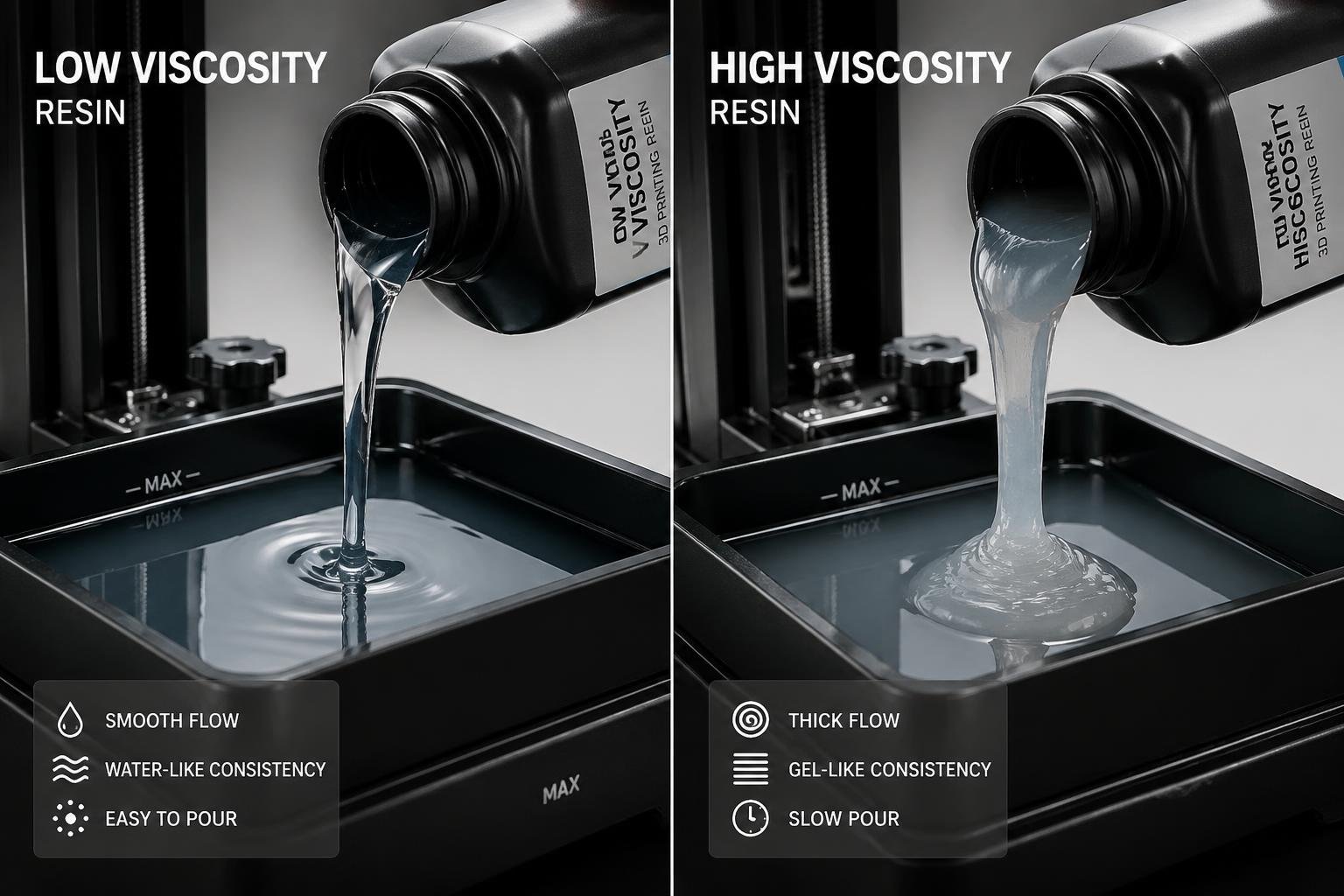
Understanding low viscosity vs high viscosity resin is one of the most important factors in achieving great 3D prints. Whether you're a hobbyist or a professional, the thickness of your resin directly impacts how your prints turn out.
Viscosity affects everything from how resin flows across your build plate to how well it captures fine details. Choosing the wrong type can lead to failed prints, poor surface quality, or wasted material. Knowing the difference helps you make smarter choices for every project.
- Low viscosity resin flows fast and captures fine details; high viscosity resin holds its shape for thicker builds
- Most standard 3D printing resins measure between 200–500 cps at 25°C
- Thin resin produces smoother surfaces and fewer defects; thick resin offers stronger layer bonds
- Low viscosity resins need shorter wait times between layers; high viscosity needs slower lift speeds
- Siraya Tech offers resins across the full viscosity range — Fast, Build, and Blu — for every printing need
What Is Low Viscosity vs High Viscosity Resin?

Viscosity just means how thick a resin is and how easily it flows. Low viscosity resin moves like water, while high viscosity resin is thick — more like honey or syrup.
How Viscosity Is Measured in 3D Printing Resins
We measure viscosity in centipoise (cps). This number tells you if your resin is runny or thick at a certain temperature.
| Resin Type | Viscosity Range (cps @ 25°C) | Characteristics |
|---|---|---|
| Ultra-low viscosity | Below 100 cps | Extremely fast flow, rare in standard printing |
| Standard / Low viscosity | 200–500 cps | Most common 3D printing resins, good balance of detail and flow |
| High viscosity | 500–2,000+ cps | Thick, holds shape well, needs longer settling time |
| Water (reference) | ~1 cps | Baseline for comparison |
Temperature matters — a cold room makes resin thicker and warmer temps thin it out. That's why manufacturers always include the measurement temperature when listing viscosity specs.
Key Characteristics of Low Viscosity Resin

Low viscosity resin pours fast and gets into small details with ease. It spreads out quickly and manages to reach tight spaces without trapping much air. This type of resin naturally lets bubbles escape — the thinness helps air rise to the surface before curing, so prints usually come out smoother with fewer defects.
Common uses include:
- Fine detail models
- Miniatures with small features
- Jewelry with intricate patterns
- Parts that need smooth surfaces
Low viscosity resin is a go-to for standard 3D prints when you want sharp details and clean results. Most standard LCD resin formulations sit in this range — around 200–500 cps at 25°C.
Key Characteristics of High Viscosity Resin

High viscosity resin is just thicker and doesn't flow as fast. It tends to stay where you put it, which is handy for building up layers or adding texture. The tradeoff is that bubbles get trapped more easily — you'll probably spend extra time removing air before printing.
Best applications:
- Sculptural pieces with texture
- Thick dimensional layers
- Parts that need more body
- Projects with embedded objects
High viscosity resin gives you more control when you want the material to stay put instead of running everywhere. Formulas between 500–2,000 cps are common in tougher, structural resin blends.
How Viscosity Affects Your 3D Prints
Viscosity shapes how resin moves through your printer and forms each layer. It impacts how well layers stick, how fast you can print, and whether your final model matches your design.
Layer Adhesion and Print Detail
Low viscosity resins slip easily between layers and fill in fine details. They spread fast across the build surface — you'll see sharper edges and better reproduction of tiny features since the liquid settles into tight spots without trapping much air.
High viscosity resins don't flow as easily and need more time to level out. The thicker texture makes it tough to hit ultra-fine details under 0.1mm. But you get more control for thick or sculptural elements because the resin holds its shape and doesn't slump.
Layer bonding strength changes with viscosity too. Thinner resins soak into the previous layer a bit before curing, making stronger chemical bonds. Thicker resins might need longer exposure or slower lift speeds to get layers to stick properly.
Set your printer's lift speed to match your resin's viscosity. If you lift fast with thick resin, you risk creating suction forces that can damage delicate features or even yank your print off the plate.
Print Speed and Resin Flow
How resin flows sets your print speed. Low viscosity resins settle in just a few seconds, so you can print faster with shorter wait times between exposures. Standard resins at 200–500 cps usually need just 2–4 seconds to level out.
High viscosity materials slow things down. The thick liquid takes longer to flow back after the build plate lifts — sometimes 10–15 seconds or more for the resin to level before the next exposure. Plan your print times accordingly.
Shrinkage, Warping, and Dimensional Accuracy
Shrinkage during curing depends mostly on resin chemistry and formulation, not viscosity alone. Generally speaking, thinner resins may shrink slightly more as molecules pack together. Thicker resins with added fillers or longer polymer chains can reduce shrinkage — always check your resin's technical data sheet for exact figures.
The thicker resin also resists internal stresses that cause warping as it cures. Temperature swings change viscosity and can affect your final dimensions — it's best to keep your workspace between 20–25°C for consistent results no matter the viscosity.
Want to protect your finished prints? Explore Siraya Tech's protective coatings for resin prints and keep your models looking their best after post-processing.
Choosing the Right Resin Viscosity for Your Project
Low viscosity resins are best for speed and fine details. High viscosity resins shine when you need structural strength or want more control over layers. It really comes down to what you're printing and how fast you want it done.
Best Use Cases for Low Viscosity Resin
Low viscosity resin fills small spaces quickly. It's well suited for high-speed 3D printing where the platform moves fast between layers. Go with low viscosity resin if you're making small, detailed models like miniatures or jewelry — the thin formula gets into tiny crevices and sharp corners without leaving gaps.
- Models with fine details and thin walls
- Fast printing on DLP printers
- Complex shapes with lots of small features
- Projects where you care most about surface smoothness
These resins usually measure below 300 cps. The low thickness allows resin to flow back quickly between layers, which supports faster print speeds.
Best Use Cases for High Viscosity Resin
High viscosity resin flows slower and gives you more control as you print. This thicker stuff helps when you need tough parts or work with LCD printers that take longer per layer. Pick high viscosity resin for parts that need to hold up under weight or resist stress.
- Large structural parts
- Prototypes that need to be strong
- LCD printers with slower speeds
- Projects where layer adhesion matters more than tiny details
High viscosity resins typically land between 500–2,000 cps. Your printer will need to wait longer between layers, but you'll get parts with better strength and less risk of separation.
Bottom line: If detail and speed are your priority, go low viscosity. If strength and layer control matter more, choose high viscosity.
Siraya Tech Resins for Every Viscosity Need
Siraya Tech has resin options across the viscosity range. Their Fast resin line uses low viscosity formulas for high-speed printing, while Build resin offers higher viscosity for structural parts.
| Siraya Tech Resin | Viscosity | Best For | Key Properties |
|---|---|---|---|
| Fast Resin | Low | High-speed printing, general models, miniatures | Fast cure, smooth flow, excellent detail reproduction |
| Blu Resin | Medium | General-purpose printing | Balances detail and strength, versatile all-around use |
| Build Resin | Low | Precision miniatures, assembly parts, fitted models | High resolution, low shrinkage, non-brittle |
Fast resins cure quickly and flow easily for detailed work. Build resins make tough, impact-resistant parts. Blu resins sit in the middle, balancing detail and strength for general printing. Need a reliable UV cure resin for your projects? Shop Siraya Tech's collection of UV cure resins and find the perfect match for your printer.