
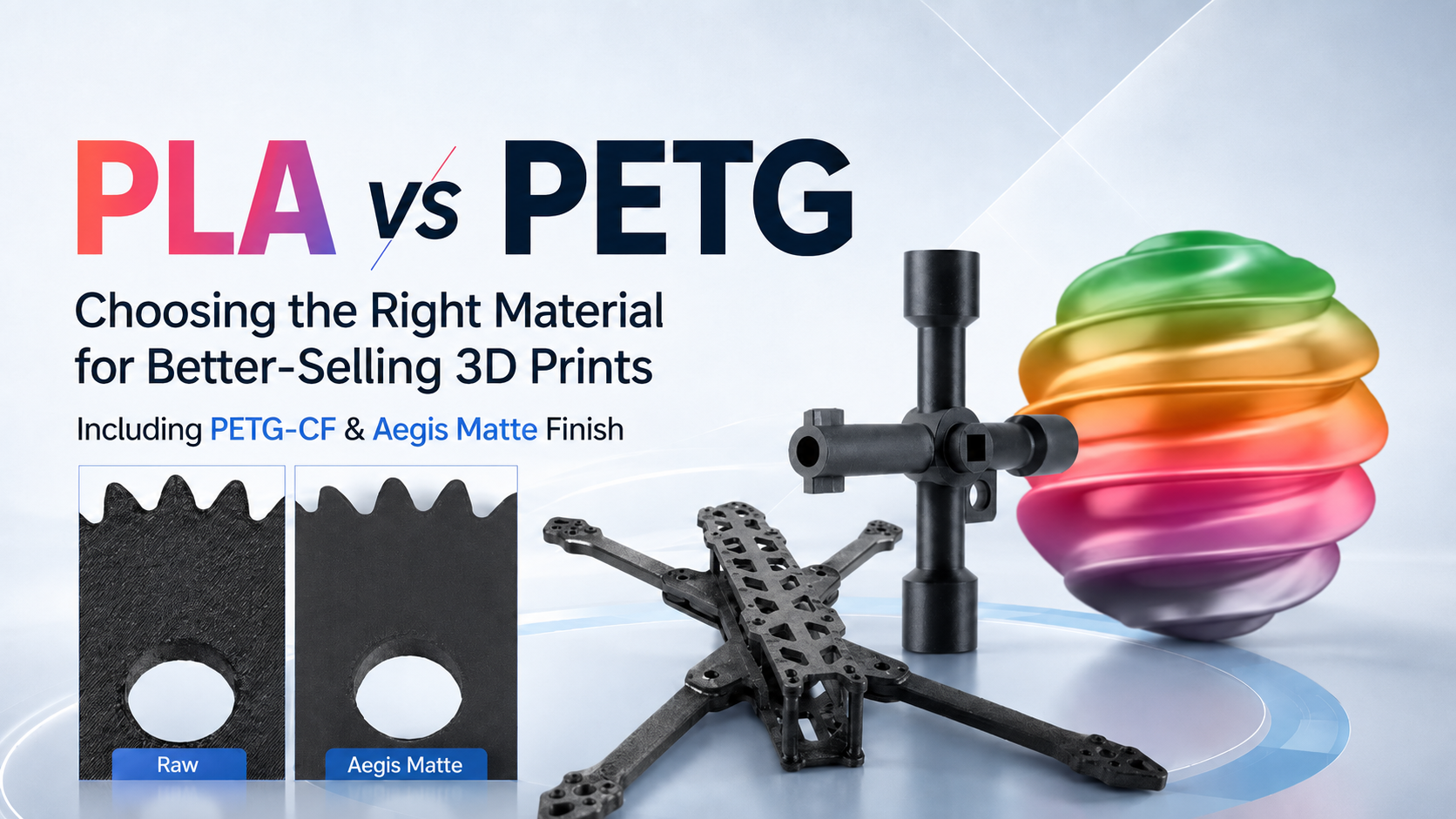
A modern desktop 3D printer can turn a digital idea into a physical product in hours. But once you start selling your creations, the question shifts from "What can I print?" to "What material helps me create products customers will pay for?"
A successful 3D printing business isn't just about low filament costs or fast print times. Customers expect store-bought quality, professional aesthetics, and daily durability. Let’s break down the PLA vs. PETG debate through a commercial lens.
Filament Performance Comparison Matrix
| Category | PLA | PETG |
|---|---|---|
| Ease of Printing | Excellent | Good (Requires Tuning) |
| Surface Detail | Excellent | Good |
| Toughness | Good for decorative use | Better for functional use |
| Heat Resistance | Lower | Higher |
| Best Application | Collectibles, artistic models, prototypes | Organizers, mechanical & outdoor parts |

PLA: The Perfect Starting Point for Beautiful Prints
PLA is famous for its unmatched visual quality and effortless printing setup. If appearance, sharp edges, complex geometries, and a massive color selection are your primary selling points, PLA remains a fantastic baseline for display models and artistic designs.
PETG: When Your Prints Need to Work in the Real World
When you transition from hobby pieces to products meant for daily handling, PETG is the preferred choice. It injects environmental resistance, functional durability, and structural confidence into every part—ensuring your customers' items won’t fail after purchase.
PETG-CF Pro: Taking Functional Products to the Next Level
Visible layer lines and plastic textures can sometimes lower a product’s perceived store value. To bypass this, Siraya Tech PETG-CF Pro fuses premium carbon-fiber reinforcement directly into PETG.
- Stunning Matte Aesthetics: Chopped carbon fiber scatters light, effortlessly hiding FDM layer lines.
- Industrial Stiffness: Exceptional dimensional stability for engineering-style components and premium accessories.
- First Impressions: Delivers a distinctly premium, store-ready feeling before a customer even touches the product.
Aegis: Turning 3D Prints Into Finished Consumer Goods
Material choice solves only part of the puzzle. To truly disguise the fact that an item was 3D printed, the Siraya Tech Aegis finishing system offers an advanced coating solution. Specifically, Aegis Matte diffuses light across surfaces to smooth out visual textures, making it an invaluable tool for professional product photography and customer-facing items.
The Ultimate Business Selection Matrix
- Making purely decorative products.
- Intricate detail & vibrant color are priorities.
- You want the easiest plug-and-play setup.
- Products require high physical toughness.
- Parts experience stress or daily handling.
- You need superior real-world durability.
- Stiffness and structural strength are vital.
- You want a premium matte, stealth aesthetic.
- Targeting high-end engineering clients.
- Surface finish directly affects sales.
- You want to systematically mask layer lines.
- Prepping prints for pristine product photos.
The goal is no longer just making objects—the goal is making products. Choose your tool wisely.