
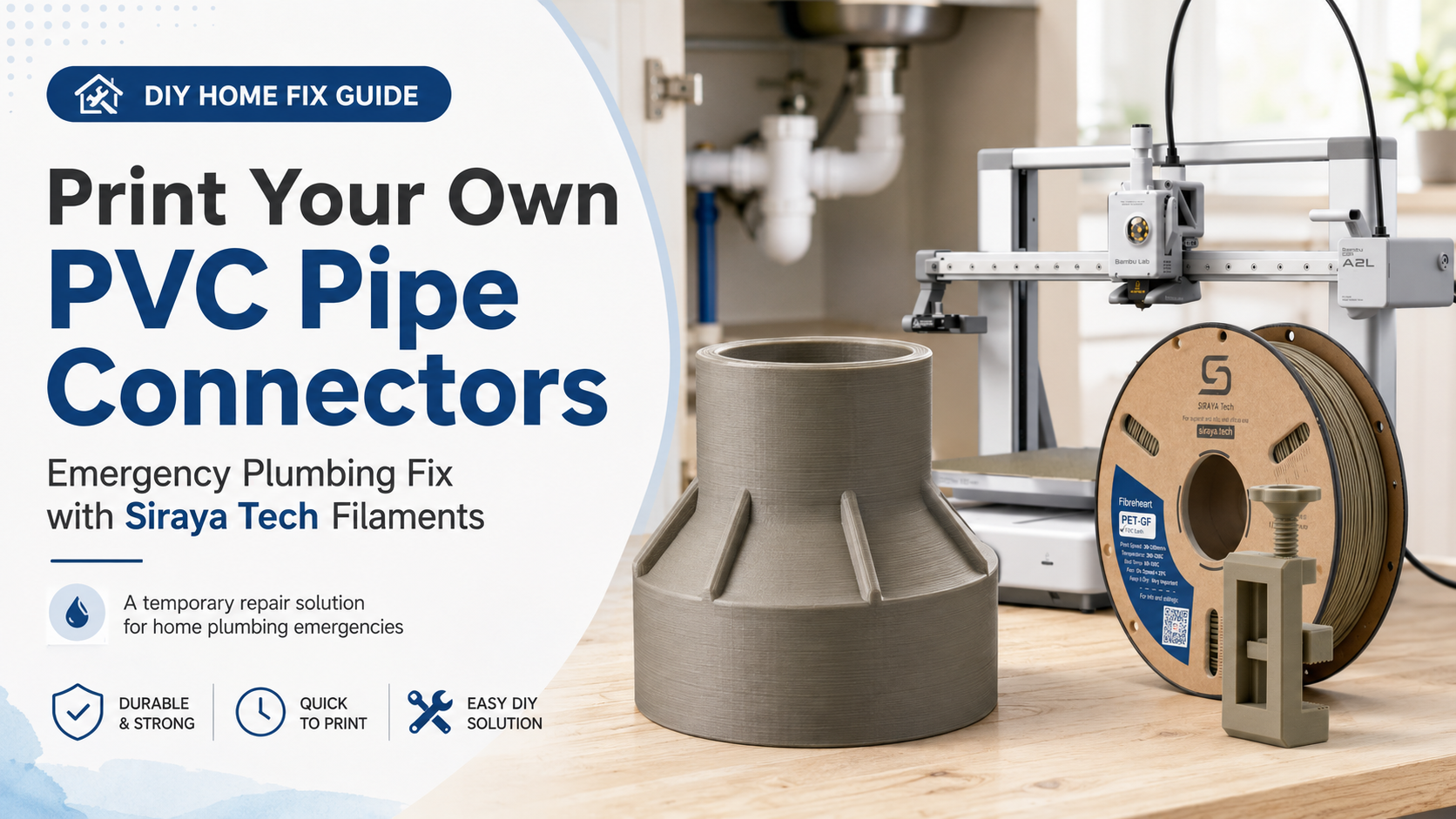
We’ve all been there: it’s late at night, a pipe is leaking, and you’re missing the exact PVC fitting you need to stop the drip. Driving to the store isn't an option because everything is closed, and you can't afford to wait for tomorrow's delivery.
Thankfully, with modern FDM printing and high-performance filaments, your 3D printer can serve as the ultimate emergency backup. It might take a couple of hours to print, but when you are stuck in a pinch with zero alternatives, it’s the perfect makeshift solution to hold things together until morning.
Today, we are looking at how you can use 3D printing to bridge the gap during a plumbing pinch. Using an excellent, versatile model collection from MakerWorld and Siraya Tech's industrial-grade filaments, you can print a functional, short-term fix for under-sink wastewater systems.
The Model: MakerWorld's PVC Pipe Fitting Collection
When you need an exact fit, you don't want to spend hours in CAD designing a plumbing adapter from scratch. The creator on MakerWorld has put together an incredibly useful PVC Pipe Fitting Collection & Reducing Connector 45°. This model profile provides an excellent geometric starting point for recreating standard 45-degree reducing connectors. It is perfectly optimized for 3D printing slicing software, making it a reliable file to slice and print in an emergency.
FDM Printing Tips for Watertight, Strong Connectors
When 3D printing for home improvement applications that handle fluids, standard slicing profiles won't cut it. FDM prints are naturally porous because of the tiny gaps between layer lines. To block leaking and ensure structural integrity under the sink, follow these rules:
1. Thicken the Walls (Crucial)
Do not rely on infill. Increase your wall loops/perimeters (aim for at least 6 to 8 walls) or set it to 100% infill. This makes the shell of the pipe connector completely solid, blocking water from weeping through internal voids.
2. Print Hotter for Better Layer Adhesion
Run your Siraya Tech filaments at the higher end of their recommended temperature spectrum. This ensures maximum polymer cross-linking between layers, reducing the chances of structural failure along the Z-axis.
3. Slightly Over-Extrude
Bumping your extrusion multiplier (flow rate) up by 1-2% can force the lines of filament closer together, sealing up potential micro-gaps.
Choosing the Right Siraya Tech Filament: ABS vs. Alternative Materials
Under-sink environments present unique challenges, particularly thermal stress from hot water (such as draining boiling water from pasta or a dishwasher cycle) and chemical exposure from household soaps. Choosing the correct material is vital to prevent immediate failure.
🏆 The Most Preferred Choice: Siraya Tech ABS & ABS-GF
For temporary plumbing connectors, Siraya Tech ABS or ABS-GF is the ultimate and most preferred choice.
- High Heat Deflection Temperature (HDT): Standard materials begin to soften and lose their structural integrity at around 70°C to 75°C. ABS boasts a much higher HDT (around 95°C to 100°C), meaning it will easily withstand temporary spikes of boiling water without sagging, deforming, or loosening at the slip joints.
- Cost-Effective Strength: They provide the ideal balance of extreme impact resistance, rigidity, and easy printability, keeping your temporary pipe safely intact.
- Siraya Tech ABS: High-impact resistance and high thermal limits mean this material won't warp when hot pots of water are drained. It offers the rigid durability needed to clamp down onto existing infrastructure without cracking.
- Siraya Tech ABS-GF (Glass Fiber Reinforced): The ultimate upgrade. The addition of glass fibers dramatically reduces the shrinkage and warping common in standard ABS, ensuring your printed slip-fit connector holds its precise dimensions. Glass fiber reinforcement pushes the thermal resistance and rigidity even higher, holding tight under structural clamp loads.
What About PET-CF / PET-GF?
You might be tempted to reach for high-end composite filaments like Siraya Tech Fibreheart PET-CF or PET-GF. While these carbon fiber and glass fiber-reinforced PET filaments are incredibly strong and will certainly get the job done, they offer no practical advantage over ABS/ABS-GF for this specific wastewater application, and they cost significantly more. Save your premium PET composites for heavy-duty structural parts and stick to cost-effective ABS for this emergency plumbing fix.
❌ Critical Warnings: Materials You Must NEVER Use
While your filament drawer might be full of options, there are two common engineering materials you must completely avoid for this application:
⚠️ CRITICAL SAFETY NOTICE: The 3-Day Rule ⚠️
While functional 3D printing is incredibly powerful, it is vital to understand the limitations of FDM-printed parts in home infrastructure: This 3D-printed drain connector is strictly a TEMPORARY, emergency solution. Do not leave this fitting in service for more than 3 days (72 hours).
Wastewater carries organic matter, bacteria, and food waste. Because FDM prints have microscopic layer ridges and internal porosity, bacteria will quickly colonize these tiny crevices, creating an unsanitary biofilm that cannot be easily cleaned or sanitized.
Additionally, constant exposure to moisture and shifting temperatures can eventually degrade the temporary joint. Use this MakerWorld model and Siraya Tech filament to keep your sink functional over the weekend. You must buy and install a permanent, code-compliant, injection-molded PVC replacement from your local hardware store within 72 hours.
Be Prepared for Your Next DIY Emergency
3D printing isn't just for hobbies—it's a powerful tool for practical problem-solving. By stocking your workshop with high-strength materials like Siraya Tech ABS-GF and PETG-CF Pro, you'll always be ready to print a quick, rugged, temporary fix when your home infrastructure demands it.
Head over to MakerWorld to bookmark the PVC Pipe Fitting Collection, and visit the Siraya Tech Shop today to equip your 3D printing setup with true engineering-grade filaments!