
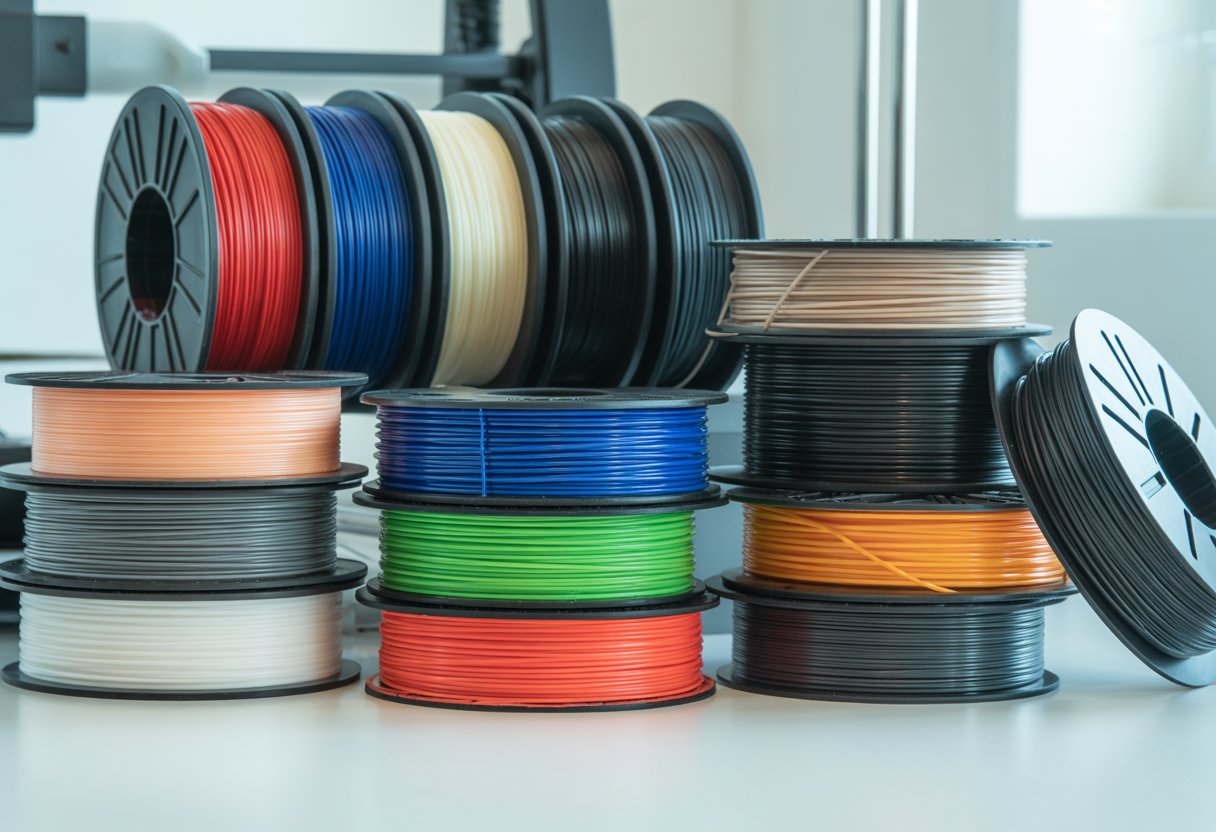
FDM filament types are the different plastic materials you can use to make objects with your 3D printer. The most common types include PLA for beginners, ABS for strong parts, PETG for flexible strength, and specialty options like TPU for bendy prints. Each filament has features that make it better for certain projects.
Picking the right filament can be confusing when you first start 3D printing. Some plastics are easy to use and cheap. Others need more skill but give you stronger or more flexible results.
This guide will help you understand what each filament type does and when to use it. You'll learn about the main types, special materials, and what makes each one different.
Key Takeaways
- Different FDM filaments have unique properties that work best for specific types of prints
- Common filaments like PLA are beginner-friendly while others like ABS need higher temperatures and more skill
- Choosing the right filament depends on strength, flexibility, printing difficulty, and moisture resistance
What Is FDM Filament?

FDM filament is a thin plastic thread that feeds into your 3D printer to create solid objects layer by layer. The printer heats this material until it melts, then pushes it out through a tiny nozzle to build your design from the ground up.
How FDM Printing Works
Your FDM printer takes the filament from a spool and pulls it into a hot end where temperatures reach between 180°C and 300°C depending on the material. The melted plastic comes out of the nozzle like toothpaste from a tube.
The printer moves the nozzle around in specific patterns while squeezing out the melted filament. Each line of plastic sticks to the layer below it as it cools and hardens. The printer builds the object one thin layer at a time, stacking them up until your design is complete.
The print bed stays warm to help the first layer stick properly. Some 3D printer filament types need hotter temperatures than others to melt correctly.
FDM Filament Materials Overview
PLA is the most popular choice for beginners because it prints easily at lower temperatures and doesn't smell bad. You can use it for toys, decorations, and basic projects.
ABS is stronger and can handle more heat than PLA. You'll find it in car parts and tools, but it releases fumes when printing so you need good air flow.
PETG gives you a good mix of strength and ease of use. It's more flexible than ABS but tougher than PLA, making it great for things that need to bend without breaking.
TPU is a rubber-like material that bends and stretches. You can make phone cases, shoe insoles, and anything that needs to be flexible.
Comparing FDM vs Other Filament Types
FDM filaments are different from the materials used in resin printers, which use liquid plastic that hardens under UV light. Your 3D printer filament comes on spools as solid plastic threads instead of bottles of liquid.
SLA and resin printers can make smoother surfaces with finer details. But FDM filaments are cheaper, safer to handle, and come in more material types. You don't need to wash your prints in alcohol or deal with toxic liquids.
FDM filament materials also let you print bigger objects since you're only limited by your printer's size. Resin printers have small build areas and the liquid resin costs more per print.
Essential FDM Filament Types

FDM printing relies on four main filament types that work for most projects. PLA works great for beginners, ABS handles heat well, PETG offers strength and flexibility, and ASA resists weather damage.
PLA (Polylactic Acid)
PLA filament is the easiest material to print with if you're just starting out. It prints at low temperatures between 180-220°C and doesn't need a heated bed.
This material comes from plant-based sources like corn starch. It prints smoothly and sticks well to your print bed without warping. You'll get nice surface quality with minimal effort.
PLA works best for decorative items, prototypes, and indoor models. It's not good for things that get hot or stay outside. The material becomes soft around 60°C, so don't use it for cups that hold hot drinks or car parts.
Key benefits:
- Easy to use for beginners
- Low printing temperature
- Little to no warping
- Smooth finish
- Available in many colors
Drawbacks:
- Not heat resistant
- Breaks easily under stress
- Poor outdoor durability
ABS (Acrylonitrile Butadiene Styrene)
ABS is a tough plastic that handles heat and impact much better than PLA. You'll need to print it at 220-250°C with a heated bed around 80-110°C.
This material produces fumes while printing, so you need good ventilation. ABS tends to warp as it cools, which means you'll need an enclosed printer or at least a heated chamber for best results.
The main advantage of ABS is its strength and heat resistance. You can use it for functional parts like tool handles, automotive components, and things that need to withstand higher temperatures. It's the same plastic used to make LEGO bricks.
Best uses:
- Functional mechanical parts
- Items exposed to heat
- Durable tools and fixtures
You can smooth ABS prints using acetone vapor, which gives them a glossy, professional finish.
PETG (Polyethylene Terephthalate Glycol)
PETG filament combines the ease of PLA with the strength of ABS. It prints at 220-250°C and needs a heated bed at 70-90°C.
This material is stronger and more flexible than PLA. It resists impact well and won't break as easily when you bend it. PETG also handles moisture better than most filaments, though it does absorb water from the air over time.
You can use PETG for both indoor and outdoor projects. It's food-safe when printed correctly, making it good for containers and kitchen tools. The material also resists chemicals and oils well.
Key features:
- Strong and flexible
- Good layer adhesion
- Chemical resistant
- Moderate heat resistance (up to 80°C)
- Some UV resistance
One downside is that PETG can be stringy during printing. You might need to adjust your settings to get clean results.
ASA (Acrylonitrile Styrene Acrylate)
ASA filament is like ABS but works better outdoors. It prints at similar temperatures to ABS (240-260°C) and needs a heated bed around 90-110°C.
The big advantage of ASA is its UV resistance. Unlike ABS, ASA won't fade or become brittle when left in sunlight. It handles rain, snow, and temperature changes without problems.
You'll need the same setup as ABS - good ventilation and preferably an enclosed printer. The material is just as strong as ABS but keeps its properties when exposed to weather.
Use ASA filament for outdoor signs, garden fixtures, automotive parts, or anything that sits in the sun. It maintains its color and strength for years outside. The material costs more than ABS, but it's worth it for outdoor applications.
Still deciding between two of the most popular materials? Get expert insights by checking out our detailed comparison, PETG vs PLA: Which Filament Is Best for 3D Printing?
Flexible and Specialty FDM Filaments

Beyond standard plastics like PLA and ABS, you can find flexible materials that bend and stretch, plus specialized filaments built for strength and special jobs. These materials give you more options when your project needs parts that move, flex, or handle tough conditions.
TPU and TPE (Flexible Filaments)
TPU (thermoplastic polyurethane) and TPE are rubber-like materials that let you print bendy, stretchy parts. These flexible filaments mix plastic with rubber-like materials to create something elastic and durable.
TPU is the most common flexible filament you'll find. It can bend and twist without breaking, making it perfect for phone cases, shoe insoles, and belts. You can also use it for tires, grips, and seals.
TPE is similar to TPU but usually softer and stretchier. Both materials bounce back to their original shape after you bend them.
Printing with flexible filaments takes patience. They're harder to work with than rigid plastics because the soft material can jam in your printer. You'll need to print slower and make sure your filament path is straight and smooth.
Nylon Filament
Nylon is a tough, strong material that can handle wear and friction better than most other filaments. It's great for gears, hinges, and parts that move or rub against each other.
This filament is durable and slightly flexible, which means parts won't crack as easily as PLA. You can use nylon for tools, clips, and mechanical parts that need to last.
The main challenge with nylon is that it soaks up moisture from the air. When wet nylon prints, the water turns to steam and creates bubbles, weak layers, and a rough surface. You need to keep your nylon filament dry in a sealed container or storage box.
Nylon also needs a hot nozzle and heated bed to print well. The material can warp if it cools too fast.
Composite Filaments
Composite filaments mix standard plastic with other materials like carbon fiber, wood, or metal particles. These blends give your prints special looks or added strength.
Carbon fiber filament adds real carbon fiber strands to nylon or other base plastics. This makes parts stiffer and stronger while keeping them light. You'll find carbon fiber composites used in drones, frames, and tools.
Wood-filled filaments create prints that look and feel like real wood. Metal composites give a metallic appearance and weight. Glow-in-the-dark materials add particles that light up after exposure to light.
Keep in mind that carbon fiber and other hard particles wear down your nozzle fast. You'll need a hardened steel nozzle instead of a standard brass one.
Engineering-Grade Materials
Some filaments are built for serious strength and heat. These engineering-grade materials cost more but handle extreme conditions that regular plastics can't.
Polycarbonate is tough and can take impacts without cracking. It also handles heat up to 110°C, making it useful for parts near hot components. You'll see it used for safety equipment, light covers, and machine parts.
PEEK (polyether ether ketone) is one of the strongest filaments available. It resists heat up to 260°C and stands up to chemicals that would melt other plastics. Hospitals and aerospace companies use PEEK for critical parts.
These materials need high-end printers with hot nozzles (often 300°C or higher) and enclosed heated chambers. They're not beginner-friendly, but they deliver performance that matches or beats traditional manufacturing materials.
Want a deeper understanding of material options beyond the basics? Read, 3D Filament Types: Complete Guide for Every 3D Project.
Support and Dissolvable Filaments
Support filaments help you print complex models with overhangs and tricky shapes. These special materials either dissolve in water or specific liquids, or they snap away easily when your print finishes.
PVA (Polyvinyl Alcohol)
PVA is a water-soluble support material that works well with PLA filament. You place your finished print in warm water and the supports dissolve away. This is useful for printing designs with internal channels or delicate features.
Your printer needs dual extrusion to use PVA. One nozzle prints your main model, while the other prints the PVA supports. The filament can be tricky to store because it absorbs moisture from the air. Keep it in a sealed bag with desiccant packs when not in use.
PVA dissolves faster in warm water than in cold. Depending on the amount of support material, it might take a few hours to overnight to fully dissolve. Stirring the water or changing it for fresh warm water can speed up the process.
HIPS (High Impact Polystyrene)
HIPS is a support material for ABS prints. You dissolve HIPS in a liquid called limonene, which smells like oranges. This works well because ABS and HIPS print at similar temperatures.
You need good ventilation when working with limonene. The chemical breaks down HIPS supports but doesn't harm your ABS model. The process can take up to 24 hours depending on how much support material you used.
HIPS is stronger than PVA and doesn't absorb moisture from the air, making it easier to store. Your dual-extrusion printer must handle high temperatures since both materials need a heated print bed and hot nozzles.
Breakaway Supports
Breakaway supports don't dissolve. You remove them by hand when your print finishes. These supports connect to your model at break points that make them easy to remove.
They work with single-nozzle printers, so you don't need dual extrusion. The same material prints both your model and supports, but slicer software creates weak connection points. You bend or twist the supports and they pop off.
Breakaway supports can leave small marks where they connected to your model. You might need to sand these spots smooth. They work best for prints with simple overhangs.
Water-Soluble and Dual-Extrusion Options
Dual-extrusion printing lets you use two different filaments at once. One extruder handles your main model material, while the other prints support filaments. This allows for more complex designs.
Water-soluble support materials like PVA and BVOH give you the cleanest results. BVOH dissolves faster than PVA and works with more types of filament. It costs more but handles higher temperatures, so you can pair it with PETG and nylon.
Your printer needs features like automated bed leveling and filament sensors to handle dual-extrusion reliably. The two nozzles must stay properly aligned or your print quality will suffer. Some printers let you adjust the nozzle offset in software to fix alignment problems.
Building parts that need to handle high temperatures? Discover our heat resistant filament collection for prints that maintain strength under thermal stress.
Key Properties And Printability Factors
Different filaments work best at specific temperatures and have unique traits that affect how well they print and perform. Knowing these factors helps you pick the right material and avoid printing problems.
Print Temperature and Bed Temperature
Each filament needs the right printing temperature to melt and flow through your 3D printer's nozzle. If the temperature is too low, the filament won't melt enough and can clog your printer. If it's too hot, you might see problems like stringing, where thin plastic threads connect your printed parts.
PLA prints at lower temperatures, usually between 190-220°C. ABS needs hotter temps around 220-250°C. PETG falls in the middle at 220-250°C, while specialty materials like nylon can need 250°C or higher.
Bed temperature is important too. A heated bed keeps the first layer of your print stuck down and prevents warping. PLA works fine with bed temps of 50-60°C or even no heat on some printers. ABS needs a hotter bed at 90-110°C to prevent the corners from lifting. Getting both temperatures right improves your printing speed and reduces failed prints.
Layer Adhesion and Warping
Layer adhesion describes how well each new layer of plastic sticks to the one below it. Strong layer adhesion makes your finished part tougher and less likely to split apart. Weak adhesion happens when temperatures are wrong or when you print too fast.
Warping occurs when plastic cools down and shrinks unevenly. The edges of your print lift off the bed, ruining the shape. Materials like ABS warp easily because they shrink a lot as they cool. PLA rarely warps since it doesn't shrink as much.
You can reduce warping by using the right bed temperature and making sure your first layer has good bed adhesion. Some people use glue sticks, tape, or special bed surfaces to help parts stick better. Enclosures around your printer help by keeping the temperature steady.
Durability, Strength, and Flexibility
Tensile strength measures how much pulling force a material can handle before breaking. ABS and PETG have higher tensile strength than PLA, making them better for parts that need to hold weight or handle stress.
Impact resistance tells you how well a material handles sudden hits or drops. ABS is good for this, which is why it's used in helmets and car parts. PLA breaks more easily when hit hard, so it's not ideal for rough use.
Some filaments bend instead of breaking. TPU and other flexible materials stretch and bounce back to their original shape. Standard materials like PLA and ABS are rigid and don't flex much. Use flexible filaments when you need parts like phone cases or hinges.
UV, Abrasion, and Chemical Resistance
UV resistance shows how well a material handles sunlight without breaking down. Regular PLA turns brittle and fades in direct sun after a few months. ASA and PETG resist UV damage much better, making them good choices for outdoor parts.
Abrasion resistance shows how well a surface holds up against rubbing and scratching. Nylon has excellent abrasion resistance, which is why it works well for gears and mechanical parts. PLA scratches more easily and wears down faster with repeated friction.
Chemical resistance protects your prints from damage by cleaners, oils, and other substances. PETG resists many chemicals and works well for containers or parts exposed to liquids. PLA dissolves in some solvents and isn't great for chemical exposure. ABS handles oils and some chemicals but can be damaged by others.
Planning to print bendy parts like phone cases or grips? Browse our flexible filaments for rubber-like prints that stretch and bounce back.
Choosing And Using FDM Filament Types
Picking the right filament means matching materials to your printer's capabilities and knowing what prep work your prints might need afterward. You may also want to consider eco-friendly choices and follow some basic tips if you're just starting out.
Printer Compatibility and Hardware Needs
Not all filaments work with every 3D printer. Your printer needs the right parts to handle different materials.
PLA works with almost any FDM printer. You don't need a heated bed, though one set to 40-60°C helps prints stick better. The nozzle can be basic brass at 190-220°C.
ABS and PETG need more. You must have a heated bed at 80-110°C. Without it, your prints will warp and fail. A regular nozzle works fine for these.
Also read:
- What is ABS Filament? Uses, Pros, and Cons for 3D Printing
- What Is PETG Filament: A Guide in 3D Printing Applications
Flexible filaments like TPU print best with a direct drive extruder. This setup pushes filament straight into the nozzle instead of from far away. Bowden-style extruders struggle because the flexible material bends and jams.
Carbon fiber, metal-filled, and glow-in-the-dark filaments contain rough particles. These wear down brass nozzles fast. You need a hardened nozzle made from steel or ruby to print these materials without replacing your nozzle every few spools.
Check your printer's max temperature. High-performance materials need hotter nozzles than basic printers can reach.
Post-Processing and Finishing
Different filaments need different finishing work after printing.
PLA sands easily and takes paint well. You can smooth it with sandpaper or use filler primer for a perfect surface. It doesn't need much work to look good.
ABS responds to acetone vapor smoothing. Put your print in a container with a small amount of acetone. The vapor melts the surface slightly and creates a glossy, smooth finish. Be careful since acetone fumes are strong.
PETG is harder to sand because it's tough and slightly flexible. It prints with a shiny surface, so you might not need much post-processing. If you do sand it, use wet sanding with fine grit paper.
Nylon absorbs moisture from the air, which affects its strength. You can dye nylon prints by boiling them in fabric dye for bright colors.
Support removal varies. PLA supports snap off cleanly. PETG supports stick harder and take more effort. TPU supports can be very difficult to remove without damaging your print.
Sustainable and Specialty Options
Some filament choices are better for the environment than others.
PLA comes from corn starch or sugarcane, making it the most eco-friendly common filament. It's biodegradable under industrial composting conditions, though it won't break down in your backyard.
Recycled PETG uses plastic from old bottles and containers. Several companies now offer quality recycled filament that prints like new material. This keeps plastic waste out of landfills.
Wood-filled filaments blend PLA with real sawdust or wood fibers. Your prints look and smell like wood. These use wood waste from lumber production.
Algae-based filaments are newer options made from algae instead of petroleum. They print like PLA but come from a renewable resource that grows quickly.
Buy from companies that use cardboard spools instead of plastic ones. Some brands offer spool recycling programs where you ship empty spools back.
Store filament properly to avoid waste. Keep it dry in sealed bags with desiccant packets. Wet filament prints poorly and you'll throw away failed prints.
Filament Selection Tips for Beginners
Start with PLA for your first prints. It's the most forgiving and works at lower temperatures. You'll get good results while learning the basics.
Buy a small spool first, not a big one. A 500g or 1kg spool lets you test the material and brand without spending too much money. Different brands of the same filament type can print differently.
Match your filament to your project needs. Making toys or decorations? Use PLA. Need something for outdoor use? Pick PETG or ABS. Making flexible parts? Get TPU.
Read the filament guide that comes with your spool. It lists the best nozzle and heated bed temperatures for that specific brand. Start with those settings.
Keep a notebook of what works. Write down which temperature and speed settings gave you the best prints for each filament type. This saves time on future projects.
Don't mix filaments in one print unless you have a multi-material printer. Switching filament types mid-print causes problems for beginners.
Store your filament in a dry place right away. Moisture ruins filament quality and causes bad prints with blobs and stringing.
Need precise diameter control for jam-free printing? Check out our 1.75mm filament with ±0.02mm tolerance for smooth extrusion and excellent layer bonding.
Wrap Up
Choosing the right FDM filament types makes the difference between failed prints and successful projects. Start with PLA to learn the basics, then move to PETG or ABS when you need stronger parts. TPU gives you flexibility, while specialty filaments open up creative possibilities.
Match your material to your project needs, printer capabilities, and skill level. Store filaments properly to avoid moisture problems. With practice, you'll know exactly which filament works best for each design. Ready to upgrade your printing? Siraya offers premium filaments engineered for consistent flow, strong layer adhesion, and reliable results—so you can print with confidence every time.
Curious about flexible printing and how to get the best results? Expand your knowledge by exploring our article, What Is TPU Filament: An Easy Guide For Smart 3D Printing
Frequently Asked Questions
What's the difference between PLA and ABS filaments?
PLA is easier to use and works well for beginners. It prints at lower temps and doesn't smell much. It's made from plants and breaks down over time.
ABS is stronger and can handle heat better than PLA. It needs higher printing temps and can smell bad when it melts. Your prints might warp or pull away from the bed if you don't keep the printer warm enough.
PLA is great for models and decorations. ABS works better for parts that need to be tough or sit in hot places.
Can you clue me in on what PETG filament is good for?
PETG gives you the best of both worlds. It's almost as easy to print as PLA but tougher like ABS.
This filament doesn't break easily and can bend a little without snapping. It handles moisture better than other common filaments. You can use it for things like phone cases, tools, and parts that people will handle a lot.
PETG sticks really well to the print bed, which is good and bad. You might need to use a release agent so your prints don't stick too hard.
I've heard about TPU – what does it bring to the table for 3D printing?
TPU is a flexible filament that bends and squishes like rubber. You can squeeze it and it bounces back to its original shape.
This makes TPU perfect for phone cases, shoe insoles, and anything that needs to be soft or bendy. It's harder to print than stiff filaments because it can get tangled in your printer.
You need to print TPU slowly and make sure your printer can handle flexible materials.
How do I choose the right type of filament for my 3D project?
Think about what your printed part needs to do. Will it sit in a hot car? Does it need to bend? Will people touch it a lot?
Pick PLA for simple projects, decorations, and practice prints. Choose ABS or PETG for parts that need strength or heat resistance. Use TPU when you need something flexible.
If you're new to 3D printing, stick with PLA or PETG first.
Got any tips for printing with exotic filaments like wood or metal composites?
Wood and metal composite filaments have tiny bits of real wood or metal mixed into plastic. They make your prints look and feel different.
Use a bigger nozzle size, like 0.5mm or 0.6mm. The particles in these filaments can clog smaller nozzles. Print slowly to avoid jamming.
These filaments can wear down your nozzle faster. Consider getting a hardened steel nozzle if you print with them often. You can sand wood filaments after printing to make them look more real.
What should I look out for when storing various 3D printer filaments?
Most filaments absorb water from the air, which can cause printing problems like pops, bubbles, and weak layers.
Store your filament in sealed bags or boxes with moisture-absorbing packets. Some people use dry boxes to keep the air inside dry.
PLA and ABS can handle some moisture for a short time, but PETG, Nylon, and TPU absorb water quickly and need better storage. If your filament gets wet, you can dry it in a food dehydrator or filament dryer before printing.