
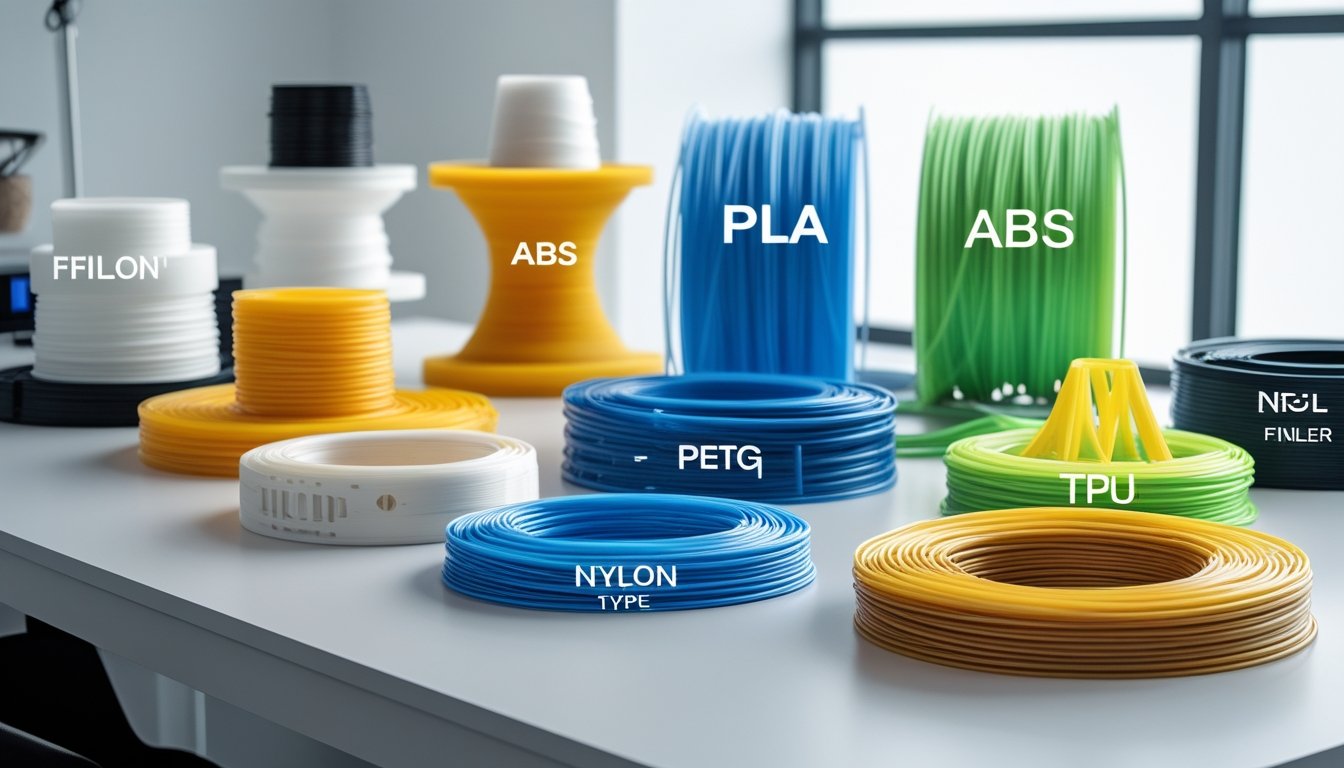
Choosing the best filament for functional parts determines whether your 3D printed components will hold up under real-world stress or fail when you need them most. Unlike decorative prints, functional parts must withstand mechanical loads, temperature extremes, and repeated use.
The right material makes all the difference between a prototype that works and one that breaks. Each 3D printer filament type offers unique properties—from impact resistance to flexibility to heat tolerance.
This guide compares the top 3D printer filament options for functional applications, helping you match material properties to your specific project requirements. Whether you're building mechanical parts, jigs, or end-use products, you'll find the perfect filament for the job.
Key Takeaways
- Each filament type shines in different ways—impact resistance, heat tolerance, rigidity, you name it.
- PETG and ABS handle most functional needs, but heat-resistant filaments are your go-tos for extreme demands.
- Matching filament to your project avoids both failures and unnecessary expenses.
Ready to tackle your next functional project? Browse our premium 3D printer filament collection for high-performance materials built to last.
What Makes a Filament Suitable for Functional Parts

Functional parts have to deal with real-world stress, temperature swings, and the odd environmental challenge. The right 3D printer filament depends on your part’s mechanical needs, operating temps, and how precisely it needs to hold its shape under load.
Strength and Durability Requirements
Your parts need to handle mechanical stress without breaking or deforming. Tensile strength tells you how much pulling force a material can take before it snaps. Polycarbonate (PC) packs a punch here, clocking in at around 60-70 MPa—great for parts that need to bear heavy loads.
Impact resistance is just as important. ABS stands out for absorbing shocks, which is why you’ll see it in automotive bits and tool housings. If you need both strength and a bit of give, look for materials that can handle a hit without cracking.
Strength-to-weight ratio comes into play for parts that need to be strong but not bulky. Nylon (PA6/66) offers high strength without unnecessary heft. Durability also means resisting wear—important for gears, bushings, and anything that moves.
Temperature and Chemical Resistance
Heat resistance decides if your part will hold up in warm spots. PLA softens around 60°C, so it’s out for anything hotter. ABS can take up to 90°C, making it a better pick for prototypes that see some heat.
Chemical resistance keeps your parts safe from oils, fuels, solvents, and cleaning agents. PETG shrugs off most household chemicals and weak acids. If your project lives outdoors, you’ll want UV resistance—ASA beats standard ABS here, keeping its looks and strength longer.
Watch out for moisture absorption. Nylon soaks up water fast, which can mess with print quality and part strength. Store it dry or risk headaches.
Dimensional Stability and Precision
Parts need to stay true to size during and after printing. Some materials like to warp, pulling away from the build plate and leaving gaps or inaccuracies.
Engineering-grade filaments usually need enclosed print chambers to keep cooling rates steady and minimize warping. Polycarbonate, in particular, needs strict temperature control. Materials with low thermal expansion hold tighter tolerances—crucial for precision fits.
Good layer adhesion means your part won’t split along layer lines when stressed. Weak bonding spells trouble under load.
Top Filament Types for Functional Applications

Different filaments excel at different jobs thanks to their unique properties. PETG strikes a nice balance between strength and printability, nylon is a workhorse for tough mechanical parts, and materials like ABS, heat-resistant polymers, and TPU solve specific problems.
|
Filament |
Tensile Strength (MPa) |
Heat Resistance |
Impact Resistance |
Flexibility |
Print Difficulty |
Best For |
|
PETG |
~50 |
~80°C |
Good |
Moderate |
Easy |
Brackets, enclosures, jigs |
|
Nylon |
~75 |
~120°C |
High |
High |
Medium-Hard |
Gears, hinges, wear parts |
|
ABS |
~40 |
~90°C |
Excellent |
Low-Moderate |
Medium |
Impact parts, housings |
|
Polycarbonate |
~65 |
~110°C |
Excellent |
Moderate |
Hard |
High-heat, safety, lighting |
|
TPU |
~30 |
~80°C |
Excellent |
Very High |
Medium |
Flexible, seals, gaskets |
|
ASA |
~45 |
~95°C |
Good |
Low |
Medium |
Outdoor, UV-resistant parts |
PETG for General Purpose Functional Parts
PETG is probably the most versatile pick for durable functional parts. It balances strength and ease of use, so you don’t need fancy equipment to get good prints.
Why pick PETG?
- Tensile strength around 50 MPa
- Handles impacts better than PLA
- Sticks together well—less splitting
- Resists most household chemicals
- Doesn’t warp much
PETG’s perfect for brackets, enclosures, jigs, and fixtures. Print it at 220-250°C, bed at 70-80°C. No enclosure needed. It bends a bit before breaking, so your parts don’t fail suddenly. PETG also shrugs off moisture better than nylon, but yeah, keep it sealed when you can.
Nylon for High-Strength Mechanical Parts
Nylon brings serious strength and durability for parts that live tough lives. It deals with repeated use and resists friction wear like a champ.
Standard nylon offers tensile strength around 75 MPa. Carbon fiber nylon goes further, adding stiffness and dimensional stability without much extra weight.
But nylon loves water—dry it before printing and keep it with desiccant. Print at 240-270°C, bed at 70-90°C.
Where nylon shines:
- Gears and bearing housings
- Hinges and living hinges
- Tool handles and fixtures
- Wear-resistant bits
- Automotive stuff
It’s flexible, so parts bend under stress instead of snapping. Carbon fiber nylon is less bendy, but stiffer—great for structural parts.
Heat-Resistant Filament for High-Temperature Applications
Some parts need to stay strong and keep their shape when things get hot. PLA melts at a measly 60°C, so it won’t cut it.
Polycarbonate (PC) holds up to 110°C and takes a beating. You’ll need to print it hot—260-300°C—and an enclosure helps. PC is solid for safety gear, lighting fixtures, and car parts.
For extreme heat, Polyetherimide (PEI/Ultem) can take 170°C or more, but you’ll need a serious printer and some patience.
Quick comparison:
|
Material |
Heat Resistance |
Print Difficulty |
|
PETG |
~80°C |
Easy |
|
Polycarbonate |
~110°C |
Hard |
|
Polyetherimide |
~170°C |
Very Hard |
Match your material’s heat resistance to your real-world needs. No sense in paying for high-temp polymers if you don’t need them.
ABS for Impact Resistance
ABS is tough and shrugs off impacts—no wonder manufacturers use it for everything from car parts to LEGO bricks.
It handles drops without cracking. Tensile strength is about 40 MPa, but its real strength is in toughness, not just numbers.
ABS is fussier than PETG. Use an enclosure to avoid warping and cracking as it cools. Print at 230-250°C, bed at 90-110°C. Ventilation matters—the fumes aren’t fun.
You can smooth ABS with acetone vapor for a slick finish that also seals layer lines. That can boost both looks and strength.
Pick ABS if you need to absorb impacts or are swapping out existing ABS parts. It’s easy to machine and drill after printing.
TPU for Flexible Functional Components
TPU (thermoplastic polyurethane) is your go-to for parts that need to flex where rigid plastics would fail. It’s rubbery but prints on most standard machines.
TPU handles:
- Shocks and vibrations
- Abrasion and tearing
- Flexing in hot or cold
- Seals and gaskets
Shore hardness for TPU usually lands between 85A and 98A. Lower means softer. Use softer TPU for cushioning, harder for flexible but sturdy parts.
Print it slow—20-40 mm/s—to avoid jams. Direct drive extruders make life easier. Go for 210-240°C on the nozzle, barely heat the bed.
TPU doesn’t snap like hard plastics. It’ll spring back after being squished and handles bending over and over. Great for phone cases, belts, bumpers, wheels, and covers. If you need a part to grip or seal, TPU is a solid bet.
Looking for even stronger functional parts with smoother finishes? Explore our 3D printing resins collection for precision applications that demand the best.
Choosing the Right Filament for Your Project

Picking the right filament means thinking about what your part has to do, how tricky it’ll be to print, and if the performance is worth the price.
Matching Material Properties to Application Needs
Start by figuring out what your part will face. Need to stand up to heat? Polycarbonate holds strong up to 110°C, and PEEK keeps going above 250°C. For impact, polycarbonate and TPU both take hits without cracking.
Outdoor parts need UV and weather resistance—ASA is a winner there. For indoor or decorative stuff, PLA is fine. Load-bearing brackets? Reach for carbon fiber blends or nylon. Flexible gaskets or cases? TPU’s elasticity is hard to beat.
Think about the type of strength you actually need. Tensile strength is for pulling, flexural strength for bending, and layer adhesion keeps parts from splitting under stress. If your part gets stressed over and over, pick something with good fatigue resistance.
Print Settings and Post-Processing Considerations
Each material brings its own printing quirks. PLA is a breeze at 190-220°C, no heated bed or enclosure needed. ABS and polycarbonate want an enclosure to avoid warping.
Abrasive carbon fiber filaments will chew up brass nozzles—use hardened ones. Nylon and polycarbonate suck up moisture, so dry them before printing or risk weak, bubbly layers.
Your printer limits your options. Most desktops handle PLA, PETG, ABS, and TPU. For stuff like PEEK, you’ll need a nozzle that hits 360-400°C—way beyond most hobby machines. Some complex shapes need support, and dissolvable supports make cleanup easier for tricky prints.
Cost vs Performance Trade-Offs
Let’s talk budget. PLA costs $15-25/kg—good for most basic jobs. PETG is $20-30/kg and adds strength and chemical resistance. Specialty filaments get pricey: polycarbonate is $40-60/kg, PEEK can be $200+ per kilo.
Don’t forget the extras. Carbon fiber filaments need hardened nozzles ($30-80). High-temp stuff might mean printer upgrades or outsourcing. Tough-to-print materials waste time and filament when prints fail.
Weigh cost against what’s at stake. Cheap filaments work for prototypes and low-stress parts. But for critical components—where failure is expensive or dangerous—spring for the good stuff. Sometimes one successful PEEK part costs less than a pile of failed prints with cheaper filaments that just can’t handle the job.
Conclusion: Best Filament for Functional Parts
Selecting the best filament for functional parts comes down to understanding your specific requirements and working conditions. PETG and nylon cover most applications, while specialized materials like ASA and carbon fiber composites handle extreme demands.
Don't overlook print settings and post-processing—even the toughest filament won't perform if printed incorrectly. Match your material choice to actual stress, temperature, and environmental conditions rather than just picking the strongest option.
Curious about how resin compares to filament for functional parts? Read our in-depth comparison of ABS-like resin vs ABS filament to discover which technology suits your project best.
Frequently Asked Questions: Best Filament for Functional Parts
Picking the right filament for parts that actually need to do some work—handle stress, heat, or just survive real use—can get tricky. Each material has its quirks and strengths, so let’s break it down in plain language.
What filament to use for functional parts?
PLA+ and PETG handle most indoor functional applications, with PLA+ offering 3-4x better impact strength than standard PLA. PETG excels with strong layer adhesion and chemical resistance for mechanical parts and containers. Nylon delivers superior toughness and wear resistance for gears and bushings, while carbon fiber PLA adds rigidity for drones and RC vehicles.
Is PETG good for functional parts?
PETG is a reliable workhorse for functional prints with good impact resistance and strong layer adhesion. Print at 235-245°C with a 70-80°C bed, and it handles moisture and outdoor conditions better than PLA. Watch for stringing and store in a dry box, but it's more affordable than nylon or polycarbonate.
Is ASA or PETG better for car parts?
ASA wins for exterior car parts with excellent UV resistance and weather durability up to 100°C. It requires an enclosure, 240-250°C nozzle temps, and proper ventilation due to fumes. PETG works better for interior parts since it's easier to print and resists common automotive chemicals.
What filament is good for moving parts?
Nylon excels for moving parts with low friction, wear resistance, and flexibility ideal for gears and bushings. It requires careful moisture control and printing at 250-270°C for best results. PETG offers easier printing for lighter-duty applications, while carbon fiber nylon maximizes stiffness for demanding mechanical stress.