
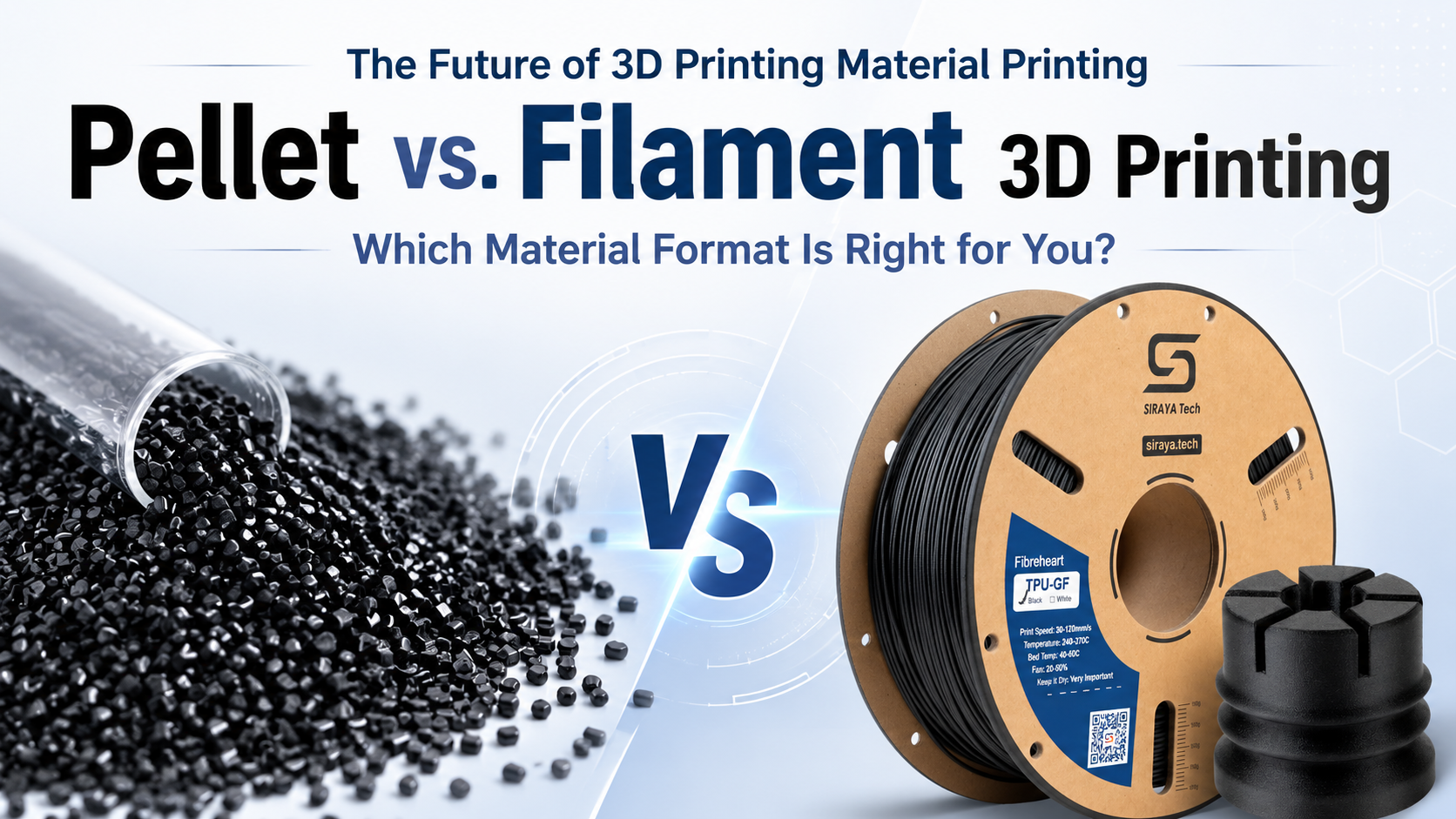
In the rapidly evolving world of 3D printing, choosing the right material format can completely change the scale, cost, and success of your projects. While Fused Filament Fabrication (FFF/FDM) remains the undisputed standard for desktop printing, Fused Granular Fabrication (FGF)—commonly known as pellet 3D printing—is rapidly gaining traction in both industrial and consumer applications.
If you are looking to scale up production, explore advanced engineering materials, or master challenging elastomeric compounds, understanding the key differences between pellet and filament printing is crucial.
Let’s break down the advantages, mechanical differences, and ideal use cases for pellet and filament 3D printing, featuring high-performance options from Siraya Tech and groundbreaking new hardware from Peopoly.
Pellet vs. Filament at a Glance
Filament printing offers accessibility, precision, and lightweight extrusion. Pellet printing delivers significantly higher material throughput, lower bulk material costs, and easier processing of ultra-soft elastomers.
What Is Filament 3D Printing (FDM/FFF)?
Filament 3D printing is the classic approach most users know. A pre-extruded plastic wire—typically 1.75 mm or 2.85 mm in diameter—is pushed by drive gears into a heated hotend and extruded through a fine nozzle.

Popular Filament Brands and the Material Ecosystem
The FDM world is supported by a massive material ecosystem. Mainstream and hobbyist users often rely on standard-grade PLA, PETG, and ABS filaments from brands such as Polymaker, Bambu Lab, eSUN, and Hatchbox.
However, when structural performance, temperature resistance, and extreme durability are required, industrial and professional users turn to specialized engineering formulations. This is where Siraya Tech’s high-performance Fibreheart™ filament lines stand out.
Fibreheart™ ABS-GF and ABS-CF
Glass-fiber- and carbon-fiber-reinforced ABS materials offering excellent rigidity, heat deflection, and reduced warping.
Fibreheart™ PPA and PPA-CF
Ultra-tough, high-temperature polyphthalamide materials designed for demanding mechanical environments and metal-replacement applications.
Fibreheart™ PET-GF and PET-CF
Glass-fiber- and carbon-fiber-filled PET materials providing excellent chemical resistance, structural performance, and dimensional accuracy.
Advantages of Filament Printing
Lightweight and Fast Extruders
Because much of the melting and material-shaping work is completed during filament manufacturing, the printer toolhead can remain lightweight. This supports rapid acceleration, fast directional changes, and high printing speeds without sacrificing motion accuracy.
Precision and Intricate Detail
FDM extruders work exceptionally well with fine nozzles, ranging from common 0.4 mm nozzles down to 0.2 mm. This allows for thin layers, smooth surface finishes, and highly complex geometries.
Accessible Entry Point
The simplicity of filament extrusion makes FDM printers affordable, easy to maintain, and accessible to hobbyists, schools, engineers, laboratories, and production teams.
Trade-Offs of Filament Printing
- Lower flow rates: Filament printing is limited by how quickly a solid plastic wire can be pushed into and melted within a relatively small hotend zone. This results in significantly lower volumetric flow rates than most pellet extrusion systems.
- Material restrictions and markup: Not every polymer can be reliably converted into a flexible, dimensionally consistent filament and wound onto a spool. Extruding, cooling, measuring, and spooling the material also adds manufacturing cost.
What Is Pellet 3D Printing (FGF)?
Pellet 3D printing skips the traditional step of converting raw plastic into spooled filament.
Instead, an FGF printer uses an integrated hopper and screw-driven extruder to melt and deposit industrial plastic pellets directly onto the print bed. These pellets are the same type of raw granules commonly used in injection molding and other industrial manufacturing processes.

Advantages of Pellet Printing
Unmatched Material Economics
Manufacturing filament requires extrusion, cooling, dimensional measurement, quality control, and spooling. Printing directly with raw pellets bypasses much of this processing markup and can reduce bulk material costs by 60% to 90%.
Vast Material Selection
Pellets are the global baseline format for raw plastics. Pellet printing therefore provides access to thousands of industrial, engineering, recycled, reinforced, and specialty material grades that may not be available as filament.
Massive High-Flow Throughput
Pellet extruders are built for heavy-duty output and can melt and deposit large amounts of plastic quickly. Output is often measured in kilograms per hour rather than grams per hour, making FGF ideal for large-scale tooling and structural components.
Trade-Offs of Pellet Printing
- Heavy and complex toolheads: Pellet extruders require internal feed screws, motors, hopper connections, and heavy-duty heating zones. The increased weight requires a robust industrial gantry or robotic arm.
- Coarser detail and thicker layers: Pellet systems commonly use larger nozzle diameters, often between 1.0 mm and 3.0 mm. This supports speed and strength on large parts but is less suitable for intricate, high-resolution models.
The Ultimate Showdown: Printing Soft TPU and Elastic Materials
One of the clearest technical differences between pellet and filament printing appears when working with flexible materials such as soft Thermoplastic Polyurethane (TPU) and Polyether Block Amide (PEBA).
Why Filament Struggles with Ultra-Soft Elastomers Below 80A
Printing very soft filament, particularly materials with a Shore hardness below 80A, is notoriously difficult on standard FDM printers.
The “Pushing a Rope” Problem
FDM extruders rely on the column strength of the filament to push it through the feed path and into the nozzle. When filament is highly flexible, it can bend, buckle, compress, or wrap around the drive gears instead of feeding forward consistently.
Soft elastomers can also stretch as they are pulled from a spool. This affects materials such as Siraya Tech Flex TPU Air, with a Shore hardness range of approximately 65A to 82A, as well as highly elastic materials such as Fibreheart™ Rebound PEBA 85A.
As the stretched material enters the hotend, it may thin out and create an inconsistent feed rate. The result can include under-extrusion, irregular flow, or catastrophic filament jams.
Why Pellets Excel at Flexible Printing
Pellet printing bypasses many of the mechanical constraints associated with feeding a long, flexible filament strand.
- Gravity and screw feeding: Pellets are fed through gravity or vacuum into a hopper instead of being pulled from a spool.
- No structural dependency: The extruder screw mechanically transports, compresses, melts, and extrudes the loose granules. The material does not need to act as a rigid column or resist pulling tension.
Why This Matters
Pellet extrusion can process ultra-soft and highly elastic materials with greater consistency because the material feed does not depend on the stiffness or tensile behavior of a filament strand.
The Cost Barrier: Why Pellet Printing Was Gatekept
Historically, engineering teams and print farms interested in FGF pellet printing faced a major financial barrier.
Traditional large-format pellet printers, including systems in the Stratasys Titan family, often carried six-figure price tags above $100,000. Beyond the machine cost, these systems frequently required bulky pneumatic feeding equipment, specialized industrial infrastructure, proprietary software, and experienced operators.
These requirements made pellet printing largely inaccessible to small and medium-sized companies, independent print farms, and agile research and development teams.
Enter the Peopoly Giga 800: Pellet Printing, Democratized
To break down this barrier, Peopoly—the sister company of Siraya Tech—launched the Giga 800, a large-format FGF printer designed to bridge the gap between industrial pellet capacity and desktop simplicity.
Starting at approximately $15,000 USD, the Giga 800 introduces large-format pellet printing at a substantially lower entry price than many traditional industrial FGF systems.

Key Features of the Giga 800
Massive Build Volume
The Giga 800 offers an 800 × 800 × 800 mm build volume, allowing users to consolidate large multi-part assemblies into fewer components or even a single overnight print.
High-Speed Throughput
A dual-zone heated screw extruder supports temperatures of up to 400°C and a maximum stated material flow rate of up to 3 kg per hour.
Advanced Active Retraction
Active mechanical material retraction works with Klipper Pressure Advance to reduce oozing, improve travel moves, create cleaner corners, and reduce post-processing requirements.
Familiar Open Ecosystem
The Giga 800 runs on open-source Klipper firmware and uses OrcaSlicer, providing a familiar workflow for experienced desktop 3D-printing users.
Air-Gap-Ready Operation
High-security defense, aerospace, and advanced research teams can operate the printer offline without relying on mandatory cloud telemetry.
Siraya Tech Pre-Configured Material Profiles
Peopoly partnered with the Siraya Tech Material Science team to develop rigorously tested material profiles designed to reduce setup time and help users begin printing more quickly.
Quick Comparison: Pellet vs. Filament
| Feature | Pellet Printing (FGF) | Filament Printing (FDM/FFF) |
|---|---|---|
| Material Cost | Extremely Low (Save up to 90%) | Higher (Includes processing and spooling markup) |
| Material Selection | Vast (Raw injection-molding grades) | Limited to extrudable, spoolable formulations |
| Common Brands | Industrial Raw Materials, Peopoly / Siraya Tech Pellet Profiles | Polymaker, Bambu Lab, eSUN, Hatchbox, Siraya Tech Fibreheart™ |
| Hardware Pricing | Historically $100k+ (Stratasys Titan); Now $15,000 with Peopoly Giga 800 | Budget desktop to high-end industrial systems ($200 - $15,000) |
| Extruder Weight | Heavy (Requires heavy-duty gantry or robotic arm) | Lightweight (Allows fast, agile motion) |
| Ideal Part Size | Large-scale structural parts, molds, and jigs | Small to medium high-precision parts |
| Soft Flexibles (<80A) | Excellent (No buckling or stretching issues) | Extremely challenging (Prone to jamming and tension errors) |
| Max Flow Rate | High to Very High (Up to 3kg/hour on Giga 800) | Low to Moderate |
Final Thoughts: Which Method Wins for Your Workflow?
The choice between pellet and filament 3D printing ultimately depends on your production goals, required scale, material needs, and available budget.
Choose Filament Printing When:
- You need precise, detailed, or visually refined parts.
- You primarily produce small or medium-sized components.
- You want accessible hardware and a mature material ecosystem.
- You need engineering-grade composites in a convenient, ready-to-print format.
Choose Pellet Printing When:
- You need to manufacture large structural parts.
- You consume enough material for bulk cost savings to matter.
- You require raw industrial or specialty material grades.
- You need significantly higher material throughput.
- You want to process ultra-soft or highly elastic materials without relying on filament stiffness.
If your focus is on highly intricate prototypes, high-resolution models, or standard parts produced with agile, lightweight toolheads, filament printing with premium composites such as the Siraya Tech Fibreheart™ series remains an excellent option.
However, if you want to scale up to large-format manufacturing, reduce bulk material costs by as much as 90%, or reliably print ultra-soft, highly elastic materials without the physical limitations of filament spooling, pellet printing offers a compelling alternative. With hardware such as the Peopoly Giga 800 making industrial FGF more accessible, there has never been a better time to integrate pellet printing into your workflow.
Need Help Choosing the Right Material?
Contact the Siraya Tech team to discuss engineering materials, flexible compounds, tested printing profiles, or your next high-performance production project.
Contact Siraya Tech