
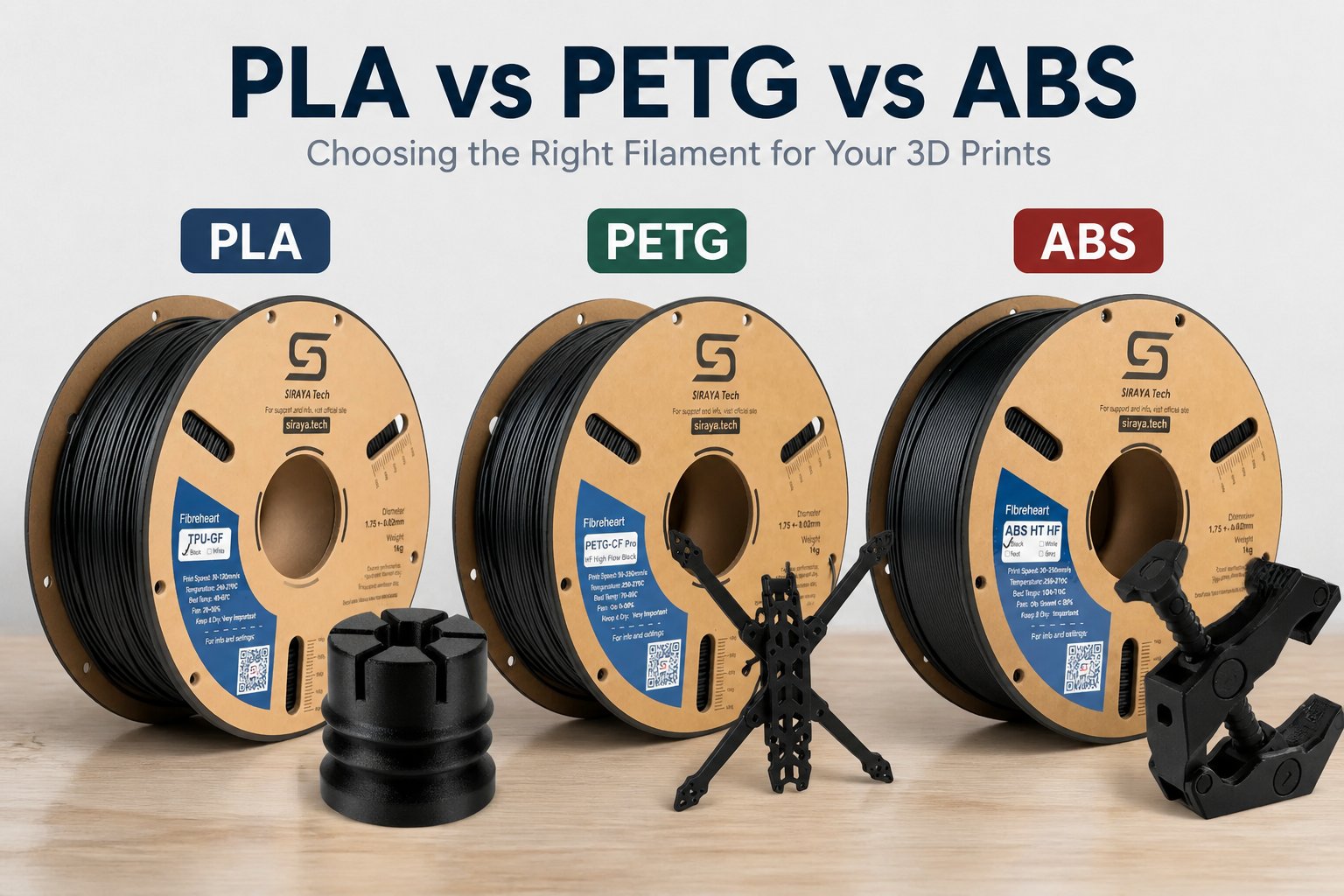
PLA vs PETG vs ABS is one of the first decisions every FDM printer faces — and it's one that affects everything from print settings to how your finished part holds up in the real world. Each filament has its strengths. PLA is beginner-friendly and easy to print. PETG adds moisture and chemical resistance without much extra hassle. ABS brings heat resistance and toughness for more demanding applications. In this guide, we break down the key differences between all three, when to use each one, and how to get the best results from whichever you choose.
- PLA is the easiest to print and shines for detailed models that won't see heat or rough handling
- PETG balances toughness and printability for functional, durable parts
- ABS needs an enclosure and ventilation but handles heat best and can be smoothed with acetone
Looking for a reliable PLA that prints clean every time? Browse our PLA filament collection and find the right spool for your next project.
Key Differences Between PLA, PETG, and ABS

PLA makes printing simple but can't take much heat. PETG sits in the middle, offering more strength and durability without making life too difficult. ABS handles the most heat but asks for a dialed-in setup and some experience.
Material Properties Comparison
PLA (Polylactic Acid) is stiff and starts to soften at just 140–160°F. It's got decent impact resistance for everyday stuff, but leave it in a hot car or on a sunny windowsill and it'll warp or sag.
PETG (Polyethylene Terephthalate Glycol) stands up to higher temps — think 175–185°F. It's got great layer adhesion and a bit of flex, so it's less likely to crack if you drop it. PETG is just tougher than PLA in most ways.
ABS (Acrylonitrile Butadiene Styrene) is the heavy hitter for heat, holding up to 200–220°F. This makes it a go-to for car parts or anything near heat. It's moderately flexible and resists impact, though PETG is still less brittle. None of these are ideal for long-term outdoor use — ABS handles heat better than PLA but is also vulnerable to UV degradation over time.
| Property | PLA | PETG | ABS |
|---|---|---|---|
| Heat Resistance | 140–160°F | 175–185°F | 200–220°F |
| Layer Adhesion | Good | Excellent | Good |
| Flexibility | Low | Moderate | Moderate |
| Impact Resistance | Moderate | High | Moderate |
Print Settings and Hardware Requirements
PLA likes a nozzle temp of 190–220°C and a bed temp between 20–60°C. You don't need an enclosure or special bed — PEI sheets or painter's tape do the trick. PLA barely absorbs moisture, so you can skip the filament dryer.
PETG needs a hotter nozzle (230–250°C) and a bed at 70–85°C. PEI sheets help with adhesion, and while an enclosure helps, it's not a dealbreaker. PETG loves to soak up moisture, so stash it in a dryer when you're not printing, or you'll get stringy, weak prints.
ABS wants a nozzle temp of 240–260°C and a bed at 90–110°C. You really need an enclosure to fight warping. PEI sheets work well, and keep ABS in a dryer or it'll print like garbage — moisture ruins layer strength and adhesion.
| Setting | PLA | PETG | ABS |
|---|---|---|---|
| Nozzle Temp | 190–220°C | 230–250°C | 240–260°C |
| Bed Temp | 20–60°C | 70–85°C | 90–110°C |
| Enclosure Needed | No | Recommended | Yes |
| Filament Dryer | Not required | Recommended | Required |
| Bed Surface | PEI / tape | PEI + glue stick | PEI / Kapton tape |
Ready to step up to PETG? Check out our PETG filament collection — built for parts that need to handle impact, moisture, and moderate heat.
Use Cases for PLA, PETG, and ABS

Each filament has its sweet spot. PLA is best for decorative stuff and prototypes, PETG is great for functional parts that need to last, and ABS is your pick for high-heat jobs.
Best Uses for PLA Filament
PLA's great for anything that stays inside and doesn't get hot. Use it for figurines, cosplay props, and display models. Beginners love it since you don't need a heated bed and it barely warps.
It nails detailed prints with clean surfaces. Organizers, toys, prototypes, and classroom models are all easy. Makers often stick with PLA for miniatures or art where looks matter more than muscle.
But skip PLA for anything that'll get hot or sit in the sun — it starts to droop at just 140°F. It'll also snap if you bend it much or hit it hard, so don't use it for tools or parts that take abuse.
Best Uses for PETG Filament
PETG is the go-to for functional parts that need both strength and a bit of give. It's solid for mechanical bits, phone cases, and brackets you mount around the house. PETG shrugs off impacts better than PLA but isn't as tricky as ABS.
It's also pretty good for stuff that gets wet or needs to handle mild chemicals. Print water bottle holders, bathroom hooks, or containers you'll wash a lot. PETG even lasts outside longer than PLA, though UV will get it eventually.
When you need something that bends before it breaks, PETG's your friend. It's perfect for living hinges, snap-fit parts, and protective cases. It'll take moderate heat up to around 175–185°F, so it works near electronics or in warm spots.
Best Uses for ABS Filament
ABS is for parts that get hot or need post-processing. Car bits, electronics cases, or anything near heat sources — ABS won't melt where PLA or PETG would sag.
You can smooth ABS with acetone vapor for a shiny, pro finish. It's good for prototypes, tool handles, and parts you want to sand or drill after printing. ABS machines well, so adding threads or making tweaks is easy.
ABS shines when you need strong, stress-resistant parts. Jigs, fixtures, and workshop tools all benefit. It fights off more chemicals than PLA, though PETG is often just as good and easier to print.
Maximizing Print Quality With Each Material
If you want the best results from PLA, PETG, or ABS, you have to know how each one behaves and how to fix the usual problems. Matching the right filament to your project is half the battle.
Troubleshooting Common Print Failures
Warping drives people nuts, especially with ABS. ABS warps a lot due to big temp swings as it cools. You need an enclosure and a hot bed (90–110°C) to keep corners down. PETG warps less but still benefits from a 70–80°C bed. PLA almost never warps — 50–60°C is plenty for the bed.
Stringing is when melted filament oozes and leaves wispy bits. PETG is famous for this since it stays gooey longer. Try retraction settings of 4–6mm at 40mm/s for PETG. PLA needs less (2–4mm), and ABS is usually fine with 3–5mm. Slowing print speed to 40–50mm/s also helps PETG string less.
Bed adhesion can be a pain. PLA sticks well to glass or painter's tape. PETG sticks so hard you might want a glue stick as a release layer to save your bed. ABS likes Kapton tape or a smear of ABS slurry on the bed.
How to Choose the Right Filament for Your Project
Go with PLA for decorative stuff, prototypes, or if you're just learning. It's the best filament for beginners because it rarely causes drama.
Pick PETG for functional parts that need to survive drops, flexing, or a bit of weather. It's a solid choice for tool holders, phone cases, or anything that needs some give.
Choose ABS for anything that gets hot or needs a smooth finish from acetone smoothing. Acetone vapor can turn rough ABS prints into shiny, pro-looking parts. You can sand any filament, but ABS is the easiest to finish — start at 200 grit and go up to 600 for a really smooth result.
Make sure your printer can hit the right temps: PLA at 190–220°C, PETG at 230–250°C, and ABS at 230–260°C. Consistent temps matter for good prints.
Need ABS that delivers consistent results? Shop our ABS filament collection — engineered for heat resistance, toughness, and a smooth acetone finish.
Conclusion: PLA vs PETG vs ABS
PLA, PETG, and ABS each have a sweet spot. PLA is your go-to for easy, detailed prints that stay indoors. PETG bridges the gap when you need toughness and moderate heat resistance without the hassle of ABS. And ABS delivers when your part has to survive real heat or needs a smooth, professional finish.
The best filament is the one that matches your project — not the most expensive or the most popular.
Want to take your printing further? Check out our guide on the best way to mass print big models on a resin printer and learn how to scale up without wasting time or resin.
Frequently Asked Questions: PLA vs PETG vs ABS
Each material fits different jobs. PLA's great for detailed prints and prototypes, PETG handles tough, functional parts, and ABS stands up to heat and stress.
When to use ABS vs PLA vs PETG?
Use PLA for easy printing and sharp details — think indoor decorations, prototypes, or classroom models that don't need to handle heat or outdoor conditions. PETG is the go-to when you need impact resistance and moderate heat tolerance for things like tool racks, mechanical parts, or phone cases. Choose ABS when your part faces high temps, needs acetone smoothing, or has to hold up in demanding environments like car interiors or electronics housings.
Is ABS better than PLA?
ABS isn't just "better" than PLA — they're good at different things. ABS wins for heat resistance and toughness, and acetone smoothing gives it a pro finish that PLA can't match. PLA is easier to print, gives finer detail, barely warps, and doesn't produce harsh fumes — so if you want a hassle-free print, PLA is the better call.
Is PETG stronger than ABS?
PETG has better impact strength than ABS — it flexes and survives drops where ABS might crack. ABS handles heat better, keeping its shape up to around 100°C while PETG softens around 80°C. Neither is stronger in every way — PETG absorbs shock better, ABS is more rigid under load, so the right pick depends on what kind of strength your project actually needs.
Is PETG really better than PLA?
PETG brings clear advantages for functional parts — it shrugs off impacts, holds its shape up to 80°C, and handles moisture and chemicals better than PLA. PLA shines for prototyping and decorative prints, nailing fine details with less fuss and usually at a lower cost. PETG doesn't always win though — it strings more during printing, can be harder to post-process, and if your project just sits indoors without needing toughness, PLA makes life easier.