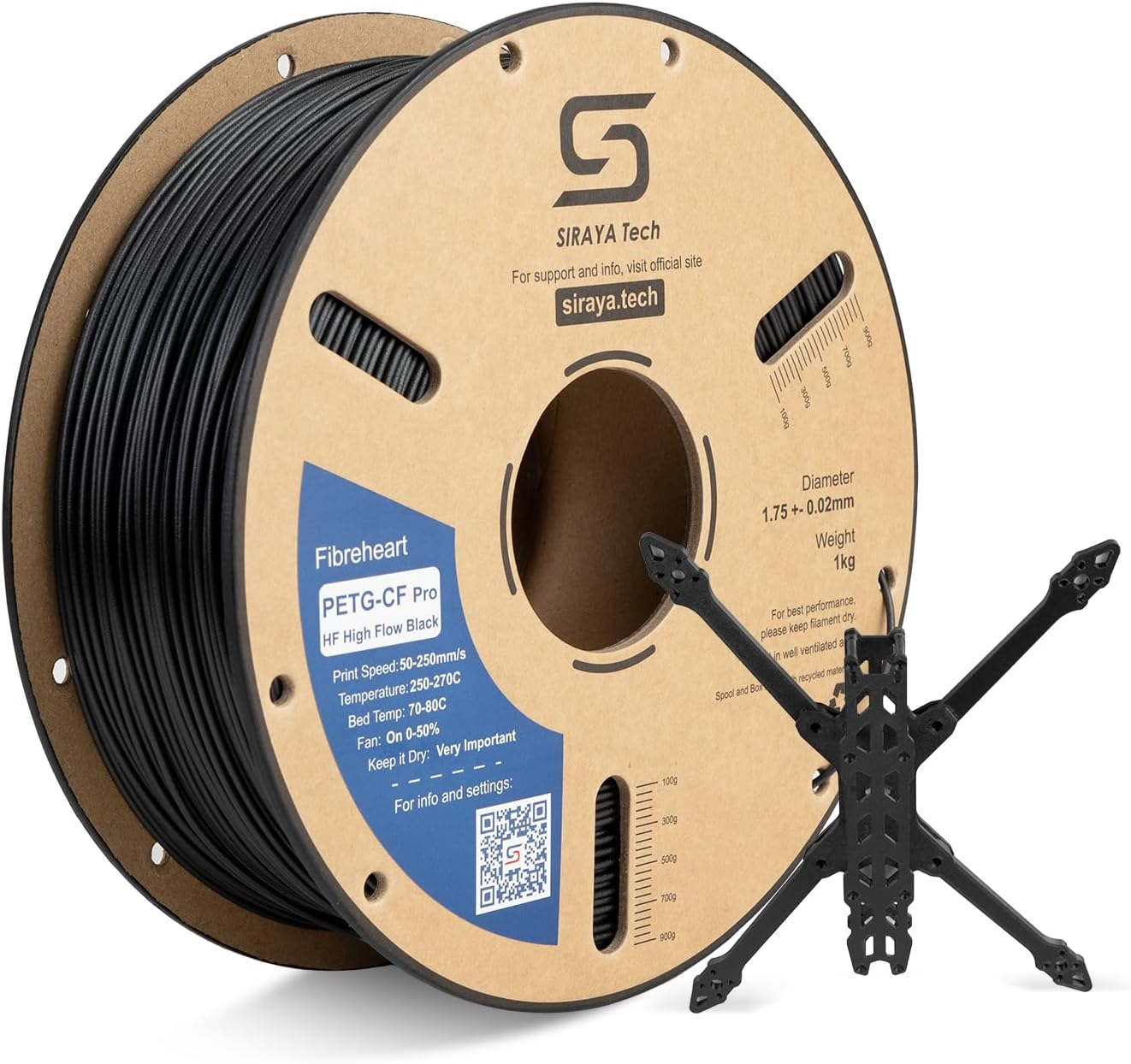
PETG Filament 1.75mm
2 製品
2 製品の1 - 2を表示しています。
PETG filament 1.75mm sits between PLA and ABS in the performance spectrum. It prints easier than ABS, is more temperature-resistant than PLA, and produces parts with good clarity and a clean surface finish. Siraya Tech's PETG range takes those base advantages and adds carbon fiber reinforcement and high-flow formulations for faster, stronger prints in demanding environments.
What Is PETG Filament
PETG (Polyethylene Terephthalate Glycol) is a thermoplastic that balances the printability of PLA with the durability of ABS. The glycol modification of standard PET gives it better impact resistance and makes it less prone to crystallization during printing, which is what causes stringing and clouding in unmodified PET.
PETG produces strong, slightly flexible parts with good chemical resistance and decent UV stability. It does not emit strong fumes the way ABS does, making it more pleasant to print indoors. The surface finish is naturally semi-gloss, which makes it look more finished than PLA straight off the build plate.
- Easier to print than ABS, with better temperature and impact resistance than PLA
- Good chemical resistance and decent UV stability for indoor and sheltered outdoor use
- Low odor printing without the fumes associated with ABS
- Natural semi-gloss surface finish looks clean without post-processing
- Carbon fiber reinforced PETG adds stiffness and reduces thermal expansion for more demanding applications
PETG vs. ABS: Which Should You Choose
PETG and ABS each have strengths. PETG prints more easily, produces less odor, and handles moisture better than ABS. ABS offers higher HDT, better impact resistance at very low temperatures, and responds better to acetone smoothing. For most functional prototyping and end-use parts, PETG is the more practical choice. For parts that need extreme temperature resistance or will be finished with acetone, ABS still wins.
Siraya Tech PETG combines the practical printability of PETG with carbon fiber reinforcement and high-flow formulations. The result is a PETG that prints faster and performs better under load than standard PETG, without giving up the ease of use that makes PETG accessible.
- Printability: PETG prints at lower temperatures than ABS and does not require an enclosure or aggressive bed adhesion. It adheres well to most surfaces and is less prone to warping than ABS.
- Strength: Standard PETG is strong but somewhat flexible. Carbon fiber reinforced PETG like Siraya Tech's PETG-CF Pro adds stiffness and moves closer to ABS in structural load capacity.
- Temperature resistance: PETG softens around 80C to 85C. Carbon fiber reinforced PETG pushes the HDT higher. For very high temperature environments above 100C, ABS or PPA is still the better choice.
- Outdoor use: PETG has better UV resistance than ABS. Carbon fiber reinforced PETG extends that advantage further, making it suitable for outdoor functional parts that need to hold up over time.
- Surface finish: PETG has a natural semi-gloss finish. Carbon fiber reinforced PETG produces a professional matte result, hiding layer lines better than standard PETG.
Siraya Tech PETG Filament 1.75mm Options
What Makes Carbon Fiber PETG Different
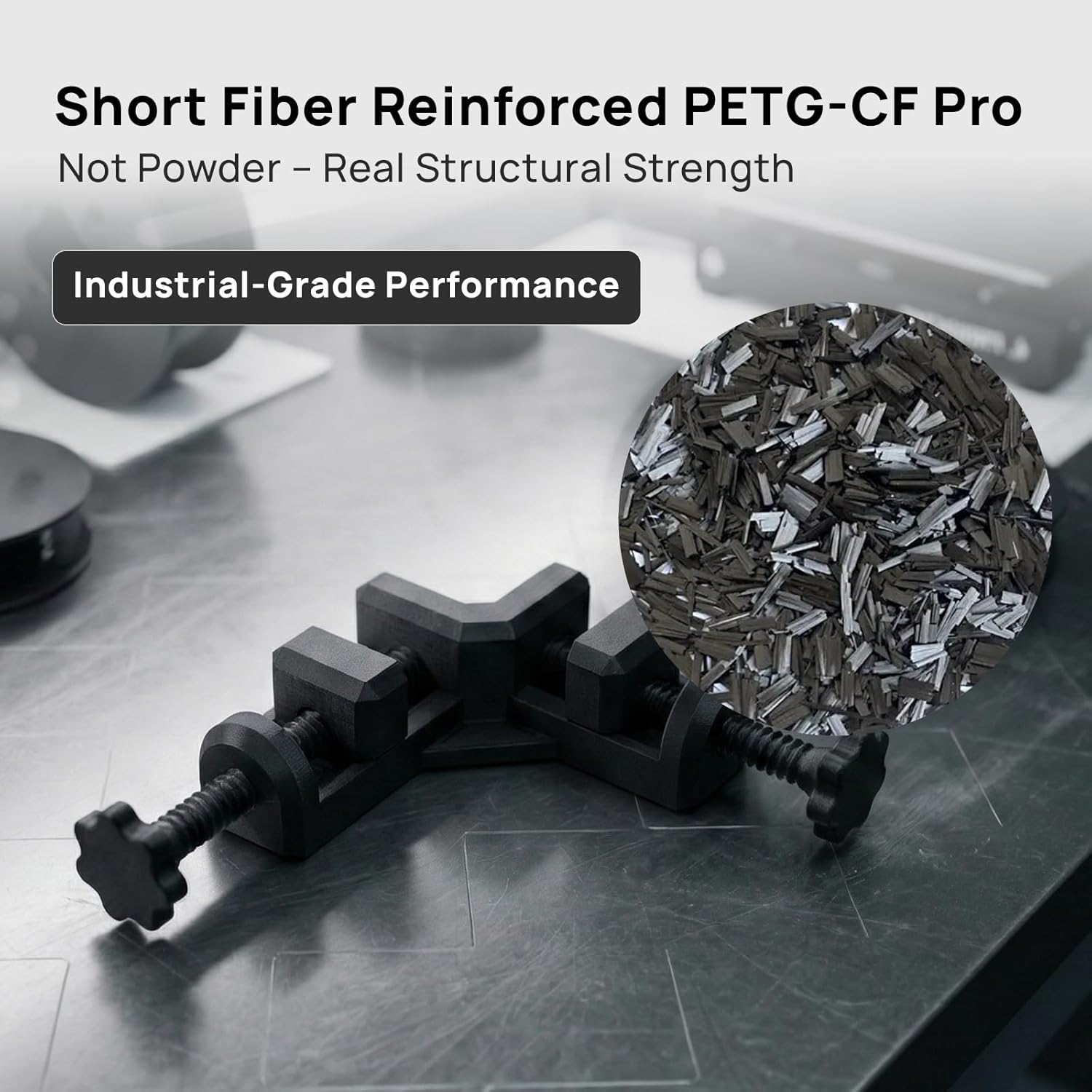
Standard PETG handles most prototyping and functional printing well. Carbon fiber reinforced PETG takes the same polymer base and adds chopped carbon fiber to improve stiffness, reduce weight, and push the thermal and mechanical performance higher.
- Stiffness: Carbon fiber reinforcement significantly increases flexural modulus compared to standard PETG. Parts that would flex under load with standard PETG hold their shape better with CF-PETG.
- Dimensional stability: Carbon fiber reduces the coefficient of thermal expansion, meaning parts hold dimensions better as temperature changes. This matters for functional parts that need to fit precisely.
- Weight: Carbon fiber reinforcement adds strength without the weight penalty of standard engineering plastics. Drone frames, brackets, and structural parts benefit from this.
- Surface quality: Carbon fiber PETG produces a clean matte surface finish that hides layer lines better than standard PETG. Parts look more finished straight from the build plate.
- Print speed: The high-flow formulations in Siraya Tech's carbon fiber PETG options are designed for faster printing without sacrificing layer bonding or surface quality.
How to Print PETG Successfully
Explore Related Collections
Frequently Asked Questions
What is PETG filament best used for?
Does PETG need a heated bed?
What is the HDT of carbon fiber PETG?
Can PETG be used outdoors?
Is carbon fiber PETG abrasive to print with?
What is the difference between PETG and PETG-CF?