
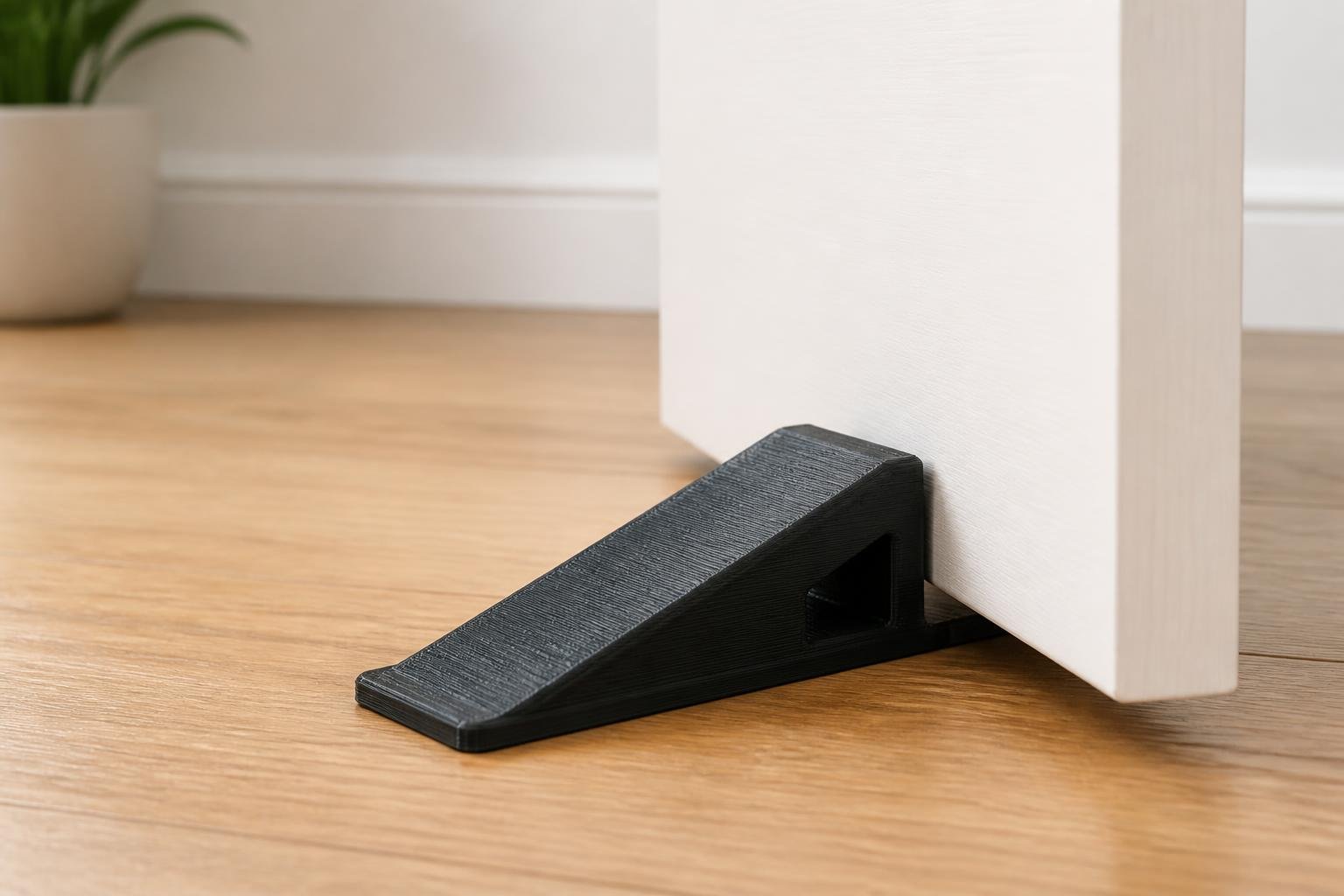
This guide shows you how to design and print a door stop that actually holds on any floor type — from smooth tile to carpet to hardwood.
Material choice, base design, and a few smart tricks make the difference between a wedge that works and one that just slides into the corner.
- Best material: TPU grips floors and compresses under the door without cracking — the clear winner for most use cases.
- PETG for heavy doors: A rigid PETG body with a TPU grip pad on the bottom combines weight and traction.
- Design anti-slip features: Teeth, ridges, or serrated bases improve grip significantly on smooth floors.
- Add weight for heavy doors: A cavity filled with sand or steel BBs helps hold fire doors and doors with closers.
- Fast print: Most door stop designs finish in under 2 hours.
- Print-in-place options: Spring-loaded or ratcheting mechanisms are possible without any assembly.
Why 3D Print a Door Stop?

You could buy a rubber wedge for a dollar. But a printed door stop can be custom-fit to your specific door gap, floor type, and holding force needs — no compromises.
- Custom-fit to the exact gap under your door, measured with calipers.
- Anti-slip patterns designed for your floor type — carpet, hardwood, tile, or concrete.
- Weighted designs for heavy fire doors or exterior doors with closers.
- Fun shapes and personality for any space.
- Reprint a replacement in hours when one wears out or you move.
Material Selection: Where Grip Comes From
The number one failure of 3D printed door stops is sliding. If the material doesn't grip the floor, the door just pushes the wedge across the room. Material choice is everything.
TPU (Best Overall)
TPU filament is the ideal door stop material. Its rubber-like flexibility creates natural grip on most floor surfaces. When the door presses down, TPU compresses slightly — increasing contact area and friction automatically.
Shore 95A TPU gives the right balance: firm enough to hold shape, flexible enough to grip. TPU door stops won't crack, won't scratch floors, and absorb door impact without breaking. Browse Siraya Tech's Flex TPU filament collection for options.
PETG
PETG makes a strong, rigid door stop body. On its own, PETG can slide on smooth floors — so pair it with anti-slip base features or glue a TPU pad to the bottom surface.
PETG is the better choice when you need a heavy, solid wedge that holds through weight rather than grip alone.
PLA
PLA is fine for a quick prototype or a light interior door on carpet. It's more brittle than PETG and can crack under repeated pressure from heavy doors. It also doesn't grip smooth floors well.
Use PLA to test fit and geometry, then reprint in PETG or TPU for the final version.
Multi-Material (Best Performance)
The best door stops combine materials. Print the main body in PETG for rigidity and weight, then print the base contact layer in TPU for grip.
If your printer supports multi-material, you can do this in a single print. Otherwise, print them separately and glue the TPU pad to the PETG body — a simple and effective approach.
Design Features That Improve Performance
A plain wedge works, but smart design details make a big difference in real-world grip and longevity.
Anti-Slip Base Patterns
Design teeth, ridges, or serrated patterns on the bottom surface. On carpet, tall narrow teeth dig into the fibers and resist sliding. On smooth floors, broad low ridges with fine texture create more friction than a flat base.
Test different patterns on your specific floor and iterate — it costs almost nothing to reprint.
Ratcheting Door Contact
Add small bumps or ridges on the top surface where the door contacts the wedge. These create a ratcheting effect: the door pushes the wedge down and the bumps prevent it from sliding backward.
This works especially well with TPU, which compresses and locks into position under load.
Weight Cavities
For heavy doors or doors with automatic closers, a lightweight plastic wedge won't hold. Design an internal cavity to fill with sand, steel BBs, or epoxy putty after printing. Cap the cavity with a glued-on printed lid.
The added weight keeps the stop in place through sheer mass — useful when grip alone isn't enough.
Handles and Pull Tabs
If you place and remove the door stop frequently, add a finger hole, pull tab, or handle to the top. This makes it easy to kick in with your foot and pull out without bending down — a small detail that matters in daily use.
Print Settings for Door Stops
| Setting | TPU (Full Flex) | PETG (Rigid Body) |
|---|---|---|
| Layer height | 0.2mm | 0.2mm |
| Walls | 3–4 perimeters | 4–5 perimeters |
| Infill | 30–50% | 30–50% (higher = more weight) |
| Print speed | 25–35 mm/s | 50–60 mm/s |
| Orientation | Flat, base on build plate | Flat, base on build plate |
| Retraction | 1–2mm or disabled | Standard |
For TPU, use a direct-drive extruder if possible. Reduce retraction to 1–2mm or disable it entirely to prevent filament buckling in the Bowden tube.
Floor-Specific Tips
Carpet
Use tall, narrow teeth on the base. TPU works well because it conforms to carpet texture. Infill can be lower since the carpet itself provides grip — the teeth just need to dig in.
Hardwood or Laminate
Use TPU with broad, flat ridges on the base. Avoid rigid plastics that slide on smooth wood. A slightly concave bottom surface can create a mild suction effect that improves grip on polished floors.
Tile or Stone
TPU is essential on tile. Rigid plastics slide easily on smooth surfaces. Design a base with fine ribbing that creates micro-channels for friction. Wider stops distribute force better on hard, smooth surfaces.
Concrete
Almost any material grips on rough concrete. PETG with aggressive teeth holds very well. Weight matters more than grip here — heavier stops perform better on textured surfaces.
Siraya Tech Filaments for Door Stops
For a door stop that grips and lasts on any floor surface, Siraya Tech's Flex TPU 95A filament delivers excellent grip, impact absorption, and durability. It feeds smoothly on direct-drive extruders and produces reliable prints at moderate speeds.
If you need softer maximum grip on smooth tile or hardwood, Flex TPU 85A provides even more rubber-like flexibility, though it requires a bit more printer tuning to feed consistently.
Final Thoughts
A 3D printed door stop is a fast, cheap, and endlessly customizable project that solves a real everyday problem. Choose TPU for grip, PETG for weight, and smart base patterns for your specific floor type.
When the first one wears out, just print another. That's the whole point.
Browse Siraya Tech's TPU filament and PETG filament collections to find the right material for a door stop that actually stays put.
Related Reading on Siraya
- What Is TPU Filament: Easy Guide
- TPU Shore Hardness Explained: 85A vs 95A
- Best Flexible Filament Types for Strong 3D Prints
- Useful Things to 3D Print
- What Is PETG Filament: Buyer's Guide
Frequently Asked Questions
What is the best material for a 3D printed door stop?
TPU is the best overall choice because it grips floors, absorbs impact, and doesn't crack under pressure. PETG is a strong alternative for heavy, rigid stops. Avoid PLA for doors with closers or heavy doors, as it can crack under repeated stress.
Will a 3D printed door stop scratch hardwood floors?
Not if you use TPU. Its rubber-like surface is softer than hardwood and won't leave marks. Rigid plastics like PLA or PETG without a soft base pad can potentially scratch polished floors if the wedge is dragged rather than lifted.
How do I make a 3D printed door stop grip better?
Print in TPU, add anti-slip teeth or ridges to the base, and add weight inside the wedge for heavier doors. For smooth floors, a fine ribbed pattern on the base creates more friction than a flat bottom surface.
How thick should a 3D printed door stop be?
Measure the gap under your door with calipers. The thickest point of the wedge should be slightly taller than this gap so the door compresses the wedge and creates friction. For most interior doors, a wedge 10–20mm tall at the thick end works well.
Can I 3D print a door stop for a fire door with a closer?
Yes, but it needs to be heavy. Design an internal cavity and fill it with sand or steel BBs after printing. Use PETG or a rigid material for the body and TPU for the base. The weight and grip need to overcome the closing force.
How long does a 3D printed door stop last?
TPU door stops last months to years of daily use. PETG stops hold up equally well. PLA may wear down faster, especially in high-traffic areas. When a door stop wears out, just reprint it — most designs take under 2 hours.