
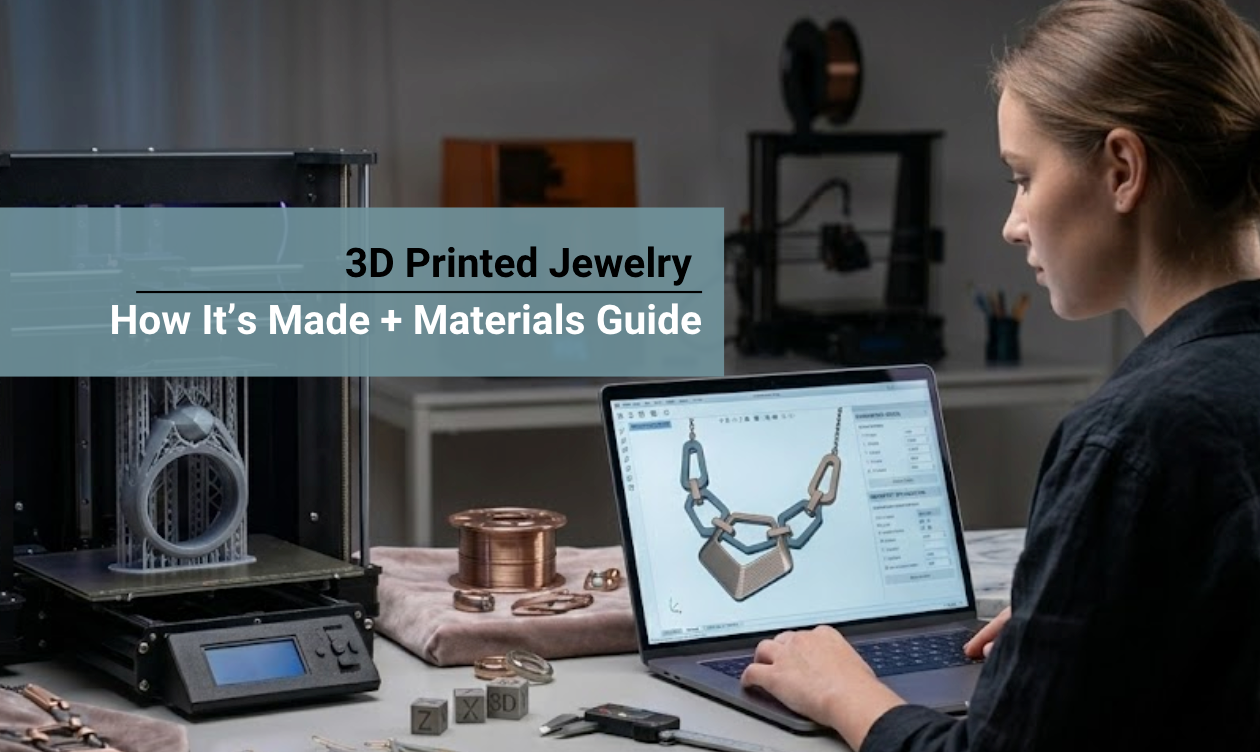
3D printed jewelry is a modern manufacturing method that combines digital precision with traditional metal casting. Instead of hand-carving wax, jewelers use high-resolution resin printers to create intricate patterns.
These patterns are then used in the lost-wax casting process to create final pieces in gold, silver, or bronze.
Success in this field depends on using high-purity castable resin, ensuring a clean burnout in the kiln, and designing models that account for the unique strengths of 3D printing technology.
This guide explores the entire workflow, from digital file to finished metal piece, ensuring your professional projects meet the highest standards.
The Evolution of Jewelry Manufacturing

Historically, crafting fine jewelry was an intensely manual, time-consuming endeavor.
The Traditional Method
The analog lost-wax casting method required artisans to painstakingly carve a master model from a hard block of jeweler's wax using scalpels and files.
Carving microscopic prongs, intricate filigree, or symmetrical interlocking bands often took weeks. If a client requested a different ring size, the jeweler had to start over from scratch.
The Digital Shift
The modern approach seamlessly blends with traditional finishing methods rather than replacing them entirely. Using CAD software, a designer digitally sculpts a ring in a fraction of the time.
A 3D printer then cures a physical resin pattern with details as fine as 25 microns (0.025mm).
This eliminates the tedious manual carving phase while retaining the traditional casting and hand-polishing stages.
Advantages of 3D Printing for Jewelers
Adopting a digital-first approach offers incredible commercial benefits, significantly lowering the barrier to entry while expanding creative boundaries.
1. Limitless Design Flexibility
3D printing removes the physical constraints associated with hand-carving.
Jewelers can now easily engineer hollow cores to reduce final gold weight, design complex interlocking chain links printed as a single piece, and create intricate, organic motifs that would be nearly impossible to carve manually.
2. Rapid Prototyping and Client Customization
In the bespoke jewelry market, client satisfaction is paramount.
- Physical Proofing: A jeweler can print a highly accurate prototype of a custom engagement ring in standard resin within two hours.
- Risk-Free Revisions: The client physically tries on the prototype to verify the fit, scale, and design. If adjustments are needed, the designer simply tweaks the CAD file and reprints it.
This ensures complete satisfaction before pouring thousands of dollars worth of molten platinum or gold.
3. Scalable Batch Production
For businesses transitioning from bespoke one-offs to retail collections, 3D printing offers unmatched efficiency.
A standard desktop resin printer can fit dozens of rings, pendants, and earrings on a single build plate, printing them all simultaneously.
Automating pattern duplication allows jewelers to maintain inventory and respond quickly to fast-moving fashion trends without increasing manual labor costs.
Table 1: Choosing the Right 3D Printing Technology
Not all 3D printers can produce fine jewelry. Understanding hardware differences is critical for setting up a successful studio.
| Technology Type | How it Works | Jewelry Application | Cost & Accessibility |
|---|---|---|---|
| SLA / DLP Resin | Uses a UV laser or LCD screen to cure liquid photopolymer resin layer by layer . | The Industry Standard. Produces ultra-high resolution patterns for investment casting . | Highly accessible ($300 - $3,000 for professional desktop units) . |
| FDM Filament | Melts plastic filament through a heated nozzle . | Lacks the resolution required for fine prongs and leaves visible layer lines . | Very cheap, but strictly limited to large, chunky costume jewelry prototypes . |
| DMLS (Direct Metal) | Fuses fine precious metal powder using a high-powered industrial laser . | Direct production of final gold, silver, or platinum pieces without the casting phase . | Extremely expensive ($100k+). Strictly for high-end industrial mass manufacturing . |
How to Make 3D Printed Jewelry: The Step-by-step Process

Transitioning a piece of digital art into wearable fine jewelry requires strict adherence to the modern investment casting workflow.
Step 1: CAD Modeling and Digital Design
The process begins in jewelry-specific CAD software. Designers must ensure structural parameters are correct, verifying that prongs are thick enough to hold gems securely and that wall thicknesses can survive the molten metal casting process.
Once finalized, the digital ring is exported as an STL file.
Step 2: 3D Printing the Master Pattern
- The STL file is sent to an SLA or DLP printer loaded with castable resin.
- After printing, the resin model is washed in isopropyl alcohol to remove unreacted liquid.
- The model is briefly post-cured under a UV lamp to guarantee structural stability.
Step 3: Spruing and Investment
- The cured resin ring is attached to a wax "sprue" tree, creating a designated channel for the molten metal to flow.
- The sprued model is placed inside a steel flask, and liquid plaster (the investment) is poured over it.
- The flask is placed in a vacuum chamber to aggressively remove microscopic air bubbles, ensuring a flawless surface finish against the resin pattern. The plaster then hardens.
Step 4: The Burnout Phase
The plaster flask is placed upside down inside an electric kiln, which slowly ramps up to temperatures exceeding 700°C. During this phase, the 3D printed resin pattern completely melts and burns away. This leaves behind a perfectly shaped negative cavity inside the glowing-hot plaster.
Step 5: Casting the Metal
While the plaster mold is still glowing, molten precious metal (such as silver, gold, or bronze) is poured or vacuum-pulled into the hollow cavity.
Once the metal cools and solidifies naturally, the plaster is quenched in water and broken away, revealing the solid metal piece.
Step 6: Finishing and Polishing
The raw metal cast is clipped off the sprue tree. The jeweler then uses traditional metal files, rotary tools, and polishing compounds to erase casting textures.
This brings the metal to a brilliant, commercial-grade shine before the final gemstones are set.
The Importance of High-Quality Castable Resin

The most common point of failure in 3D printed jewelry occurs during the kiln burnout phase.
Attempting to cast a pattern printed in standard modeling resin is disastrous. Standard plastics expand as they heat up, which easily cracks the delicate plaster mold.
Furthermore, standard resin leaves behind heavy carbon ash when burned; this ash mixes with the molten gold, causing severe pitting, porosity, and ruined casts.
To achieve professional success, jewelers must use specialized materials such as Siraya Tech Cast - Castable Resin. Engineered specifically to replace traditional jeweler's wax, it offers distinct advantages:
- High Wax Content: Unlike standard plastics, Siraya Tech Cast contains real wax components (often up to 30%). This allows it to melt seamlessly and burn out, leaving no ash residue.
- Immaculate Detail: It captures the sharpest micro-pave settings with a flawless surface finish and is formulated to print easily on desktop machines without extreme environmental modifications.
- Investment Compatibility: It works perfectly with standard, readily available jewelry investment powders, eliminating the need to purchase expensive high-expansion plasters.
Table 2: Traditional Hand-Carved Wax vs. 3D Printed Castable Resin
| Feature | Traditional Jeweler's Wax | 3D Printed Castable Resin (Siraya Cast) |
|---|---|---|
| Creation Method | Hand-carved with scalpels, files, and heat tools. | Digitally modeled in CAD, extruded via UV light . |
| Time Investment | Hours–to–days per piece; highly labor-intensive. | 1 to 3 hours print time; fully automated operation . |
| Symmetry & Precision | Relies entirely on the artisan's eye and steady hand. | Flawless geometric symmetry down to 25 microns . |
| Burnout Quality | Melts seamlessly with virtually zero ash . | Engineered wax-based formula mimics traditional burnout . |
| Scalability | Extremely poor; duplicates must be carved manually. | Exceptional; can print dozens of identical patterns at once . |
Recommended Collections for Jewelers
Bringing digital art to your wardrobe has never been easier. If you are ready to modernize your studio, adopting the right material ecosystem is your first step toward profitable production.
We highly recommend exploring our curated Resin Casting Jewelry Collection. This collection brings together our carefully formulated Cast Purple and Cast True Blue resins, designed specifically for clean details, strong print structures, and reliable, ash-free results in the kiln.
Whether you are testing new pendant designs or executing a massive custom bridal order, integrating these wax-based resins will drastically reduce your failure rates and ensure your metal casts look polished and flawless.
Conclusion
3D printed jewelry represents the perfect harmony between cutting-edge technology and ancient artisanal craftsmanship.
Integrating CAD modeling and high-resolution resin printing into your workflow allows you to bypass the tedious, time-consuming limitations of hand-carving wax.
This digital evolution unlocks breathtaking geometric complexity, rapid prototyping for client approvals, and highly efficient batch production.
However, your success relies entirely on the quality of the raw materials used during the casting transition.
By utilizing specialized, high-wax formulations like Siraya Tech Castable Resin, you guarantee a clean, ash-free burnout, ensuring that every digital voxel is faithfully replicated in brilliant, solid metal.
FAQs About 3D Printed Jewelry
Is 3D printed jewelry made of real metal?
Yes and no. While industrial Direct Metal Laser Sintering (DMLS) machines print directly in precious metals, the vast majority of 3D printed jewelry is initially printed in a castable wax-resin. This resin model is then used in a traditional lost-wax casting process to create a mold, into which molten gold, silver, or platinum is poured. The final result is a solid, 100% real metal piece of jewelry.
How long does it take to 3D print a ring?
Printing time depends heavily on the height of the design and the specific layer settings of the SLA/DLP printer. However, a standard engagement ring printed at an ultra-high resolution of 50 microns typically takes 1.5 to 3 hours. Because resin printers cure entire layers simultaneously, you can print one ring or twenty rings in the exact same amount of time.
Can I use regular 3D printer resin to cast jewelry?
No, using standard modeling resin for investment casting results in severe failures. Standard resins expand under high heat—cracking the delicate plaster mold—and they leave behind heavy carbon ash that ruins the surface of the molten metal. You must use a specialized, wax-based castable resin designed specifically for clean thermal burnout.
How durable is 3D printed jewelry?
When produced via the standard lost-wax casting method, the final piece is exactly as durable as any traditional fine jewelry. Because the final product is cast in solid precious metal and undergoes traditional polishing and stress-relief annealing, it possesses the same structural integrity, longevity, and wear resistance as a ring cast from a hand-carved wax model.