
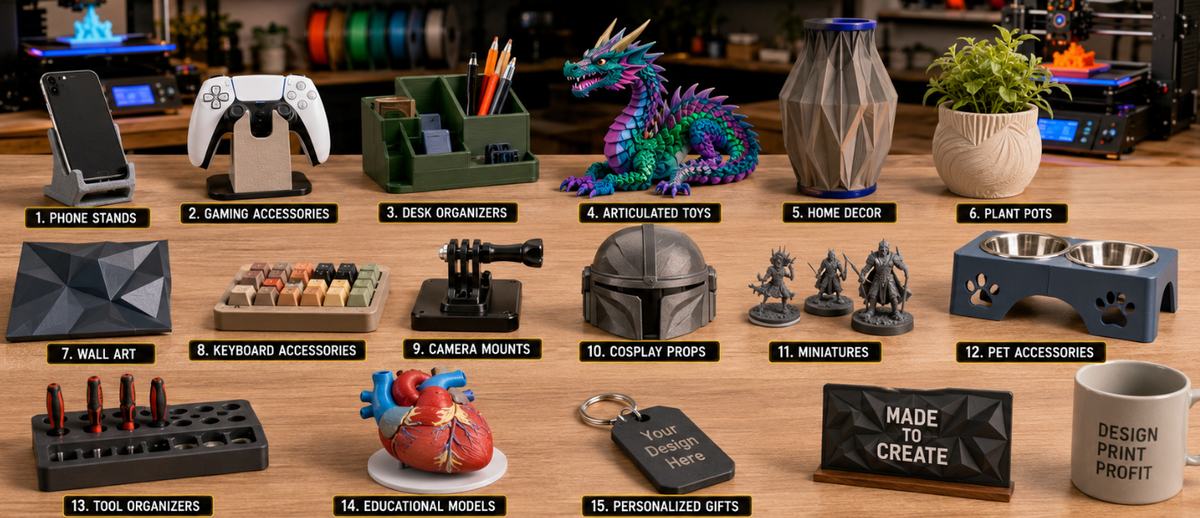
If you own a printer and want to earn from it, the question is simple: what are the most profitable things to 3D print and sell? The answer is not whatever looks coolest. Profit comes from low material cost, fast print time, and high perceived value.
This guide ranks 15 proven money-makers with real margin data, shows the best resin and filament for each, and answers the questions buyers ask most. Use it to skip the trial-and-error and print things people actually pay for.
- Highest margins: STL files (95%+), keychains, and replacement parts win on tiny cost and fast turnaround.
- Best perceived value: jewelry, miniatures, and cosplay props let you charge premium prices for detail.
- Material matters: resin for fine detail (jewelry, minis), tough FDM filament for parts that must survive use.
- Niche beats popular: demand plus low competition equals real profit, so pick a focused audience.
- Stay legal: sell original designs, not copyrighted characters or logos.
What makes a 3D print actually profitable

Before the list, learn the filter. A best-selling item is not always the most profitable one, because high demand usually brings heavy competition. The prints that make steady money share four traits:
- Low material cost — ideally under a dollar of resin or filament per unit.
- Fast, reliable print time — so you fill orders without babysitting the printer.
- High perceived value — the buyer pays for the idea, fit, or personalization, not the plastic.
- Repeat or seasonal demand — the same design keeps selling all year or every holiday.
Check real demand on Etsy and Amazon Handmade before you commit. Look at review counts and stable prices. If similar items sell again and again at a healthy price, the demand is proven. Then subtract every cost (material, electricity, finishing, packaging, fees, and your time) to confirm the margin is worth it.
| Item | Material cost | Sell price | Margin | Difficulty |
|---|---|---|---|---|
| STL files (digital) | $0 | $3–$50+ | 95%+ | High |
| Replacement parts | $0.50–$5 | $8–$50 | 80–95% | Medium |
| Keychains | $0.20–$1 | $3–$12 | 80–90% | Low |
| Miniatures | $0.50–$3 | $5–$25 | 75–85% | Medium |
| Jewelry | $1–$5 | $15–$50+ | 70–85% | Medium |
| Cosplay props | $5–$30 | $30–$150+ | 60–80% | High |
| Home decor | $3–$15 | $15–$80 | 65–80% | Medium |
| Toys & fidgets | $2–$3 | $10–$15 | 70–80% | Low |
The 15 most profitable things to 3D print and sell
1. STL files (digital downloads)
The most profitable thing of all is a file you never print. Design once, sell forever. After the design work, your cost is zero: no material, no shipping, no inventory.
List on Printables, Cults3D, or MyMiniFactory and earn while you sleep. It takes real design skill, but the passive income ceiling is the highest on this list.
Profit: $0 material · Sell $3–$50+ · Margin 95%+
2. Custom jewelry

Jewelry has tiny material cost and very high perceived value. Buyers happily pay boutique prices for rings, pendants, and earrings they cannot find anywhere else. Resin printing captures fine textures and detail that look luxury.
Cast pieces in metal using a castable resin for clean burnout, or print wearable designs directly in high-detail resin.
Profit: $1–$5 material · Sell $15–$50+ · Margin 70–85%
3. Replacement and spare parts
People hate buying a whole new appliance over one broken knob. A $2 print that saves a $200 replacement is an easy sale, and discontinued parts have almost no competition.
These need strength and heat resistance, so print them in a durable engineering filament rather than brittle plastic. This is one of the highest-margin niches once you find your audience.
Profit: $0.50–$5 material · Sell $8–$50 · Margin 80–95%
4. Keychains and keyrings
Cheap, fast, and endlessly personalizable. Add a name, a logo, or a low-poly shape and the value jumps.
Keychains are the perfect starter product and sell brilliantly in bulk for events, weddings, and promotions. Pennies to print, sold for a few dollars each.
Profit: $0.20–$1 material · Sell $3–$12 · Margin 80–90%
5. Miniatures and tabletop terrain
The D&D and wargaming crowd is huge and always hungry for detailed figures and scenery. Minis are small, so they sip material and print fast, yet collectors pay well for sharp detail.
This is a perfect resin job: an ABS-like resin gives crisp edges and a tough, paint-ready surface.
Profit: $0.50–$3 material · Sell $5–$25 · Margin 75–85%
6. Articulated animals (dragons, cats, axolotls)
Print-in-place articulated animals are some of the most-sold items on Etsy and Cults3D. They wiggle, they are fun, and they make great gifts.
The category is well known, so stand out with unique colors, holiday themes, or zodiac variants. A flexible touch in the joints comes from printing in a flexible TPU filament.
Profit: $3–$8 material · Sell $15–$35 · Margin 65–75%
7. Cosplay props and masks
Cosplayers want accuracy and pay top dollar for it. Helmets, armor, weapons, and masks are hard to buy off the shelf, so quality makers clean up at conventions all year.
Print rigid shells in tough resin or filament and add comfort with flexible parts. Margins are strong even though the prints are large.
Profit: $5–$30 material · Sell $30–$150+ · Margin 60–80%
8. Phone cases, stands, and grips
The phone accessory market is enormous, yet owners of older or unusual models cannot find cases. That gap is your opening.
Flexible cases need a soft, grippy material, so print them in TPU 95A for a snug, shock-absorbing fit that mass brands ignore.
Profit: $1–$4 material · Sell $8–$25 · Margin 65–80%
9. Home decor (vases, wall art, planters)
People want décor that fits their exact space and style. Vases, geometric planters, and wall art are always in demand and let you charge design prices.
Smooth the finish and kill layer lines with the Aegis coating system for a showroom look that justifies a higher price.
Profit: $3–$15 material · Sell $15–$80 · Margin 65–80%
10. Toys, puzzles, and fidgets
Fidget toys and puzzles are quick to print, fun, and appeal to adults as much as kids. They follow trends fast, so you can ride whatever is hot this month.
Low cost, easy sales, and a great impulse buy at markets.
Profit: $2–$3 material · Sell $10–$15 · Margin 70–80%
11. Pet accessories (tags, AirTag holders, bowls)
Pet owners love personalizing their animals. Custom collars, name tags, AirTag holders, and feeders sell well because mass-market versions rarely fit or feel special.
Use durable, body-safe materials and add names or patterns for instant value.
Profit: $1–$5 material · Sell $8–$30 · Margin 70–85%
12. Personalized gifts
A name, a date, or a custom message turns a cheap print into a treasured gift.
Birthdays, weddings, and holidays create year-round demand, and personalized items command higher prices because they show thought.
Low effort to customize, high emotional payoff for the buyer.
Profit: $1–$5 material · Sell $10–$40 · Margin 70–85%
13. Desk organizers and practical gadgets
Cable holders, pen cups, drawer trays, and headphone stands sell steadily to the work-from-home crowd.
Margins are thinner than personalized items because they compete on function, but they make a reliable second product line that never goes out of season.
Profit: $1–$8 material · Sell $8–$40 · Margin 70–85%
14. Garden decor (plant markers, bird feeders)
An underrated, growing niche. Print outdoor items in UV-stable, weather-resistant material so they survive sun and rain far longer than store-bought décor.
Plant markers, stakes, and feeders let gardeners personalize their space and pay for it.
Profit: $2–$8 material · Sell $10–$35 · Margin 65–75%
15. Educational and architectural models
Schools, clinics, and developers need detailed scale models: anatomy, terrain maps, and building mockups.
These are larger, higher-priced jobs where a high-temperature, dimensionally stable material matters.
A high-temperature resin holds fine detail without warping for premium client work.
Profit: $5–$50 material · Sell $25–$500+ · Margin 60–80%
Which material should you use?
The right resin or filament decides whether your product sells once or earns five-star reviews. Match the material to how the item will be used.
| You're printing | What it needs | Recommended material |
|---|---|---|
| Jewelry for casting | Clean burnout, fine detail | Cast – Castable Resin |
| Miniatures & figures | Crisp edges, tough surface | Fast – ABS-Like Resin |
| Replacement parts | Strength & durability | Fibreheart Engineering Filament |
| Phone cases & grips | Flexibility & grip | Flex TPU 95A |
| Articulated animals | Bendable joints | Flex TPU Family |
| High-temp / models | Heat resistance, no warp | Sculpt – High Temp Resin |
| Food-contact items | FDA platinum silicone | Defiant Silicone |
| Smooth display pieces | No layer lines | Aegis Coating System |
How to sell your prints successfully
Great prints still need a smart sales approach. A few habits separate hobby income from a real business:
- Pick a niche. Find items people want but cannot easily buy, then own that corner.
- Customize everything. Names, colors, and fit raise perceived value with almost no extra cost.
- Market with short video. TikTok, Reels, and YouTube Shorts show your prints in action and drive sales.
- Protect yourself legally. Sell original designs and licensed models only; avoid copyrighted characters and logos.
- Nail your finish. Clean post-processing earns better reviews and repeat buyers.
Start printing for profit
The most profitable things to 3D print share one pattern: low cost in, high value out. Start with a beginner-friendly winner like keychains or miniatures, then grow into jewelry, parts, or STL files as your skills build.
The product is only half the story; the material is the other half. Reliable, high-detail resin and tough filament are what turn a neat print into something customers pay for and recommend.
Pick one item from this list, choose the right Siraya Tech material, and make your first sale this month.
Frequently Asked Questions
What is the single most profitable thing to 3D print?
Is 3D printing still profitable in 2026?
What sells best, resin prints or filament prints?
How much can you make selling 3D printed items?
Is it legal to sell 3D printed items?
Siraya Tech Team — We make high-performance UV resins, FDM filaments, and platinum silicones used by 3D printing makers and small businesses worldwide. Our material guidance comes from years of testing with real sellers and creators.