
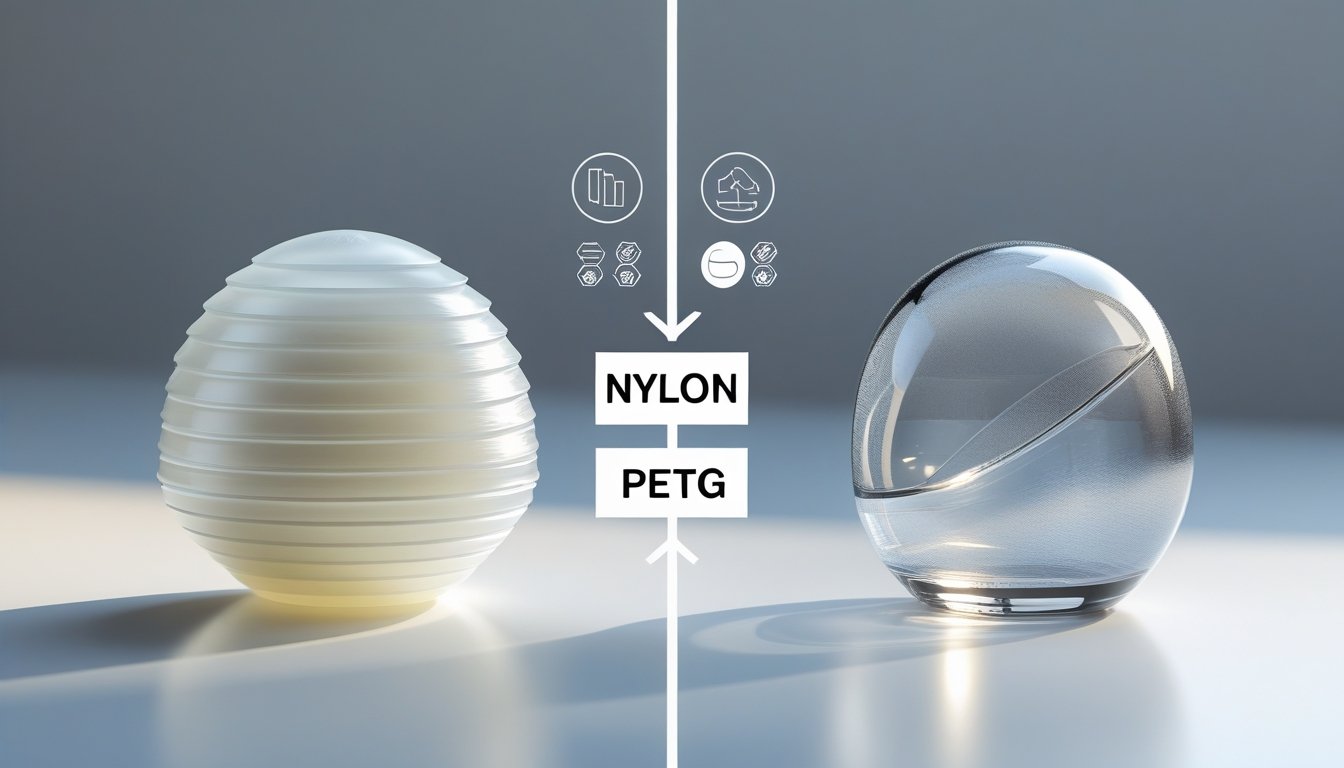
Understanding the nylon vs PETG material comparison helps you choose the right filament for demanding 3D printing projects. Both materials excel at functional parts, but they offer very different strengths, printing characteristics, and real-world performance.
Nylon delivers superior strength and wear resistance, making it ideal for mechanical components. PETG offers excellent chemical resistance and easier printing, perfect for general-purpose functional parts.
This guide breaks down the key differences between these two popular engineering filaments. You'll learn when each material shines, how their printing requirements differ, and which one fits your project's specific needs and budget.
Key Takeaways
- Nylon brings better wear resistance and flexibility for mechanical parts; PETG gives you solid toughness and is easier to print
- Nylon soaks up more moisture, so you need to store and dry it carefully. PETG is more forgiving in a typical workshop
- PETG is great for housings and brackets with a glossy look. Nylon fits gears, hinges, and anything that sees a lot of friction
Ready to tackle high-performance mechanical parts? Explore our nylon filaments collection for superior strength and wear resistance.
Key Properties of Nylon and PETG

Nylon and PETG are pretty different when it comes to toughness, temperature tolerance, and chemical stability. Nylon’s polyamide structure makes it tough and wear-resistant. PETG’s copolyester chemistry gives it balanced strength and reliable performance.
Strength and Durability Characteristics
Nylon (usually PA12 or PA6) stands out for high tensile strength and mechanical durability. Its semi-crystalline structure adds abrasion resistance and helps it survive repeated flexing. You’ll see nylon used for gears, hinges, and moving parts because it handles wear and sliding contact better than most.
PETG (polyethylene terephthalate glycol) is an amorphous copolyester that sits comfortably between PLA and ABS in terms of toughness. It holds up well structurally and sticks to itself nicely between layers. While PETG can’t quite match nylon’s abrasion resistance, it does the job for housings, brackets, and prototypes that just need to be strong and dependable.
|
Property |
Nylon (PA12/PA6) |
PETG |
|
Structure |
Semi-crystalline |
Amorphous |
|
Abrasion resistance |
High |
Moderate |
|
Fatigue behavior |
Excellent |
Good |
|
Layer adhesion |
Good (when dry) |
Very good |
Temperature and Chemical Resistance
Nylon melts around 180°C (for PA12), and its heat deflection temperature depends on the grade and any fillers. Some nylons can handle pretty warm conditions, but chemical resistance varies with the specific type and any additives.
PETG has a glass transition temperature of about 80°C. It stays stable in most household chemical environments. Since it’s amorphous, its thermal limits are about the glass transition, not a true melting point. PETG actually resists a lot of common solvents and cleaners better than nylon. Its heat resistance is fine for room temperature but don’t expect it to survive in hot car interiors or near engines.
- Nylon: higher heat deflection, interacts with moisture, chemical resistance varies
- PETG: moderate Tg (~80°C), strong chemical stability, predictable results
Flexibility and Impact Performance
Nylon is tough and flexible—especially when it’s picked up a bit of moisture. It absorbs energy and resists breaking even when flexed over and over. That makes it great for parts that bend, snap, or see a lot of mechanical load.
PETG gives you a nice mix of stiffness and impact strength. It’s less brittle than PLA but not as flexible as nylon, especially when nylon’s been exposed to humidity. PETG holds up well in normal workshop humidity. If you need even more stiffness, you can get PETG blends with glass or carbon fiber, though you’ll lose some impact performance.
Looking for reliable, easy-to-print functional materials? Browse our PETG filament collection for versatile performance at an affordable price.
Printing Nylon vs PETG

Nylon asks for higher nozzle temps and strict control over moisture, while PETG is more relaxed about storage and sticks to the bed without much fuss. Both need a heated bed, but nylon warps more, so you’ll have to take extra steps to keep it down.
Print Settings and Temperature Requirements
Nylon filament usually prints best between 240°C and 280°C, depending on the grade and whether it’s reinforced. Keep your print speed moderate—30 to 50 mm/s is typical—so the layers can fuse well. PETG filament prints at slightly lower temps, usually 230°C to 255°C, so it’s a bit easier on your printer’s hotend.
Heated beds really matter. Nylon likes a bed temp between 50°C and 80°C to fight warping. PETG does well with the bed at 70°C to 85°C, which helps it stick but doesn’t make it impossible to remove after printing.
Layer adhesion is a mixed bag. Nylon bonds strongly if it’s dry, but even a little moisture can ruin that. PETG is more forgiving and sticks well across a wider range of conditions, so you’ll get more predictable prints.
Moisture Sensitivity and Storage Needs
Here’s where things really split. Nylon is like a sponge—it’ll suck up water from the air fast. Even a little moisture causes bubbling, stringing, and weak prints. You have to store nylon in airtight containers with desiccant, and honestly, you’ll probably end up drying it before every print.
PETG can absorb moisture too, but it takes longer and won’t ruin your prints as quickly. Wet nylon prints look awful and fall apart. PETG might show some stringing if it’s wet, but it’s usually still usable.
If you print nylon often, a filament dryer is almost mandatory. Most people dry nylon at 70-80°C for 4-6 hours before printing. PETG can benefit from drying, especially if you live somewhere humid, but you’ll get away with a lot more before it causes real trouble.
Bed Adhesion and Warping Challenges
Nylon is notorious for warping, so you’ll probably use a glue stick, PVA glue, or a special build plate to keep it from lifting. As it cools, nylon contracts and pulls up at the corners, so you need to be ready for a fight.
PETG sticks to glass and PEI beds almost too well. Sometimes you’ll need a release agent, or you might risk chipping your build surface. Warping isn’t really a problem with PETG unless your settings are way off.
Support removal is a bit different, too. Nylon supports can be tough but usually snap off along the layer lines. PETG supports bond tightly, so they’re harder to remove, but you won’t get as much stringing between support and print. If you want to print nylon without warping, an enclosure helps a lot. PETG, though, prints just fine on an open-frame machine.
Best Applications for Each Material

Nylon is your go-to for tough, flexible parts that take a beating. PETG is better for general-purpose prints, especially when you want easy printing and don’t want to fight moisture. What you pick depends on what your part needs, your printer setup, and your budget.
When to Choose Nylon Over PETG
If your part will see repeated stress or impact, nylon is the clear winner. Its flexibility makes it perfect for gears, bushings, and mechanical parts that need to handle shock without snapping.
In industrial settings, nylon’s heat resistance and toughness pay off. Automotive parts like engine covers, brackets, and mounts hold up better under heat with nylon. It also handles friction much better than PETG, so it’s ideal for moving parts that wear down other plastics.
For tough prototypes—hinges, clips, flexible connectors—nylon is hard to beat. Its semi-crystalline structure shrugs off abuse. If you need an enclosure that stands up to chemicals or heat, nylon fits the bill, but you’ll need to manage its moisture sensitivity and warping.
When PETG is the Better Choice
PETG is the easy pick for prototypes and functional parts where you just want a hassle-free print. It’s great for beginners—less warping, fuss-free bed adhesion, and fewer surprises.
If your part will live outdoors, PETG wins. It doesn’t soak up water, so enclosures, mounts, and brackets exposed to the elements stay strong. You can skip the drying routine, too.
For medical or food-contact items, PETG is FDA-approved and can be sterilized without falling apart. That makes it a solid choice for containers and simple medical tools.
Need something that looks good? PETG prints with a shiny, clear finish and works well for transparent or colorful parts. It handles most mechanical jobs unless you need maximum flexibility or impact resistance.
Cost and Accessibility Considerations
PETG usually costs $20–$30 per kilo, so it’s easier on your wallet. Nylon runs $30–$60 per kilo, and reinforced blends can get pricey—up to $80 per kilo.
You’ll need different gear, too. PETG works fine with a standard hotend and doesn’t need an enclosure. Nylon needs an all-metal hotend, a heated bed, and ideally an enclosure to keep warping at bay.
PETG is easier to find and comes in more colors. Nylon’s less common, and you’ll spend more on storage—airtight bins and desiccant are a must if you want it to last between prints.
Need maximum durability for demanding applications? Discover our strong filament collection featuring the toughest materials for critical projects.
Conclusion: Nylon vs PETG
The nylon vs PETG material comparison shows that neither filament is universally better—each excels in different applications. PETG offers ease of printing and chemical resistance, while nylon delivers superior wear resistance and flexibility for demanding mechanical parts.
Your choice depends on your specific project requirements, budget, and printer capabilities. PETG suits most general functional needs with minimal hassle, while nylon tackles high-stress applications that require extra durability.
Want to explore even tougher materials for extreme applications? Check out our comprehensive guide on the strongest 3D printer filament to discover which materials can handle the most demanding projects.
Frequently Asked Questions: Nylon vs PETG
Each material brings its own strengths to FDM printing, and which one’s “stronger” depends on what kind of stress your part will see. PETG is better for chemical resistance and moisture stability, while nylon is unbeatable for wear resistance and low friction.
Which is stronger, nylon or PETG?
Nylon typically wins for toughness, energy absorption, and handling repeated impacts and flexing. PETG offers strong layer bonding with a balance of strength and flexibility, ideal for housings and brackets. Choose nylon for wear resistance and low friction, or PETG for chemical resistance and easier printing.
What are the disadvantages of PETG?
PETG has a lower glass transition temperature (~80°C) and can soften under heat and load. It tends to string more than other filaments if retraction settings aren't optimized. PETG also scratches easily and isn't ideal for moving parts due to higher friction compared to nylon.
What material is stronger than PETG?
Nylon surpasses PETG in toughness and wear resistance for high-impact or flexing applications. Polycarbonate offers greater tensile strength and heat resistance than PETG. Carbon fiber-reinforced filaments provide superior stiffness and dimensional stability under load.
What material is stronger than nylon?
Polycarbonate delivers higher tensile strength and better heat resistance than most nylon filaments. Carbon fiber nylon combines polyamide toughness with added rigidity while maintaining impact resistance. High-performance materials like PEEK and PEI exceed nylon's capabilities but require advanced printers with high-temperature nozzles and heated chambers.