

Picking the strongest 3D printer filament is one of the most important decisions you make before starting any functional print. Get it wrong and you end up with parts that crack under load, warp in the heat, or snap the first time they take an impact. Get it right, and your prints last for years in real-world conditions.
The strongest 3D printer filaments include polycarbonate, PEEK, nylon, and carbon fiber composites. But "strongest" does not mean the same thing for every project. A drone frame needs something different from a living hinge or a structural bracket.
This breakdown covers what each material actually does, who it is for, and when to upgrade to a reinforced version.
Key Takeaways
- Polycarbonate (PC) delivers the highest tensile strength and heat resistance for home printing
- Carbon fiber composite filaments offer the best strength-to-weight ratio for structural parts
- Nylon is the best choice for parts that need both toughness and flexibility
- PETG is the easiest strong filament to print, but Siraya Tech's PETG-CF adds carbon fiber reinforcement for matte finish, greater hardness, and significantly reduced warping
- ABS composites like Siraya Tech's ABS-CF, ABS-GF, and ABS-CF Core take a familiar material and make it genuinely performance-grade
- Print settings, wall count, and filament dryness matter as much as the material itself
- Siraya Tech offers engineering filaments, flexible TPU, engineering resins, and castable resin options for makers who need more than just one type of output
How Strength Is Measured in 3D Printer Filaments

Before comparing materials, it helps to understand what "strong" actually means in the context of 3D printing. There are three properties that matter most.
Tensile Strength
Tensile strength measures how much pulling or stretching force a material can handle before it breaks. It is measured in megapascals (MPa). A higher number means the part can hold more load before snapping. This matters most for hooks, brackets, cable ties, and any structural part that stays under constant stress.
Impact Resistance
Impact resistance describes how well a material absorbs sudden hits without cracking. Brittle materials shatter. Tough materials bend, absorb the energy, and stay intact. This is the property you need for drone frames, protective casings, gears, and anything that takes real-world abuse.
Layer Adhesion
Even the strongest filament produces a weak part if the layers do not bond correctly. Layer adhesion is affected by print temperature, cooling speed, layer height, and print speed. A print with poor layer adhesion acts more like a stack of paper than a solid block.
Strongest 3D Printer Filaments at a Glance
Here is a quick comparison of how the main contenders stack up across the properties that matter most for functional printing.
| Filament | Tensile Strength | Impact Resistance | Heat Resistance | Printability | Best For |
|---|---|---|---|---|---|
| Polycarbonate (PC) | Very High (65-75 MPa) | Excellent | HDT 110-130°C under load | Difficult | Structural parts, protective gear |
| PEEK | Highest (100+ MPa) | Very Good | Up to 250°C | Very Difficult | Industrial and aerospace use |
| Nylon (PA) | High (45-85 MPa) | Very Good | Up to 120°C | Moderate | Gears, bushings, living hinges |
| PETG-CF | High | Good | Up to 80°C | Easy-Moderate | Everyday functional parts |
| ABS-CF / ABS-GF | High | Good | Up to 100°C | Moderate | Housings, prototypes |
| ASA-GF | Moderate-High | Good | Up to 95°C | Moderate | Outdoor and UV-exposed parts |
| PPA-CF | Very High | Very Good | Up to 180°C | Moderate | Structural, high-load parts |
| TPU (flexible) | Moderate | Excellent | 60-80°C | Easy-Moderate | Gaskets, cases, dampeners |
| PLA | Moderate (50-70 MPa) | Poor | Up to 60°C | Very Easy | Decorative, low-stress parts |
The Strongest 3D Printer Filaments, Explained by Use Case

Polycarbonate (PC): Highest Tensile Strength for FDM Printing
Polycarbonate is widely recognized as one of the strongest filaments available to home users. It reaches tensile strengths between 65 and 75 MPa and can tolerate temperatures approaching 140°C (its glass transition), with heat deflection under load typically in the 110-130°C range.
PC is optically clear when printed well, which makes it useful for light pipes, protective shields, and electrical housings. It does not crack easily under impact, and it holds its shape under heat that would soften most other materials.
The tradeoff is that PC is demanding to print. It needs hotend temperatures of 270 to 310 degrees Celsius, a heated bed at 90 to 110 degrees, and ideally a fully enclosed chamber to prevent warping. Without an all-metal hotend, polycarbonate is not a practical option.
Best for: functional prototypes, automotive components, electrical housings, protective gear.
Nylon (Polyamide): Best for Toughness and Fatigue Resistance
Nylon ranks near the top of the strongest 3D printer filament list because of its combination of tensile strength, flexibility, and fatigue resistance. It can bend repeatedly without snapping, making it the material of choice for living hinges, gears, and bushings.
Its self-lubricating surface means nylon parts work well wherever two surfaces rub against each other. It also resists oils, solvents, and chemicals that would degrade materials like PLA.
The main challenge with nylon is moisture. It absorbs water from the air rapidly, and wet nylon prints with bubbles, poor layer adhesion, and significantly reduced strength. Dry nylon at 60 to 80 degrees Celsius for 8 to 12 hours before printing, and keep it in a sealed dry box during the print.
Best for: gears, sliding mechanisms, bushings, living hinges, parts that need to flex under load.
PETG and PETG-CF: The Best Everyday Strong Filament
PETG is the most accessible of the strong filaments. It prints reliably on most FDM printers at 230 to 250 degrees Celsius, sticks well to glass and PEI beds, and offers better impact resistance, layer adhesion, and heat tolerance than PLA, though PLA can have slightly higher raw tensile strength. It also produces far less warping than ABS.
Standard PETG is not something Siraya Tech stocks directly, but the carbon fiber-infused version tells a different story. Siraya Tech's PETG-CF Pro shares PETG's core properties, including its chemical resistance and ease of printing, while adding a matte finish, greater surface hardness, and noticeably reduced warping.
The carbon fiber reinforcement also stiffens the part so it resists flex under load. For Peopoly setups, the Peopoly Lancer PETG-CF HF Filament (manufactured by Siraya Tech) is worth considering for high-flow printing at speed.
Best for: mechanical parts, brackets, containers, protective cases, any print that needs more than PLA can offer.
ABS and ABS Composites: A Classic Material Made Better
ABS has been a staple of functional 3D printing for years. It handles temperatures above 80 degrees Celsius, machines and sands well, and offers decent impact resistance. The issue has always been warping and fumes during printing.
Composite versions solve most of ABS's original weaknesses. Here is how Siraya Tech's ABS composite lineup breaks down:
| Filament | Reinforcement | Key Advantage | Nozzle Required |
|---|---|---|---|
| ABS-CF | Carbon fiber | Greater stiffness and dimensional stability | Hardened steel |
| ABS-GF | Glass fiber | Improved heat resistance at lower cost than CF | Hardened steel |
| ABS-CF Core | Carbon fiber core | More efficient load distribution through the filament strand | Hardened steel |
Best for: functional housings, engineering prototypes, heat-exposed parts, structural brackets.
ASA and ASA-GF: Outdoor Durability with Fiber Reinforcement
ASA is the outdoor version of ABS. It resists UV degradation, which means parts hold their color and mechanical properties under direct sunlight far longer than ABS or PETG.
Siraya Tech's ASA-GF adds glass fiber to ASA's already solid outdoor performance, improving stiffness and heat resistance. This is a strong option for brackets, enclosures, and structural parts used outside or near windows.
Best for: outdoor fixtures, garden tools, enclosures, automotive exterior components.
Carbon Fiber and Glass Fiber Composites: Maximum Strength-to-Weight
Composite filaments pair a base material like PET, PPA, or nylon with chopped carbon or glass fibers. The result is a printed part that is dramatically stiffer than the base material, often with improved dimensional stability, though impact toughness can sometimes decrease as the parts become more brittle under sudden loads.
| Filament | Base Material | Reinforcement | Best Application |
|---|---|---|---|
| PET-CF | PET | Carbon fiber | Stiff, lightweight structural parts |
| PET-GF | PET | Glass fiber | Cost-effective composite strength |
| PPA-CF | PPA (Nylon-based) | Carbon fiber | High-load, high-temp structural parts |
| PPA-CF Core | PPA (Nylon-based) | Carbon fiber core | Maximum stiffness with efficient fiber placement |
| PPA-GF | PPA (Nylon-based) | Glass fiber | Heat-resistant, tough structural parts |
Every composite filament requires a hardened steel nozzle. The reinforcing fibers will destroy a standard brass nozzle within a single spool.
Best for: drone frames, robotic components, automotive parts, manufacturing jigs and fixtures.
TPU: Strength Through Flexibility
TPU is not the strongest filament in tensile terms, but it excels at a different kind of strength: impact absorption and tear resistance. TPU can stretch significantly and return to its original shape, absorbing hits that would shatter rigid materials entirely.
Siraya Tech's Flex TPU line covers a range of hardness levels for different applications:
| Filament | Hardness | Best Use |
|---|---|---|
| TPU 85A | Soft (85A) | Grips, gaskets, phone cases, wearables |
| TPU 95A | Medium (95A) | Functional flex parts, protective covers |
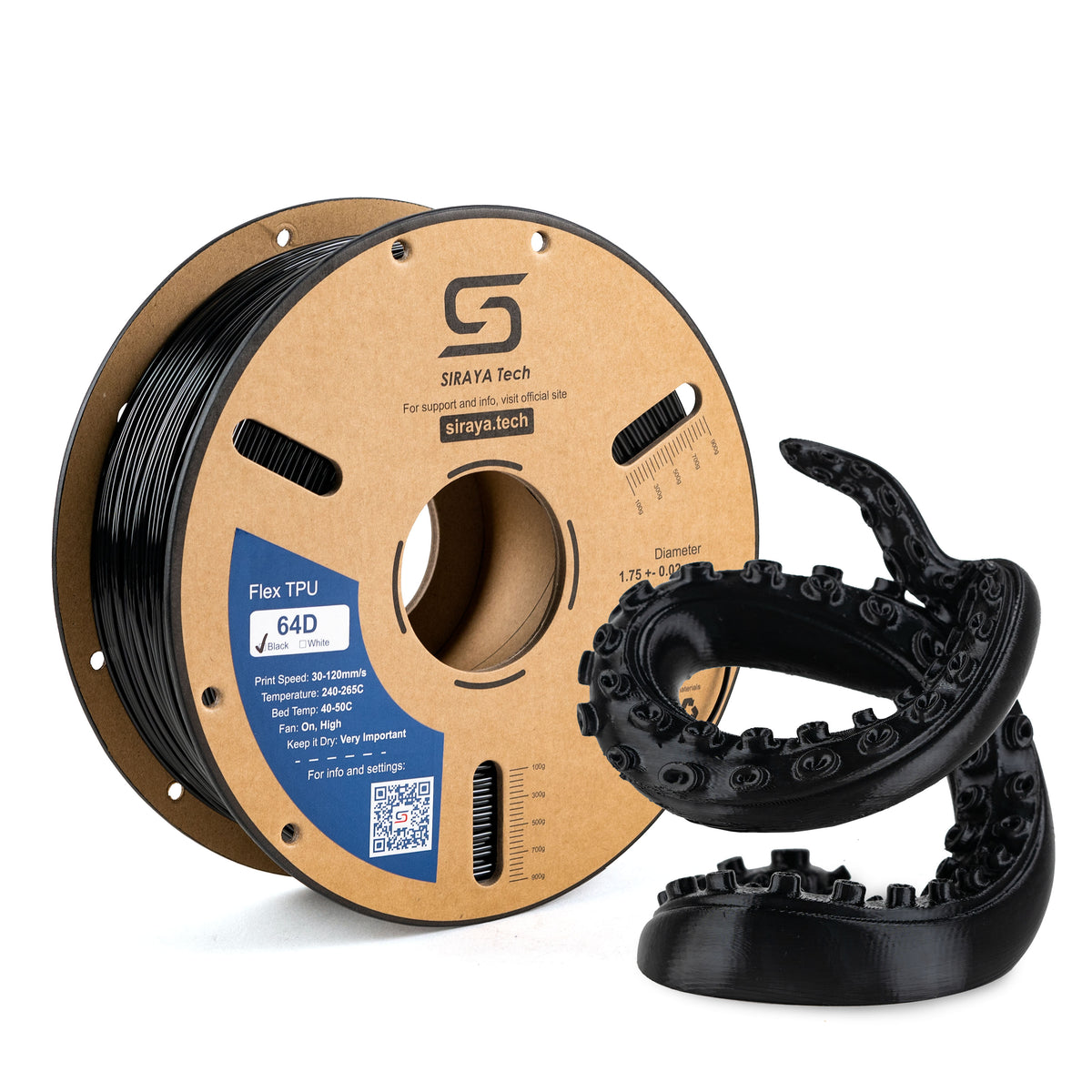
| TPU 64D | Semi-rigid (64D) | Hard-flex parts that still need some give |
| TPU Air 65A-82A | Variable (foaming) | Lightweight cushioning, shoe midsoles |
| TPU-GF | Reinforced flex | Abrasion-resistant flexible parts |
Best for: phone cases, vibration dampeners, gaskets, shoe insoles, protective bumpers.
Siraya 3D Filaments and Resin You May Shop
Explore More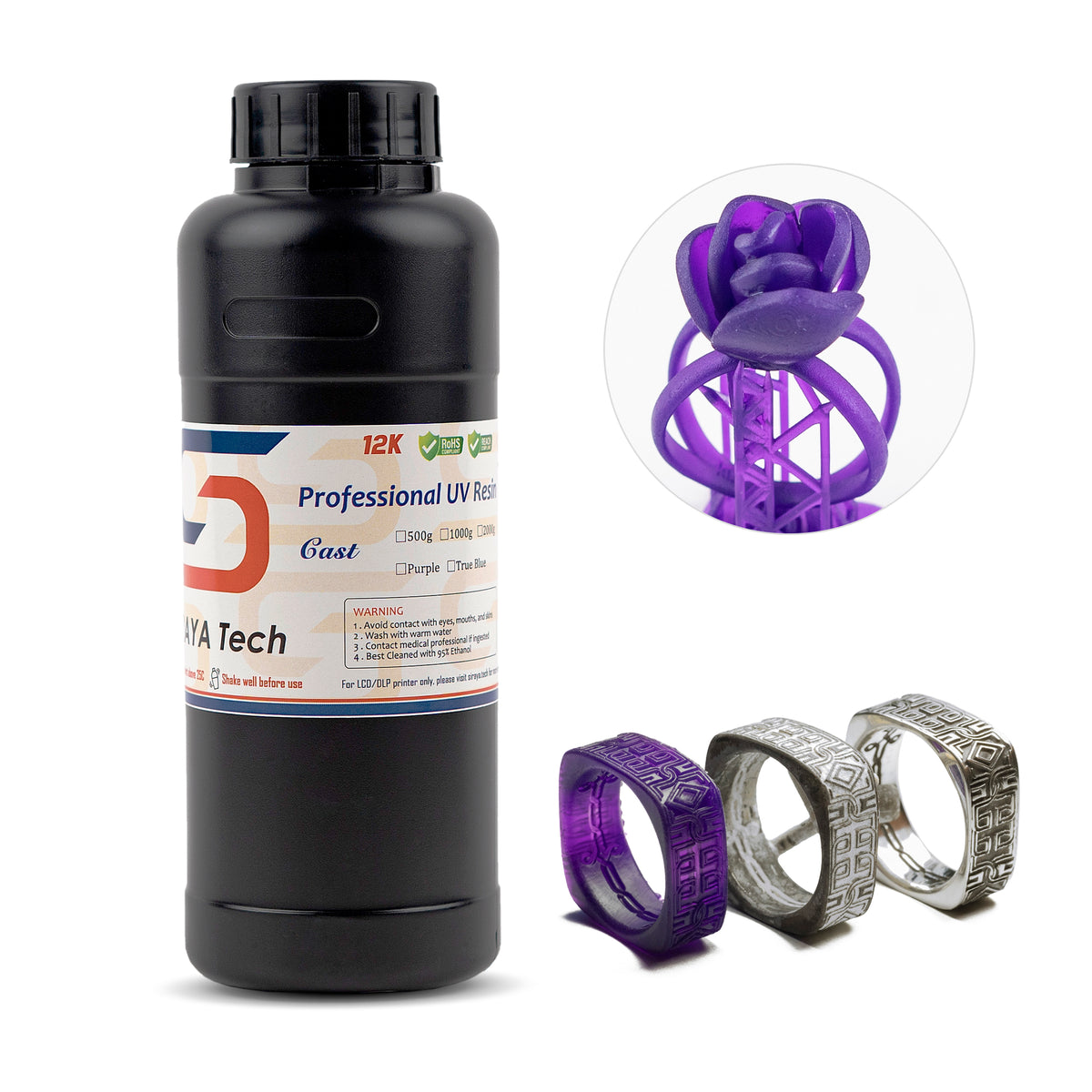

Printer Requirements for High-Strength Filaments
Stronger materials generally ask more of your printer. Here is what to check before committing to an engineering filament.
Temperature Requirements by Filament
| Filament | Hotend Temp | Bed Temp | Enclosure Needed |
|---|---|---|---|
| PLA | 190-220°C | 45-60°C | No |
| PETG / PETG-CF | 230-250°C | 70-85°C | Recommended |
| Nylon / PPA | 250-270°C | 80-100°C | Yes |
| ABS / ABS-CF / ABS-GF | 230-260°C | 90-110°C | Yes |
| ASA / ASA-GF | 240-260°C | 90-110°C | Yes |
| Polycarbonate | 270-310°C | 90-110°C | Yes |
| PEEK | 360-400°C | 120-150°C | Yes (heated chamber) |
| TPU | 220-240°C | 30-60°C | No |
Nozzle and Hardware Requirements
Any filament containing carbon fiber or glass fiber will abrade a standard brass nozzle within a single spool. Hardened steel is the minimum for composite filaments. Ruby-tipped nozzles last longer and suit the highest-volume printing.
Flexible filaments like TPU work best with direct drive extruders. The short path from gear to hotend prevents the material from bunching inside a Bowden tube during printing.
Drying Requirements by Filament
| Filament | Drying Temp | Drying Time |
|---|---|---|
| Nylon / PPA | 60-80°C | 8-12 hours |
| Polycarbonate | 70-80°C | 6-8 hours |
| ABS / ABS-CF / ABS-GF | 60-70°C | 4-6 hours |
| PETG / PETG-CF | 45-55°C | 4-6 hours |
| TPU | 50-60°C | 4-6 hours |
Print Settings That Directly Affect Filament Strength
The material sets the ceiling. Your slicer settings determine how close you get to it.
| Setting | Recommendation | Why It Matters |
|---|---|---|
| Wall count (perimeters) | 4 to 6 walls | Outer walls carry most of the load; more walls builds a stronger shell |
| Infill percentage | 40 to 60% | Diminishing returns above 60%; 100% can cause heat buildup |
| Print orientation | Align layers with expected force direction | Layer lines are the weakest point in any FDM print |
| Print temperature | 5°C above minimum recommendation | Improves layer bonding and adhesion between layers |
| Print speed | Slower for engineering filaments | More time for layers to bond and heat to distribute evenly |
Beyond Filament: When Resin or Silicone Makes More Sense
Some applications fall outside what any FDM filament can reliably produce. Fine detail, flexible mold-making, and high-resolution functional parts often point toward resin or silicone instead.
Siraya Tech's engineering resins cover a range of functional needs. The Tenacious flexible resin is built for parts that need to bend and snap back without cracking. The Blu tough resin handles impact well while maintaining sharp surface detail. For applications that require metal casting from a 3D printed pattern, the Cast castable resin burns out cleanly for lost-wax processes.
For mold-making and over-molding applications, Siraya Tech's Defiant silicone (available in Shore 15 and Shore 25 hardness) gives soft, durable, tear-resistant results that no filament can replicate.
Check Out These Collections
FAQs About the Strongest 3D Printer Filaments
Is PETG stronger than PLA?
PETG offers better impact resistance, layer adhesion, and heat tolerance than PLA, though PLA can actually have slightly higher raw tensile strength in many cases. PLA is more brittle and more likely to crack under sudden stress or elevated temperatures. If your part needs to survive drops or hold shape under heat, PETG is the better choice. Siraya Tech's PETG-CF takes that further by adding carbon fiber for harder, stiffer results with a matte finish.
Is carbon fiber filament stronger than nylon?
It depends on the base material. Carbon fiber PLA is still weaker than pure nylon. Carbon fiber nylon such as PPA-CF typically outperforms standard nylon in stiffness and dimensional stability, but nylon holds an edge for flexible, fatigue-resistant applications.
Which filament is best for impact resistance?
TPU leads for raw impact absorption due to its rubber-like flexibility. Nylon and PETG are strong performers for rigid impact-resistant parts. ABS composites also do well. PLA is the weakest choice for impact-heavy applications.
Is ABS or PETG stronger?
PETG typically has higher tensile strength than ABS, while ABS often performs better in impact resistance and high-heat environments. PETG also prints with fewer warping issues and is generally easier to work with. If you need ABS-level heat resistance with better mechanical properties, Siraya Tech's ABS-GF and ABS-CF are worth evaluating over standard ABS.
Does higher print temperature make filament stronger?
Slightly higher temperatures improve layer bonding and can meaningfully boost part strength. The gains come from better layer adhesion rather than any change in the material itself. Going too hot introduces stringing and poor surface finish. Increase temperature in 5-degree increments and test between each change.