
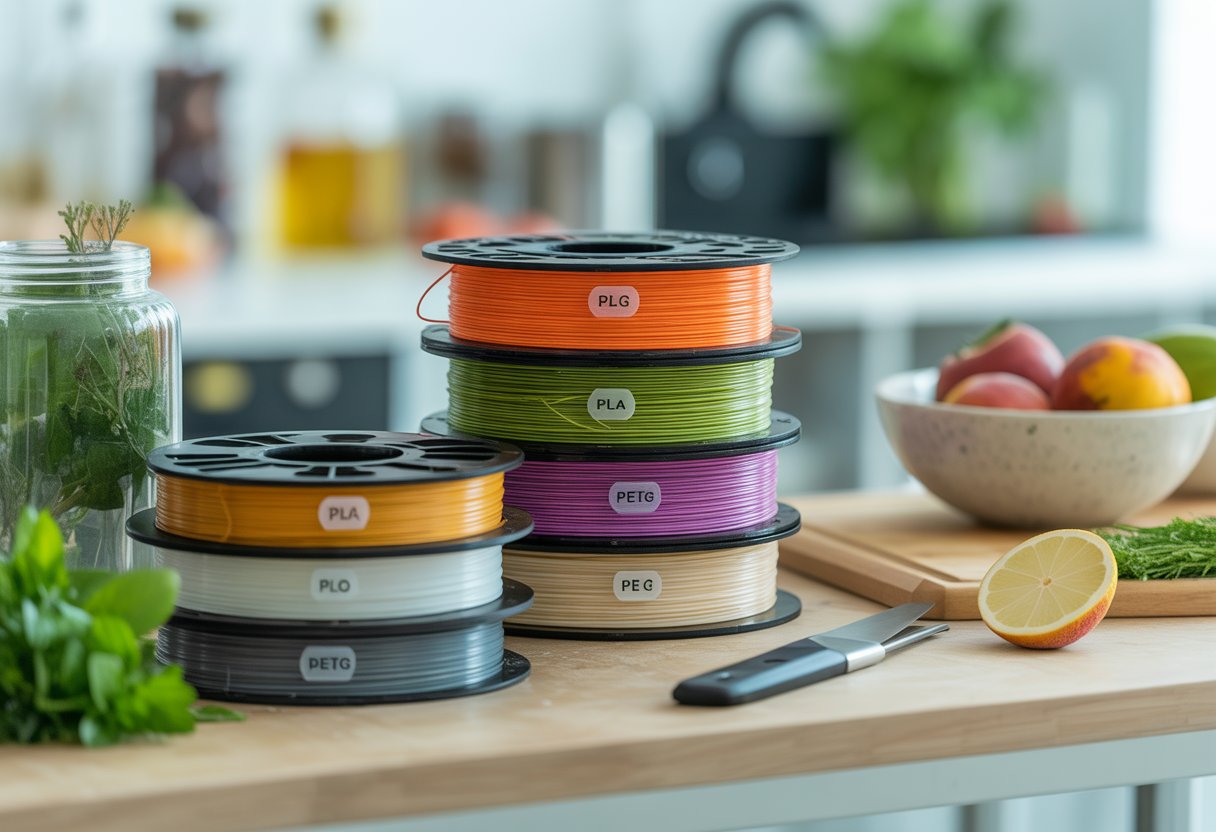
Food safe filament is a type of 3D printing material designed to be safe when it touches food, but not all filaments labeled as food-safe actually meet the same safety standards. The safety of your printed item depends on the base material, any extra chemicals added, how you print it, and what happens after printing. PLA-based filaments are the most common food-safe option, but the way you print them and the final surface texture are just as important as the material itself.
Making kitchen items with a 3D printer sounds cool, but you need to know the facts before you start. Your printed spoon or cookie cutter might look perfect, but tiny holes in the surface can trap bacteria and make people sick. The printing process creates rough surfaces that are hard to clean completely.
Understanding which filaments work for food contact and how to use them correctly keeps you and others safe. Read on to learn which materials you can trust and how to print food-safe items the right way.
Key Takeaways
- Food-safe filament must have safe base materials, proper certifications, and be printed in ways that prevent bacteria growth
- PLA is the most popular choice but needs smooth surfaces and proper care to stay safe for food contact
- Your printing method and how you finish the surface are just as important as picking the right filament material
Food-safe prints need durability to withstand cleaning and daily use. Check out our strong filament collection to find materials that balance safety with mechanical performance for functional kitchen items.
What Does Food-Safe Filament Actually Mean?

The terms "food-safe" and "food-grade" are often used in 3D printing, but they mean different things. Understanding these labels and the rules behind them helps you make smart choices about which filaments are actually safe to use with food.
The Difference Between Food-Grade and Food-Safe
Food-grade means the raw material itself is approved for food contact. For example, the plastic resin used to make the filament comes from the same material used in food containers or water bottles.
Food-safe means the final printed object won't contaminate your food. A filament can be food-grade, but your printed part might not be food-safe.
3D printers create tiny gaps and grooves between each layer. Bacteria can hide in these spaces and grow. Even worse, your printer's brass nozzle might have lead in it, which can leak into your print.
Regulatory Standards for Food Contact Materials
In Europe, Regulation (EC) No 1935/2004 sets the rules for materials that touch food. These materials can't transfer harmful chemicals into food or change how food tastes or smells.
The FDA handles food contact rules in the United States. They keep a list of approved substances for food packaging. Just because a plastic is on this list doesn't mean every filament made from it is safe to use.
NSF/ANSI 51 is another important standard. It focuses on materials used in commercial food equipment. Some filaments, like certain nylon products, carry this certification.
Understanding Certification Labels
When you see "food-safe" on a filament package, look for specific details. Does it list which standards it meets? Does it show test results or certification numbers?
Many filaments claim to be food-safe just because they're made from PLA or PETG. But these claims don't mean much without proper testing. The manufacturer needs to prove their specific product is safe, not just the base material.
Real certifications include:
- FDA compliance letters with specific regulation numbers
- NSF/ANSI 51 certification from an accredited lab
- EU 10/2011 compliance for plastic materials
Watch out for vague terms like "made from food-grade materials" without backup documentation.
Read our article on PETG vs PLA: Which Filament Is Best for 3D Printing? to understand which material suits your specific food-contact needs.
Types of Food-Safe 3D Printing Filament

Not all 3D printing filaments work safely with food. PLA is the most common choice because it's made from plant materials, PETG offers better heat resistance, and PP filament matches what many food containers use.
PLA and Food-Safe PLA
PLA is one of the easiest filaments to print with. It's made from corn starch or sugarcane, which sounds safe. But regular PLA from the store isn't always food-safe.
The problem is what gets added to the filament. Companies mix in colors, stabilizers, and other chemicals that might not be safe for food contact. Some PLA also contains recycled materials that could have contaminants.
Food-safe PLA is different. These special filaments use virgin materials with no recycled content. They only use additives that meet FDA standards. The companies test their filaments to make sure they're safe.
Even with food-safe PLA, you need to be careful. The tiny layers in 3D prints create small gaps where bacteria can grow. Use these prints for single-use items or dry foods only.
PETG and Food-Grade Variants

Fibreheart™ PETG-CF Pro Filament
PETG is the same basic material used in water bottles and food containers. It handles heat better than PLA, which makes it useful for items that need washing or hold warm foods.
Standard PETG might be food-safe in its raw form, but the filament version can have added chemicals. Look for food-grade PETG that's specifically labeled and tested for food contact.
This filament type is stronger than PLA. It can bend without breaking, which helps for containers and lids. PETG also resists moisture better, so it won't break down as fast when wet.
The printing temperature for PETG is higher than PLA. Make sure your nozzle and hotend are clean before printing anything for food use.
Check out our guide, What Is PETG Filament: A Guide in 3D Printing Applications to learn how to use this material safely.
PP Filament for Food Contact

Siraya Tech Fibreheart PPA Filament
PP filament is made from polypropylene, the same plastic in many food storage containers and bottle caps. It's naturally resistant to chemicals and can handle being washed multiple times.
This material is tough to print with. It shrinks as it cools and doesn't stick well to print beds. You'll need to adjust your printer settings and possibly use special surfaces.
PP filament works well for food storage because it doesn't absorb moisture or odors. It can handle both hot and cold temperatures without breaking down. Many yogurt containers and medicine bottles use this same material.
The main challenge is finding PP filament that's certified food-safe. You need virgin material with no additives except approved ones. Always check if the manufacturer provides food safety certification for their specific filament.
Printer compatibility affects your ability to use certified food-safe materials. Read our article: Do All 3D Printers Use the Same Filament? to understand equipment limitations before starting food-contact projects.
Evaluating Safety: Filament Additives, Printing Processes, and Certification

Food-grade filament isn't safe just because the base plastic is approved for food contact. The colorants and additives mixed into the filament, plus what happens during printing, determine whether your finished part is truly safe to use with food.
Risks from Additives and Fillers
The base polymer might be food-safe, but companies add other things to filament that can cause problems. Colorants give filament its bright colors. Heat stabilizers help the plastic melt smoothly. Some makers use recycled plastic to lower costs.
These extra ingredients can leak into your food. A white PLA filament might use titanium dioxide for color. A red PETG could contain pigments with heavy metals. You won't know what's inside unless the maker lists every additive.
If you previously printed with a different filament, residue stays in your nozzle. That old material mixes with your new food-safe filament and ruins it. Even a tiny bit of leftover ABS or colored PLA can contaminate your print.
You need virgin filament with no recycled content. The maker should list every additive and colorant on their data sheet. Natural or clear filaments have fewer additives than bright colors, which makes them safer for food contact.
Verifying Manufacturer Data Sheets
A data sheet tells you what's actually in the filament. Look for a technical data sheet or material safety data sheet from the company. These papers list the base polymer, additives, colorants, and any test results.
Check if the filament meets NSF/ANSI 51 standards or similar food-contact rules. Real certification means an outside lab tested the material. Some companies just say "food safe" without any proof.
The data sheet should include migration testing results. This test measures how much material moves from plastic into food. It should also show heavy metal testing to prove the filament doesn't contain lead, cadmium, or other toxic metals.
If a company won't share their data sheet, don't trust their filament for food use. You need written proof, not just marketing claims on the package.
Understanding Migration and Heavy Metal Testing
Migration testing shows how much plastic and additives transfer into food. Labs put the material in contact with food simulants like water, oil, or acid. They measure what comes out of the plastic after hours or days.
Food-grade filament should pass migration limits for your country. In the US, the FDA sets these rules. In Europe, different limits apply. The test needs to match how you'll actually use the part.
Heavy metal tests look for toxic elements in the filament. Lead and cadmium show up in some colored plastics. Even small amounts can build up in your body over time and cause health problems.
Your filament should have test reports showing heavy metal levels below legal limits. Without these tests, you're guessing whether the material is safe.
Check out our 1.75mm filament collection for products that improve both print quality and food safety.
Best Practices for Food-Safe 3D Printing Projects
Getting your print settings right and keeping your equipment clean matters just as much as picking the right filament. Using a food-safe coating after printing helps seal up those tiny cracks where bacteria can hide.
Choosing Appropriate Print Settings
Your print settings make a big difference in how safe your printed items will be. Higher layer heights create bigger gaps between layers where food and bacteria can get stuck. Use smaller layer heights to make smoother surfaces with fewer cracks.
Print at higher temperatures if your filament allows it. This helps the layers stick together better and leaves fewer gaps. A nozzle made from stainless steel is better than brass for food safe 3d printing because brass can contain lead.
Use a direct drive extruder if you can. This setup gives you better control and more consistent prints. Set your infill to 100% for items that touch food directly. Hollow spaces inside your print can trap moisture and grow bacteria.
Print slowly to get better layer adhesion.
Sealing and Post-Processing with Food-Safe Coatings
Even the best prints have tiny ridges and gaps that can trap food particles. A food-safe coating seals these spaces and makes your printed items much safer to use.
Food-grade epoxy resin is one of the most popular options. You apply it to your finished print and let it cure completely. This creates a smooth, waterproof barrier over the layer lines. Make sure you pick an epoxy that says it's FDA compliant or food contact safe.
Another option is food-safe polyurethane. It works like epoxy but goes on thinner. You might need several coats to fully seal your print.
Always follow the coating instructions carefully. Let it cure for the full recommended time before using the item with food. Some coatings need 72 hours or more to become fully food safe.
Maintaining Clean Equipment
Your 3D printer needs to be clean before you start any food safe 3d printing projects. Old filament stuck in your nozzle can contaminate your new print.
Do a cold pull before printing food-safe items. Heat your nozzle to printing temperature, then let it cool slightly. Pull the filament out quickly to remove leftover material from previous prints.
Clean your build plate with soap and water between prints. Oils from your hands or residue from other projects can transfer to your food-safe prints.
Check your nozzle regularly for wear. Replace it if you see any damage or buildup you can't remove. Keep a separate nozzle just for food-safe prints if possible.
Store your food-safe filament in a sealed container away from other materials. This keeps it clean and dry until you're ready to use it.
Browse our 3D printer filament collection to compare properties and find the right balance of safety and printability.
Common Applications and Limitations of Food-Safe 3D Printed Kitchenware
3D printed kitchenware works well for some uses but has serious limits for others. The type of food contact and how long the item touches food makes a big difference in whether it's safe to use.
Kitchen Utensils and Short-Term Food Contact
You can use 3D printed items for quick food contact, like cookie cutters and cake toppers. These items touch food for just a few seconds or minutes.
Short-term contact items include:
- Cookie cutters
- Cake decorating stencils
- Fondant stamps
- Food molds (if cleaned properly)
The key is that food doesn't sit on the printed surface for long. This gives bacteria less time to grow in the tiny cracks between print layers.
Even with these items, you need to be careful. The small gaps in 3D printed surfaces can still trap food bits. Wash these items right after use and let them dry completely.
Don't reuse items that touched raw meat or eggs. The bacteria risk is too high.
Items for Prolonged Use or Hot Food
Don't use regular 3D printed items for hot food or drinks. Heat can make plastic filaments release harmful chemicals into your food.
Storage containers and water bottles are also risky. When food or liquid sits on a 3D printed surface for hours, bacteria can grow in the layer lines. These tiny spaces are almost impossible to clean well.
Most food safe 3D printing filaments can't handle dishwasher heat. High temperatures will warp or melt your printed items. Hand washing doesn't get deep enough into the microscopic cracks to remove all the bacteria.
Items you should avoid making with 3D printing:
- Water bottles
- Coffee mugs
- Food storage containers
- Cutting boards
- Plates and bowls for regular meals
Alternative Approaches: Molding and Liners
The safest way to use 3D printed kitchenware is with barriers between the print and your food. You can print a mold, then pour food-grade silicone into it to make the final item.
This method lets you design custom shapes while keeping food away from the printed surface. The silicone piece that touches food is smooth and safe.
Another option is using food-safe liners. Print a container, then put a plastic bag or parchment paper inside before adding food. The liner protects food from touching the printed layers.
You can also coat 3D prints with food-safe epoxy resin. This fills in the layer lines and creates a smooth, cleanable surface. Make sure you use only FDA-approved coatings designed for food contact.
Different materials offer different safety levels for food contact. Read our article, 3D Filament Types: Complete Guide for Every 3D Project, and learn which materials work best for kitchen applications.
Wrap Up
Food-safe 3D printing requires more than just picking the right filament. You need certified materials like food-grade PLA or PETG, clean equipment, proper print settings, and appropriate coatings to seal layer lines.
Even with perfect materials, surface texture and post-processing determine whether your prints are truly safe for food contact. Short-term use items like cookie cutters work well, while containers for prolonged contact need extra care.
Siraya offers high-quality filaments engineered for consistent extrusion and reliable performance. Whether you're printing functional parts or creative kitchen projects, Siraya's tested materials deliver the dependable quality you need for safer, more successful prints.
Frequently Asked Questions
Which 3D printing materials are safe for making kitchen gadgets?
PLA is your best bet for kitchen items. It's made from plant materials like corn starch and is non-toxic. PETG is another good choice because it's the same plastic used in water bottles.
Some companies make special food-safe versions of these filaments. They don't add colors or chemicals that could get into your food. Regular colored filaments might have additives that aren't safe to eat.
ABS is not a good pick for kitchen stuff. It can release harmful fumes and isn't meant for food contact.
How do I tell if a 3D printed container can hold my snacks without being sketchy?
Check if the filament says "food safe" or "food grade" on the package. But that's just the first step.
Look at the surface of your printed container. If you see tiny gaps between the layers, bacteria can hide in those spaces. That makes it unsafe for food even if you used safe filament.
The nozzle and printer parts matter too. If your printer made other projects with random filaments, leftover bits could mix into your food container.
Can you give me the lowdown on coatings to make 3D prints okay for food?
Food-safe epoxy resin can seal up those tiny layer lines. You brush it on and let it cure completely. This creates a smooth surface where bacteria can't hide.
Make sure the coating says it's FDA approved or food safe. Regular epoxy might have chemicals you don't want near your food.
The coating needs to cover every part that touches food. Any missed spots are still porous and unsafe.
Hey, got any tips for printing stuff I can actually eat off?
Use a brand new nozzle that's only for food-safe prints. Brass nozzles can have lead, so stainless steel is better.
Print with a thicker layer height to reduce the number of layers. Fewer layers means fewer gaps for germs to hide.
Design your item with smooth surfaces instead of lots of details. Complex shapes have more places for bacteria to grow.
Clean your print bed well before starting. Any dust or leftover filament can end up in your print.
Is it cool to pop my 3D printed cup in the dishwasher, or is that a no-go?
Most 3D printed items can't handle dishwashers. The hot water will warp and melt them.
PLA starts to get soft around 140 degrees Fahrenheit. Your dishwasher gets hotter than that.
Hand wash your printed items with warm soapy water instead. Don't use super hot water or scrub too hard.
What's the deal with food grade certifications for 3D printing filaments?
Food grade means the base plastic is approved for food contact. Companies get this certification by testing their filament to make sure it doesn't contain harmful chemicals.
Look for certifications like FDA approval or EU food contact compliance. These show the filament passed safety tests.
However, certified filament alone doesn't guarantee your printed object is safe. The printing process, printer cleanliness, and surface texture also affect safety. Certification is only one part of making safe items.