
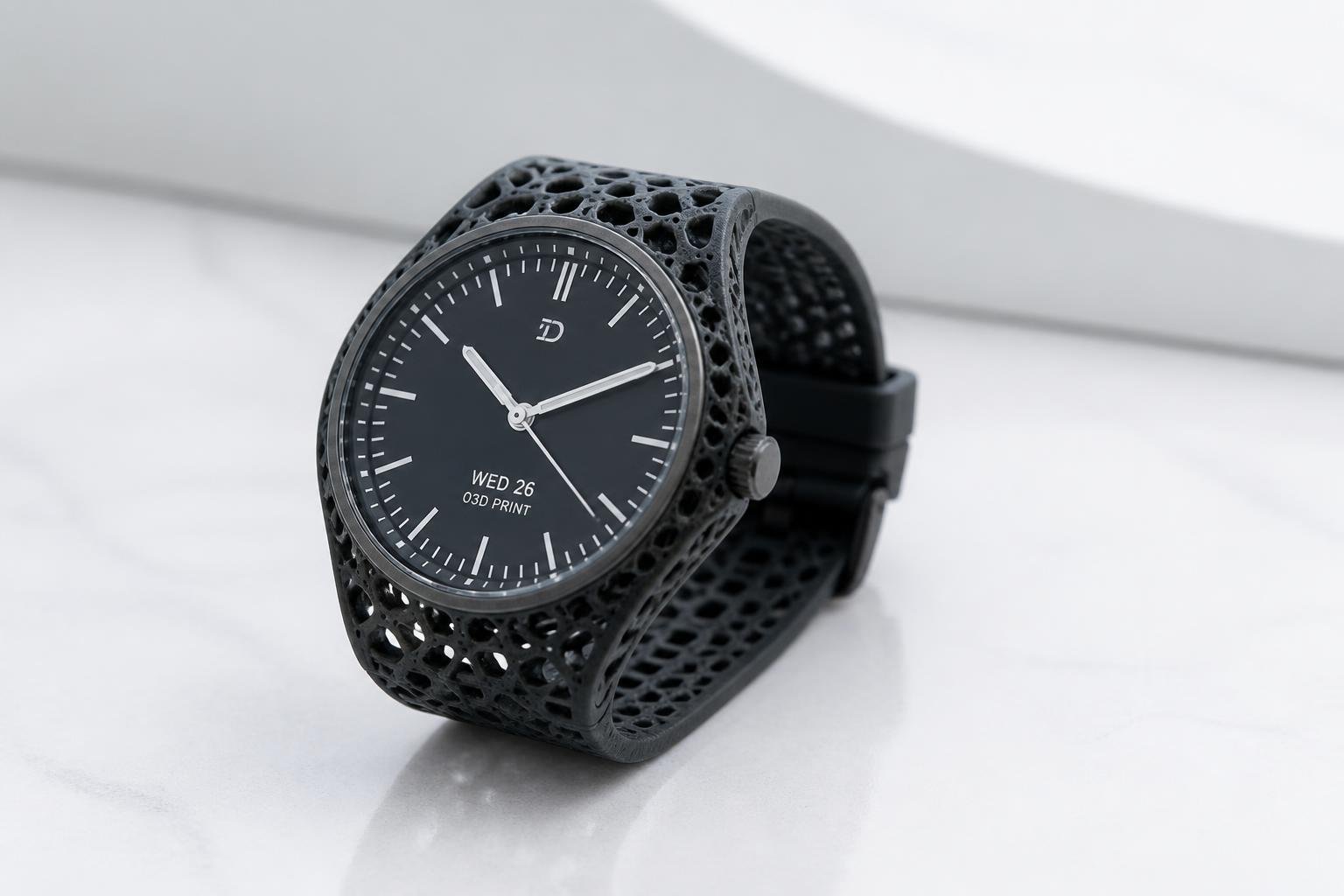
3D printing covers the external components of a watch. The movement that actually keeps time is a precision device you'll purchase separately — but everything you see and touch can be made exactly to your spec.
This guide walks through materials, movements, design tips, and finishing techniques for building a watch you'll actually wear.
- Best for cases: Resin printers produce the smoothest, most detailed watch cases. FDM works best for bands.
- Best for bands: TPU is the ideal material — flexible, comfortable, and durable against daily wear.
- Movements: Standard quartz movements ($5–15) are easy to install in custom 3D printed cases.
- Wall thickness: Case walls need at least 1.5–2mm for structural integrity around the movement cavity.
- Post-processing matters: Sanding, coating, and painting transform a basic print into a polished wearable.
- Go modular: Modular designs let you swap cases, bands, and dials for endless customization.
What You Can 3D Print (and What You Can't)
3D printing covers the external components of a watch. The internal movement — the mechanism that actually keeps time — is precision-engineered and can't be replicated with consumer printers.
What You Can Print
- Watch cases, bezels, dials, chapter rings, and cosmetic crowns
- Bands, straps, and buckle bodies
- Display stands and charging docks
What You Need to Buy
- Quartz or mechanical movement
- Watch hands
- Crystal (glass cover)
- Crown stem, spring bars, and pin buckle hardware
Miyota quartz movements are the most popular for DIY watch projects. They're accurate, inexpensive ($5–15), and widely available. Standard sizes like the Miyota 2035 fit many open-source 3D printed case designs.
Choosing Materials for Each Watch Component

Watch Cases
Cases need precision, surface quality, and structural integrity. Resin printing produces the best results here — it captures fine details, smooth surfaces, and tight tolerances that FDM printers can't match.
A resin-printed case can be sanded and coated to look nearly indistinguishable from injection-molded plastic. For FDM-printed cases, PETG or ABS work well at 0.1mm layer height. ABS cases can be vapor-smoothed with acetone for a glossy finish.
Watch Bands
TPU filament is the clear winner for bands. It's flexible, comfortable against skin, and durable enough for daily wear.
Shore 85A TPU gives a soft, rubbery feel ideal for wearables. Shore 95A is stiffer and easier to print — a good choice for structured band designs with geometric patterns or ventilation holes. Siraya Tech's Flex TPU filaments have ISO 10993 biocompatibility test data available, which matters for something worn against your skin all day.
Dials and Bezels
Resin printing shines here too. Detailed markers, indices, and text on a watch dial require the sub-millimeter resolution that LCD/DLP resin printers deliver.
Print in white and paint by hand for a traditional look, or use a high-detail model resin in the color of your choice. Browse Siraya Tech's 3D printing resins for options suited to fine-detail work.
Designing a Wearable Watch Case
A 3D printed watch case needs to protect the movement, hold the crystal securely, and sit comfortably on the wrist. Here are the design parameters that matter.
Wall Thickness
Case walls should be at least 1.5–2mm around the movement cavity. Thinner walls risk cracking when tightening the caseback or inserting spring bars. The movement seat should fit snugly with 0.1–0.15mm tolerance per side.
Lug Width
Match lug width to standard strap widths: 18mm, 20mm, or 22mm. This lets you use off-the-shelf spring bars and swap in a commercial strap anytime.
Crystal Seat
Design a 0.5mm deep channel that holds an acrylic crystal disc firmly via press-fit. For waterproofing — which is difficult with 3D printed cases — consider adding an O-ring channel.
Caseback Design
Design the caseback as a separate piece secured with small screws. This lets you access the battery and movement without damaging the case. Include a battery compartment opening for quartz movements.
Print Settings for Watch Components
| Component | Method | Key Settings |
|---|---|---|
| Resin case | LCD/DLP resin | 0.025–0.05mm layer height, angled on build plate, medium-heavy supports |
| FDM case | FDM (PETG/ABS) | 0.1mm layer height, 4+ walls, 30–40% infill, face down on smooth surface |
| TPU band | FDM (TPU) | 0.2mm layer height, 2–3 walls, 15% infill, 25–35 mm/s print speed, flat on build plate |
| Dial | LCD/DLP resin | 0.025–0.05mm layer height, high-detail model resin |
Assembly and Post-Processing
Once your case, band, and dial are printed, the real craftsmanship begins. Assembly is where the project comes together.
- Sand the case progressively from 400 through 1000 grit, then 2000 grit for a glossy finish. Resin cases respond especially well to wet sanding.
- Apply a clear coat or Siraya Tech's Aegis coating to protect the surface and add a professional sheen.
- Press the movement gently into the case cavity. Attach the dial and hands per the movement manufacturer's instructions.
- Slide the crown stem through the case hole and trim to length. Press-fit the crystal into its groove.
- Attach the band using standard spring bars. Quick-release spring bars let you swap bands without tools.
Taking It Further With Modular Designs
The real advantage of a 3D printed watch is the ability to iterate endlessly. Design a modular system where the same base case accepts different outer shells, bezels, or decorative rings.
Print multiple bands in different colors or patterns. Create seasonal dial designs that swap in and out. Some makers have even built smart watch housings that accept small microcontrollers and OLED displays — turning a simple wristwatch into a programmable wearable.
Final Thoughts
A 3D printed watch is part engineering project, part fashion statement, and entirely yours. Start with an existing open-source design to learn the basics, then move on to custom cases and bands that match your style.
Browse Siraya Tech's TPU filament collection for comfortable, skin-contact-tested watch bands, or explore their 3D printing resins for precision watch cases with a premium finish.
Related Reading on Siraya
- What Is TPU Filament: Easy Guide
- TPU Shore Hardness Explained: 85A vs 95A
- Ideas to Print with TPU
- Clear Coat for 3D Prints: How to Apply
- Sanding 3D Prints: Complete Guide
Frequently Asked Questions
Can you 3D print a working watch?
Yes, with a purchased quartz movement. You can 3D print the case, band, and dial, then install a commercial movement to make it functional. The timekeeping mechanism itself requires precision gears and an oscillator that consumer 3D printers can't replicate.
What material is best for a 3D printed watch case?
Resin produces the smoothest and most detailed cases. For FDM printing, PETG or ABS provide good strength and surface quality. ABS can be vapor-smoothed with acetone for a glossy finish. Avoid PLA, as it softens in warm conditions like direct sunlight on your wrist.
Is TPU safe to wear as a watch band?
Quality TPU is widely used in commercial wearables and watch bands. Some TPU filaments have been tested under ISO 10993 protocols for skin-contact biocompatibility. Check the manufacturer's data sheets for specific certification information before use.
How much does it cost to build a 3D printed watch?
A basic quartz watch build costs about $15–30 total. That includes filament or resin, a $5–15 Miyota movement, watch hands ($3–5), a crystal ($2–3), and spring bars ($1–2). Premium movements and finishing materials increase the cost.
Can you make Apple Watch bands with a 3D printer?
Yes. TPU filament is ideal for printing custom Apple Watch bands. You'll need to purchase Apple Watch connector lugs separately (available online for about $3–5). Print the band flat and attach it to the connectors using small screws.
How durable is a 3D printed watch?
With the right material and finishing, a 3D printed watch can last years of daily wear. Resin cases sealed with a clear coat resist scratches and moisture. TPU bands are naturally durable and resistant to sweat and skin oils. The main wear point is the surface finish, which benefits from periodic recoating.