
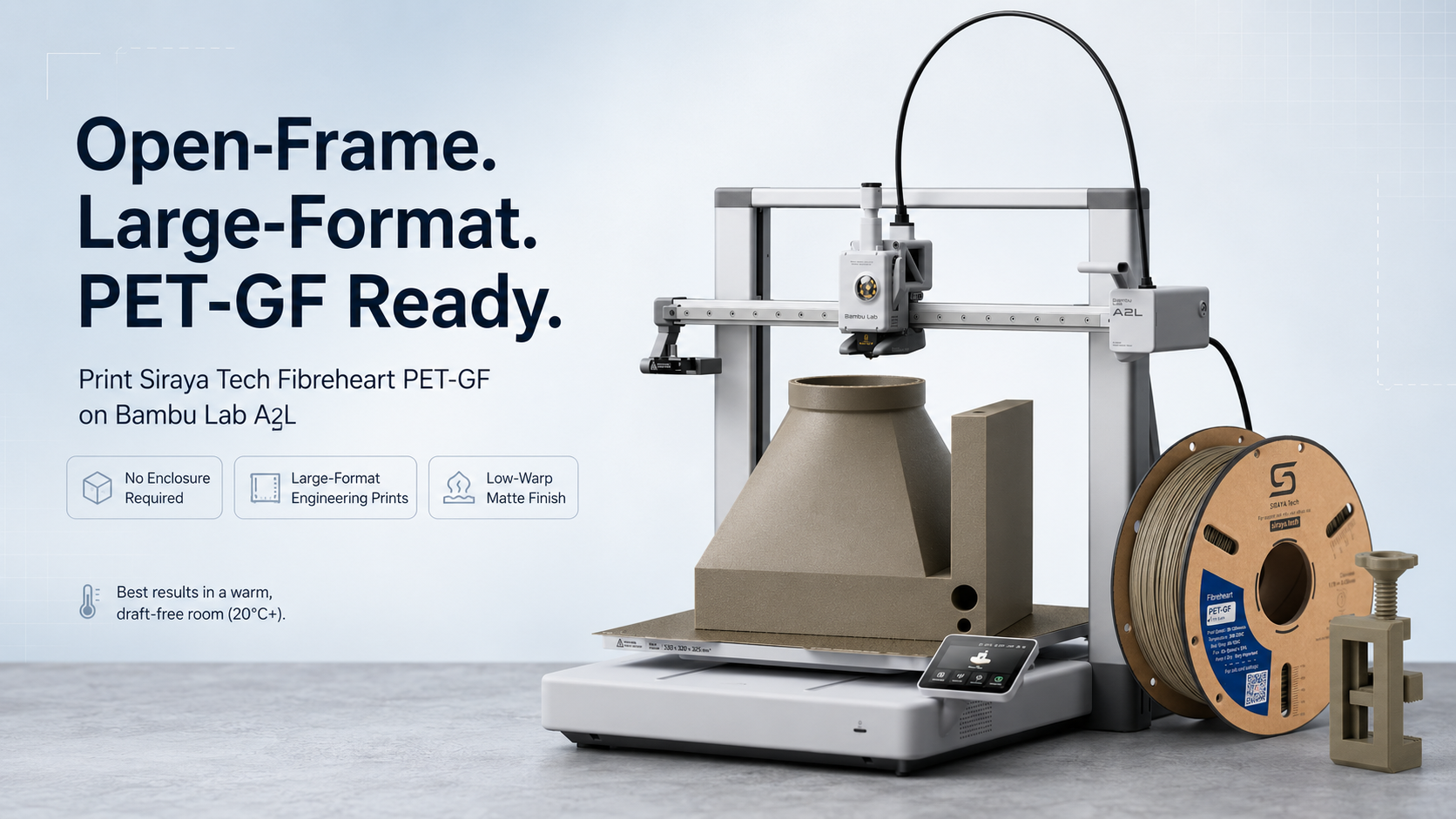
The 3D printing world just got a lot bigger. With the launch of the Bambu Lab A2L, makers finally have an affordable, large-format "bed-slinger" boasting a massive 330×320×325 mm build volume. It is a massive playground for printing full-scale helmets, massive functional prototypes, and multi-part assemblies without the tedious chore of slicing and gluing.
However, the A2L comes with one major catch that has engineering-grade enthusiasts sweating: it is an open-frame printer with no enclosure.
Traditionally, trying to print high-performance composites like PET-GF (Glass Fiber Reinforced Polyethylene Terephthalate) on an open printer is a recipe for warping, splitting, and immediate heartbreak. But thanks to modern material science, you don't need a heated chamber to unlock industrial strength.
Here is how you can successfully print Siraya Tech Fibreheart PET-GF on the open-frame Bambu Lab A2L.
The PET-GF Dilemma: Breaking the Enclosure Rule
If you look up standard guidelines for Glass Fiber PET, almost every expert will tell you the same thing: Use an enclosed printer. Glass fiber adds incredible structural stiffness, dimensional stability, and UV resistance to parts, making it perfect for outdoor gear, drone frames, and automotive jigs. However, those same fibers usually introduce high internal stresses as the plastic cools. On an open-frame printer, drafts and rapid cooling cause the corners to lift, ruining your print hours into a long run.
The Siraya Tech Workaround: Advanced Formulation
We engineered Siraya Tech Fibreheart PET-GF with proprietary fiber reinforcement technology. By tightly controlling how the 15% chopped glass fibers disperse within the polymer matrix, it forms an internal mesh structure.
What does this mean for your Bambu Lab A2L?
-
Near-Zero Warping: The specialized formulation actively fights shrinkage as it exits the nozzle.
-
Open-Air Stability: It is explicitly designed to maintain excellent layer adhesion even without an enclosed build chamber.
-
Stunning Surface Finish: The matte texture naturally hides layer lines, which look incredible across the A2L’s large build area.
Visual Proof: Going Big in Flat Dark Earth (FDE)
To prove what this pairing can do, take a look at this massive, single-piece functional component printed entirely on an open-frame system using Siraya Tech PET-GF in Flat Dark Earth (FDE):


Notice the sharp, crisp corners and the complete absence of delamination. On a standard PET-GF filament, a print with a footprint this large on an open bed would look like a banana within the first 50 layers. With this advanced formulation, it stays completely flat.
The Golden Rule for Open-Frame PET-GF: Keep it Warm!
While Siraya Tech’s advanced formulation allows you to bypass the need for a physical printer hood, you cannot completely ignore physics. The ambient environment still plays a vital role in your success.
⚠ Crucial Printing Tip: When printing PET-GF on an open printer like the Bambu Lab A2L, your room's ambient temperature must be a stable 20°C (68°F) or higher.
If you attempt to print in a chilly basement, a drafty garage, or directly under an air conditioning vent, the sudden drop in ambient temperature will shock the plastic. Keep the printer in a warm, draft-free room to ensure the layers bond flawlessly and the material cools uniformly.
Quick-Start Settings for PET-GF on the Bambu Lab A2L
Ready to slice your first model? The A2L features a hardened steel extruder gear right out of the box—which is perfect, because glass fiber is highly abrasive and will chew through standard brass nozzles in no time.
Configure your custom material profile in Bambu Studio or OrcaSlicer using these baseline parameters:
|
Setting
|
Recommended Value
|
Why It Matters
|
|
Nozzle Temperature
|
300°C
|
Ensures complete melting and maximum layer fusion.
|
|
Build Plate Temperature
|
80°C
|
Keeps the base layers firmly anchored to the PEI plate.
|
|
Cooling Fan Speed
|
OFF
|
Vital for preventing thermal shock and shrinkage.
|
|
Print Speed
|
30–120 mm/s
|
Slow down outer walls for a flawless surface finish.
|
|
Max Volumetric Speed
|
20 mm/s³
|
Prevents under-extrusion at high speeds.
|
Note: Always remember to dry your filament at 100–120°C for 4–6 hours if it has been sitting out in high humidity, as trapped moisture can cause surface artifacts.
Maximize Your Large-Scale Printing
The Bambu Lab A2L proves you don't need a massive budget or a bulky enclosed industrial rig to create huge, robust parts. When paired with a chemically optimized filament like Siraya Tech Fibreheart PET-GF, your creative limits disappear.
To dial in your printer settings or grab a spool of FDE, Olive Green, Black, or White for your next project, visit the official profile repository and material guide on the Siraya Tech Support Page
Have you tried pushing advanced composites on an open-frame printer yet? Let us know your results and drop your build questions in the comments below!