
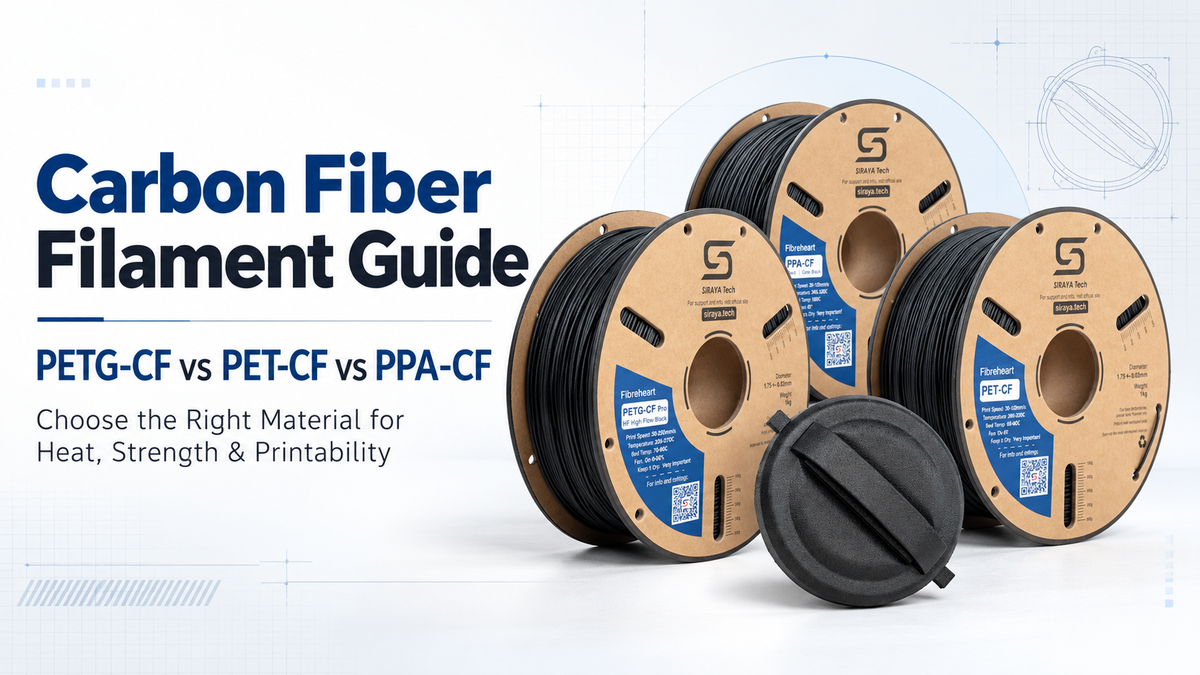
Carbon fiber filament has a simple promise: stiffer, more stable parts than the plain base plastic. But "carbon fiber filament" covers very different materials. A PETG-CF that prints fast on a stock printer and a PPA-CF built for oil, heat and chemical exposure have almost nothing in common except the fiber.
This guide helps you pick the right one, set your printer up for it, and avoid the usual mistakes (worn nozzles, snapped filament, wet spools). It's based on our own Fibreheart carbon fiber range, so the settings and limits below come from our product pages and data sheets.
What carbon fiber actually does in filament
Short chopped carbon fibers are blended into a base polymer. The fibers form a skeleton inside the plastic, which gives you:
- Higher stiffness. The part flexes less under load.
- Better dimensional stability. Less warping and shrinkage than the unfilled plastic.
- A matte, low-gloss finish that hides layer lines.
What it does not do is make plastic tough in every sense. Carbon fiber makes filament stiffer and more brittle, which is why a spool can snap in a tight feed path. The base polymer still decides most of the heat resistance, chemical resistance and moisture behavior, so choose the base first and the fiber second.
Fiber form matters too. Powdered carbon fiber is easier to print and gives a smoother surface, while chopped short fibers give more strength and stiffness but are harder on nozzles. For a deeper look at fiber types and handling, see Demystifying Fiber-Reinforced Filaments .
Carbon fiber filament compared
| Filament | Base polymer | Fiber | What stands out | Needs |
|---|---|---|---|---|
| PETG-CF Pro HF | PETG | Chopped carbon fiber | High-flow formula, up to 25 mm³/s, HDT 76°C, matte black | Hardened steel nozzle (0.4 mm+); enclosure recommended for large parts |
| PET-CF | PET | 15% chopped | Low warping, strong dimensional stability, more heat resistant than PETG-CF | Hardened steel nozzle; dry at 90°C for 4 to 6 hours before printing |
|
PPA-CF also called PAHT-CF |
PPA (high-temp nylon) | 15% chopped | Heat and chemical resistance, low moisture uptake, wear resistance | High-temp printer, all-metal hotend, hardened nozzle |
| PPA-CF Core | PPA | 25% in the core, pure PPA shell | Better Z-axis adhesion, less nozzle wear, less skin irritation | Same as PPA-CF; direct drive or short path |
Two details from the table are worth underlining. PPA-CF Core keeps the fibers in the center of the filament and leaves a pure PPA shell around them, which is how it improves layer bonding and reduces wear on your nozzle. And PETG-CF Pro uses chopped fibers rather than powder, which is why it is stiffer than a typical PETG-CF.
If you want the full PET versus PETG breakdown, read PET-CF vs PETG-CF: Differences in Performance and Applications .
Which carbon fiber filament should you pick?
You want fast, easy, stiff parts
Start with PETG-CF Pro HF. It is the easiest of the group to print, runs at high flow, and the 76°C HDT is fine for indoor and moderate-temperature use. It is a good fit for jigs, fixtures, drone frames and brackets.
You need parts that stay accurate and hold up to more heat
Choose PET-CF. Carbon fiber in a PET matrix gives low warping and good dimensional stability, and PET handles heat better than PETG. It asks a little more of your setup, including drying and a controlled environment, so it suits you once you have PETG-CF printing well.
You need heat, chemical, oil or wear resistance
Choose PPA-CF. PPA is a high-temperature nylon that absorbs far less moisture than standard PA6, and the carbon fiber adds stiffness. You need a printer that can reach 280 to 320°C.
You need the strongest layer bonding and the least nozzle wear
Choose PPA-CF Core. The core-shell design gives the highest impact strength in our range (13.1 kJ/m² Charpy, ISO 179) and is the one to pick for long runs.
Quick rule: start with the base polymer you need first — PETG for easier printing, PET for better stability and heat resistance, or PPA for high-temperature and chemical-heavy applications.
If you are not sure, compare against our heat-focused picks in Best Filament for Heat Resistance .
What your printer needs
Carbon fiber is abrasive. A few hardware rules apply to all of these filaments:
- Hardened steel nozzle or better, 0.4 mm or larger. Brass wears out quickly. Rubidium or tungsten carbide nozzles last longer. For PET-CF at high speed, a 0.6 mm nozzle helps avoid clogging.
- Direct drive or a short, gentle filament path. Carbon fiber filament is brittle and can break in long, tightly curved tubes. We don't recommend PET-CF or PPA-CF Core in an AMS. PETG-CF Pro is stiff enough that it loads smoothly in systems like the AMS, according to its product page.
- All-metal hotend for PPA. PPA prints at 280 to 320°C.
- An enclosure for PPA and for large PETG-CF parts. A stable chamber temperature reduces warping and helps layer adhesion.
- A bed that reaches 80°C for PPA-CF Core, with a PEI surface and glue stick or PVP coating.
One more PPA-CF Core note: avoid CHT-style multi-path nozzles. They redistribute the carbon fiber core and can leave a noticeably rougher surface. A standard hardened steel nozzle gives the best result.
Print settings: where to start
Starting settings for PPA-CF Core, from its product page:
| Setting | Value |
|---|---|
| Nozzle temperature | 280 to 320°C |
| Bed temperature | 80°C |
| Cooling fans | Off |
| Print speed | 30 to 120 mm/s |
| Layer height | 0.2 mm recommended |
| Retraction distance | 1 to 3 mm |
| Retraction speed | 1800 to 3600 mm/min |
For PET-CF, PETG-CF Pro and PPA-CF, grab the matching slicer profile from our print setting download page and check the TDS on each product page. Tune from there.
Every printer and hotend reads temperature a little differently, so treat any starting number as a first test, not a final answer.
Drying and storage
Carbon fiber filament is only as dry as the polymer underneath it.
- PET-CF: dry at 90°C for 4 to 6 hours before printing, and keep it sealed with desiccant between uses.
- PPA-CF: store in a dry box below 15% relative humidity. If it has picked up moisture, dry it at 100°C for 4 to 6 hours.
- PPA-CF Core: ships dried and vacuum-sealed in aluminum bags and can be printed straight out of the bag unless it visibly absorbed water. If needed, dry it at 80 to 100°C for 4 to 6 hours.
Wet filament shows up as popping, stringing, rough surfaces and weak layers. Reseal the bag promptly after every use.
Common problems and fixes
- Nozzle wearing out fast. You are probably using brass. Switch to hardened steel, and consider PPA-CF Core for long runs because the shell protects your nozzle.
- Filament snapping before it reaches the extruder. Carbon fiber is brittle. Use direct drive, shorten the path, and avoid AMS-style feeders for the stiffest grades.
- Rough or fuzzy surface. Check for moisture first, then your nozzle type, especially CHT nozzles with PPA-CF Core.
- Weak layer bonding. Dry the spool, print hotter within the recommended range, and consider PPA-CF Core for better Z-axis strength.
- Warping. Use an enclosure, keep fans off for PPA, and use a PEI plate with glue.
For more diagnosis, see our filament troubleshooting guide .
Handling carbon fiber filament safely
The fibers are locked inside the plastic, so brief contact with a spool is not a concern. The thing to manage is fine particles from printing and especially from sanding or cutting.
Ventilate your space, print in an enclosure where you can, wear PU gloves when handling, and use a respirator when sanding. Core-shell filaments like PPA-CF Core also reduce fiber exposure on the surface of the filament.
Our safety section in Demystifying Fiber-Reinforced Filaments covers this in more detail.
Annealing for extra heat resistance
Annealing relaxes internal stress and lets nylon-based parts reach their full strength and heat resistance.
For PPA-CF Core, our guideline is 80 to 100°C for 4 to 8 hours, then natural cooling to room temperature.
Read the full guides: annealing PET-CF and annealing PPA-CF (PAHT-CF) .
If you are choosing between nylon bases, this comparison of PPA, PA6, PA12 and PA612 helps.
FAQ
Is carbon fiber filament stronger than regular filament?
It is stiffer and more dimensionally stable than the same plastic without fiber, but it is also more brittle. For parts that need to flex or absorb impact, a tough unfilled material can be the better choice. Carbon fiber shines where rigidity and accuracy matter.
Do I need a hardened steel nozzle for carbon fiber filament?
Yes. Carbon fiber is abrasive and will wear a brass nozzle quickly. Use hardened steel (0.4 mm or larger), or rubidium or tungsten carbide for a longer life.
Can I print carbon fiber filament in an AMS?
It depends on the grade. We don't recommend PET-CF or PPA-CF Core in an AMS because they are brittle and can break in the feed path. PETG-CF Pro is stiff enough to load smoothly in systems like the AMS, per its product page. A direct-drive extruder is the safest option for all of them.
What is the difference between PET-CF and PETG-CF?
PETG-CF is easier to print. PET-CF is stiffer, more dimensionally stable and more heat resistant, but it needs more careful drying and setup. Our PET-CF vs PETG-CF article goes through the details.
Is PPA-CF better than nylon carbon fiber?
PPA is a high-temperature nylon with much lower moisture uptake than standard PA6 (about ten times lower, according to our PPA-CF user manual), so it holds its dimensions and properties better in humid or hot conditions. It also needs a hotter printer than PA6.
Do I need an enclosure?
For PPA-CF and PPA-CF Core, an enclosed printer is recommended. For PETG-CF Pro it is highly recommended on large or complex parts, because a stable chamber prevents corner lift and improves layer adhesion.
Ready to print?
Browse the full Fibreheart carbon fiber filament range, or start with PETG-CF Pro if this is your first carbon fiber spool.
Questions about which grade fits your printer? Our support team can help at support@siraya.tech .