
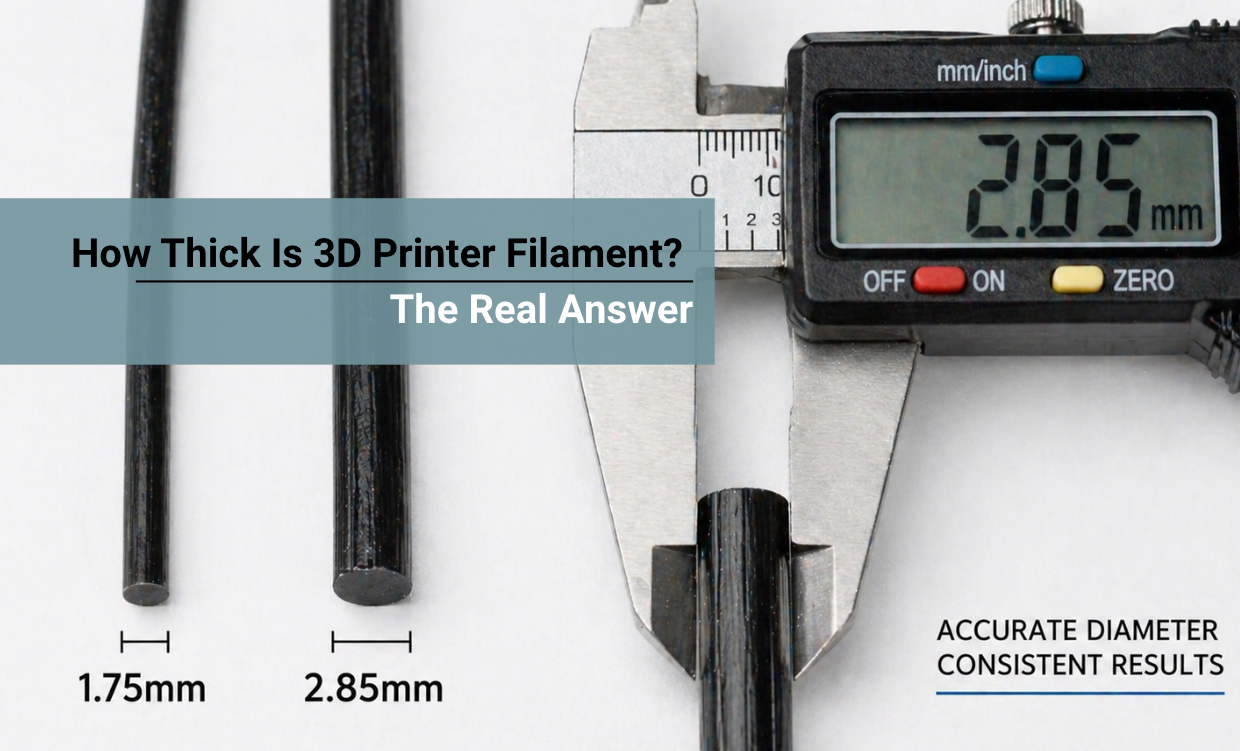
About 85 to 89 percent of home 3D printers on the market today use 1.75mm filament. The other 10 to 15 percent use 2.85mm (often called 3mm).
Getting the wrong size will clog your printer on the first print, so this is one of the first things to check before you buy a spool.
This guide covers every size in use, how to measure filament, tolerance ratings, and why the number matters.
- 1.75mm is the standard size for 3D printer filament in 2026, used by about 85 to 89 percent of printers.
- 2.85mm (sometimes labeled 3mm) is the other common size, used by some Bowden printers like older Ultimaker and LulzBot models.
- Compatibility: You cannot swap between sizes without changing the extruder and hotend hardware.
- Tolerance: This matters more than the number itself. Good filament is ±0.02mm. Cheap filament can be off by 0.1mm or more.
- Performance: Smaller diameter (1.75mm) prints finer details and works better with flexible filaments. Larger diameter (2.85mm) carries more material per turn.
The Real Sizes of 3D Printer Filament

Filament diameter is the thickness of the plastic strand that feeds into your 3D printer. Knowing which one your printer takes is step one of buying filament.
Table 1: 3D Printer Filament Sizes Explained
| Size | Also Called | Market Share | Typical Use | Printers That Use It |
|---|---|---|---|---|
| 1.75mm | Small, thin, standard | ~85 to 89% | Hobby, prosumer, modern printers | Bambu Lab, Creality, Prusa MK4, Anycubic, Elegoo, Voron |
| 2.85mm | 3mm (incorrectly), thick | ~10 to 12% | Older Bowden printers, some industrial | Older Ultimaker, LulzBot, older MakerBot |
| 3.00mm | True 3mm (rare now) | Under 1% | Very old industrial printers | Early Stratasys, legacy industrial |
| 1.00mm / 0.5mm | Specialty | Very rare | Experimental setups | Hobby research setups |
Why 1.75mm Became the Standard
The shift from 2.85mm to 1.75mm happened over the last 10 years for a few practical reasons:
- Better detail control: A thinner filament gives the extruder finer control over volumetric flow.
- Faster melting: 1.75mm strands heat through more evenly than 2.85mm at the same hotend temperature.
- Flexible reliability: TPU and soft materials are easier to push through without buckling when the strand is thinner.
- Wider selection: 95% of specialty filaments (carbon fiber, silk, metal-filled) are only made in 1.75mm.
This is why Siraya's filament lineup and almost every other major brand default to 1.75mm. Browse the full 1.75mm filament collection to see what is available.
When 2.85mm Still Makes Sense
2.85mm is not dead. It still wins in a few cases:
-
Long Bowden tubes. Thicker filament resists buckling inside long tubes. Older Ultimaker and LulzBot printers used Bowden setups that needed 2.85mm to feed reliably.
-
High volume printing. At the same volumetric flow, 2.85mm requires about one third the extruder motor revolutions of 1.75mm. Less motor work means less heat buildup and less wear over multi-day prints.
-
Older printers. If you have a 5 to 10 year old industrial machine, it was probably built for 2.85mm.
-
Large nozzles. If you print with a 0.8mm or 1.0mm nozzle (pellet-like flow), 2.85mm carries material faster.
For everyone else buying a new printer in 2026, 1.75mm is the right answer.
How to Measure Your Filament Correctly

The printed number on the spool is a target, not a guarantee. Real filament varies, and that variation matters for print quality. Here is the process:
- 1. Cut a meter of filament off the spool.
- 2. Measure the diameter at 5 random spots with digital calipers.
- 3. Calculate the average.
- 4. Enter that average into your slicer's filament diameter setting.
For a deeper breakdown of extrusion issues caused by wrong diameter values, the Over Extrusion 3D Print guide on Siraya covers the slicer side.
Filament Tolerance: What the Numbers Mean
| Tolerance | Quality Level | What You Will See | Price Range (1kg) |
|---|---|---|---|
| ±0.01mm to ±0.02mm | Premium | Consistent flow, clean walls, no surprise failures | $22 to $40 |
| ±0.03mm | Good | Reliable for most prints, minor artifacts possible | $18 to $28 |
| ±0.05mm | Standard | Works for basic prints, issues at high speeds | $15 to $22 |
| ±0.1mm or higher | Cheap | Expect failed prints, under-extrusion, and stringing | $8 to $14 |
Can You Use 2.85mm Filament on a 1.75mm Printer (or Vice Versa)?
Short answer: no.
The extruder gears, the PTFE tube inner diameter, and the hotend bore are all built around one specific filament size. Force a 2.85mm strand into a 1.75mm extruder and it will snap the lever or jam solid in the hotend.
Force a 1.75mm strand into a 2.85mm extruder and it will slip past the gears and the printer will under-extrude.
If you want to switch sizes, you need to change:
-
The extruder assembly (or at least the drive gears and lever)
-
The PTFE tube (Bowden printers)
-
The hotend bore
-
The slicer profile
For most hobbyists, it is cheaper to just buy a new printer in the size you want than to convert.
For more on how different printers handle different filaments, see Do All 3D Printers Use the Same Filament on the Siraya blog.
Does Filament Thickness Affect Print Quality?
Yes, in a few specific ways:
-
Detail and precision. 1.75mm has the edge here because extruder steps per millimeter are finer, giving more granular control over flow.
-
Flexible filament printing. 1.75mm is easier with TPU because thinner strands bend less in the feed path. The TPU 85A Filament is a good example, with tight ±0.03mm diameter control to prevent buckling.
-
Volumetric flow. 2.85mm carries more material per turn, which matters at very high print speeds with large nozzles. For regular 0.4mm nozzles, there is no meaningful speed difference.
-
Motor wear. 1.75mm extruders work harder per gram of plastic extruded. Over multi-day industrial prints, this can shorten motor life.
For hobby and prosumer printing with nozzles up to 0.6mm, filament thickness has almost no effect on print quality. Material choice, slicer settings, and filament quality matter way more.
A Quick Note on Specialty Sizes
You may also see mentions of these sizes, though they are not mainstream:
-
1.0mm filament. Used by some experimental mini printers and research setups. Rare.
-
0.5mm filament. Only in very specialized research applications.
-
Pellet extrusion. Not filament at all, but raw plastic pellets fed directly to an industrial extruder. Used for large-format prints and injection molding hybrids.
None of these apply to standard hobby printers. Stick to 1.75mm or 2.85mm based on your printer manual.
FAQs: 3D Printer Filament Thickness
What is the standard thickness of 3D printer filament?
The standard thickness is 1.75mm for about 85 to 89 percent of hobby and prosumer printers in 2026. The other common size is 2.85mm, sometimes labeled "3mm," used mostly by older Bowden printers like older Ultimaker and LulzBot models.
Is 3D printer filament 1.75mm or 3mm?
Most modern filament is 1.75mm. When sold as "3mm," it is almost always 2.85mm. True 3.0mm filament is now rare. If your printer manual says 3mm, you should buy 2.85mm filament.
How do you measure the diameter of 3D printer filament?
Use digital calipers to measure at 5 different spots along a meter of filament, then average the readings. Enter that average into your slicer's filament diameter setting. Premium filament measures within ±0.02mm of its labeled size.
What happens if you use the wrong size filament?
It will cause immediate jams or damage. A 2.85mm strand will not fit through a 1.75mm extruder. A 1.75mm strand in a 2.85mm extruder will slip past the gears, causing severe under-extrusion. You cannot swap without replacing the hardware.
Why is 1.75mm filament more popular than 2.85mm?
1.75mm offers finer print detail, melts more evenly, prints flexibles more reliably, and is cheaper to manufacture. Around 95 percent of specialty filaments are only made in 1.75mm.
Final Thoughts
How thick is 3D printer filament? For almost every printer sold today, the answer is 1.75mm. Before you buy, check the required size, the tolerance rating (aim for ±0.02mm), and the material.
Get those right and filament thickness stops being a problem you have to think about.
Recommended Products & Collections
- Primary pick: Siraya 1.75mm Filament Collection for tight-tolerance material across every category.
- Full range: Siraya 3D Printing Filament Collection to compare PLA, PETG, ABS, and TPU.
- Flexible printing: TPU 85A Filament with ±0.03mm diameter control to prevent buckling.
- Strength-critical: PETG-CF Collection with ±0.02mm tolerance and carbon fiber reinforcement.