
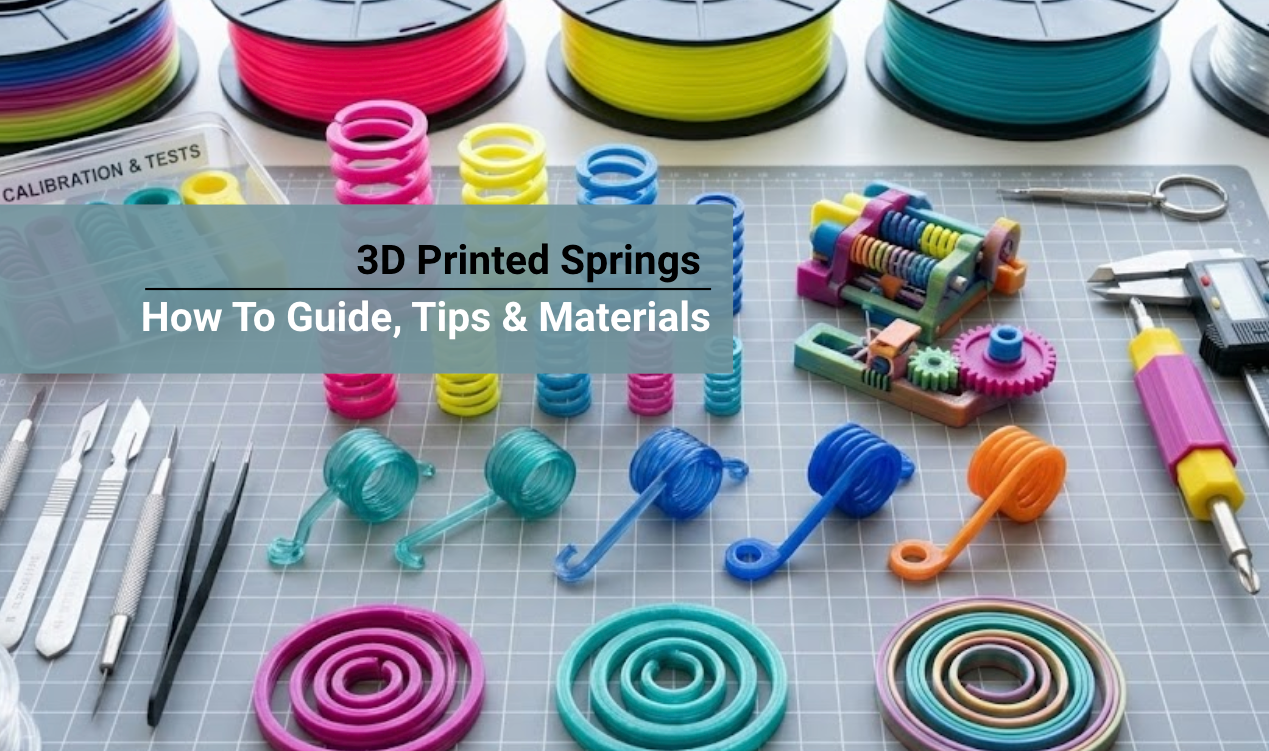
A 3D-printed spring is a complex mechanical component that enables energy storage and shock absorption within a printed assembly.
Unlike traditional metal springs, plastic versions are limited by material fatigue and "creep," where the plastic permanently deforms under constant load.
Success in printing functional springs depends on the correct coil geometry, high perimeter counts for structural integrity, and the use of a material with high elasticity. PETG is often cited as the best all-around filament for functional springs, while TPU offers superior durability for high-deformation applications.
In this comprehensive guide, we explore the core principles of spring mechanics, how to optimize your slicer settings, and the best flexible filaments and resins for maximum durability and rebound.
Understanding 3D Printed Spring Mechanics

Before designing a spring in CAD software, you must understand how plastic differs from metal.
Springs store mechanical energy when deformed and release it as they return to their original shape.
The performance of your printed spring depends on three key factors:
- Spring Constant (k): Defined by Hooke’s Law, this dictates the overall stiffness of the spring.
- Geometry: The physical shape, wire thickness, and spacing between the coils.
- Material Elasticity: Unlike metal, plastic suffers from "creep" (plastic deformation). If a 3D printed spring remains fully compressed for an extended period, it will slowly lose its ability to bounce back to its original height.
Adjusting Spring Geometry
To fine-tune your spring's behavior, adjust these physical dimensions within your CAD software:
- Wire Thickness: Thicker wires drastically increase stiffness and load capacity but severely reduce flexibility. Thinner wires deform more easily, making them ideal for lightweight, responsive mechanisms.
- Coil Diameter: Expanding the overall diameter makes the spring softer and reduces stiffness.
- Number of Coils: Adding more coils allows for greater extension and compression, but generally reduces overall stiffness.
- Coil Spacing (Pitch): You must leave adequate vertical space between the coils. Otherwise, the printer will fuse the layers together, turning your spring into a solid, immovable tube.
Types of 3D Printable Springs
Not all springs are standard coils. Additive manufacturing allows you to create various mechanisms tailored to specific mechanical needs.
- Compression Springs: The standard coiled design that resists being pushed together. (Tip: Always print these vertically).
- Extension Springs: Designed to stretch and pull back. They require strong, integrated end-hooks to attach to other mechanisms.
- Leaf Springs: Composed of flat, layered plastic segments, leaf springs are excellent for heavy-duty suspension systems. (Tip: Orient these flat on the build plate for optimal strength.)
- Spiral Springs: Flat, coiled designs that store rotational energy. These are often used in clockwork mechanisms or retractable badges.
- Integrated Flex Zones: Instead of printing a separate spring, you can design thin, curved "living hinges" directly into a solid 3D model, allowing the part to flex and snap back natively.
| Spring Type | Primary Function | Best Print Orientation | Best Material Profile |
|---|---|---|---|
| Compression | Resists pushing forces | Vertical (Standing up) | High Elasticity (TPU) |
| Extension | Resists pulling forces | Vertical | High Tensile Strength (PETG) |
| Leaf Spring | Heavy load suspension | Flat (Horizontal) | High Toughness (PETG) |
| Spiral/Clock | Stores rotational energy | Flat (Horizontal) | Maximum Flex (TPU) |
The Best FDM Filaments for Springs
Standard PLA is excellent for decorative prints, but it is highly brittle; if you compress a PLA spring, it will shatter. For functional, moving parts, you must upgrade to engineering-grade materials.
1. PETG: Best for Rigid Springs
If you need a functional spring with moderate flexibility and high strength, PETG (Polyethylene Terephthalate Glycol) is the ideal choice.
- Why it works: PETG combines the easy printability of PLA with the durability of ABS. It possesses excellent natural elasticity. When bent or compressed, PETG springs back into shape rather than snapping.
- Best Uses: Leaf springs, snap-fit joints, and heavy-duty structural components.
2. TPU: Best for Extreme Flexibility
If your application requires significant deformation, meaning the spring must compress completely flat and bounce back repeatedly, you must use TPU (Thermoplastic Polyurethane).
- Why it works: TPU behaves like real rubber. Standard 95A TPU offers incredible impact resistance and stretch. For even softer, highly elastic springs, an 85A TPU variant provides incredible rebound for wearable mechanisms.
- Explore Options: Check out the Siraya Tech TPU Filament Collection for durable, flexible materials.
The Best SLA Resins for Springs
Historically, SLA resin printing was considered useless for springs because standard modeling resins are notoriously brittle. However, modern material science has solved this limitation.
If you need microscopic springs for tiny mechanisms or high-resolution flex joints, filament printers cannot achieve the required detail. Instead, you must use a specialized flexible resin.
- Siraya Tech Tenacious: This is a dedicated 65D flexible resin engineered specifically for high impact resistance and extreme elasticity.
- Why it works: Its high toughness allows thin printed objects to bend 360° without breaking and recover their shape instantly. With Tenacious, you can print highly complex, functional spiral springs and micro-compression coils that easily withstand heavy loads.
Slicer Settings for Perfect Print Execution

Even the best material will fail if printed incorrectly. Optimize your slicer settings to ensure structural precision:
- Layer Height: Use a smaller layer height (e.g., 0.1 mm to 0.15 mm). Finer layers create smoother surfaces, reducing friction and stress-concentration points where the spring might snap.
- Infill Density: For FDM filaments, use a very high infill (70% to 100%) to guarantee maximum structural integrity inside the wire.
- Print Speed: Slow down significantly. Printing small, circular coils at high speeds causes the printer to pull the filament tight, which cuts corners and ruins the circular geometry.
- Cooling: If using PETG or TPU, optimize your cooling fan settings to prevent hot plastic from sagging into the empty spaces between the coils.
Conclusion
Designing and manufacturing 3D printed springs requires a careful balance of mechanical geometry, correct print orientation, and specialized polymer selection.
While 3D printed plastics cannot perfectly replicate the heavy-duty load capacities of metal coils, high-performance materials like Siraya Tech PETG and flexible TPU allow you to create highly functional, reliable mechanisms.
By fine-tuning your wire thickness and slowing down your print speeds, you can unlock an entirely new level of print-in-place mechanical design for prototypes, toys, and custom robotics.
3D Printable Springs FAQs
Can you 3D print a functional spring?
Yes, you can absolutely 3D print functional springs. While they cannot replace heavy-duty metal springs used in industrial machinery, plastic springs are highly effective for light mechanical applications, snap-fit joints, prototypes, and custom toys. Success relies entirely on using the correct geometry and flexible materials.
What is the best filament for 3D printing springs?
Standard PLA is too brittle. For rigid springs requiring moderate flexibility and high strength, PETG is the optimal choice. For springs that require extreme compression, stretching, and rapid rebound, flexible TPU (like 95A or 85A shore hardness) is the best material available.
How should I orient a spring for 3D printing?
Compression and extension springs must be printed vertically (standing straight up on the build plate). This maximizes strength along the axis of deformation and minimizes the risk of layer delamination. Conversely, leaf springs and flat spiral springs should be printed lying horizontally.
Can I 3D print springs using a resin printer?
Yes, but you cannot use standard modeling resin, which will shatter instantly under pressure. You must use an engineering-grade flexible resin, such as Siraya Tech Tenacious, which allows the printed parts to bend and compress without breaking.
Why do my 3D printed springs lose their bounce?
Plastic suffers from a material phenomenon known as "creep" (plastic deformation). If a 3D printed spring remains fully compressed for a long time, the polymer chains permanently realign, and the spring fails to return to its original length. To minimize this, use highly elastic materials like TPU and design the spring with thicker wire diameters.