
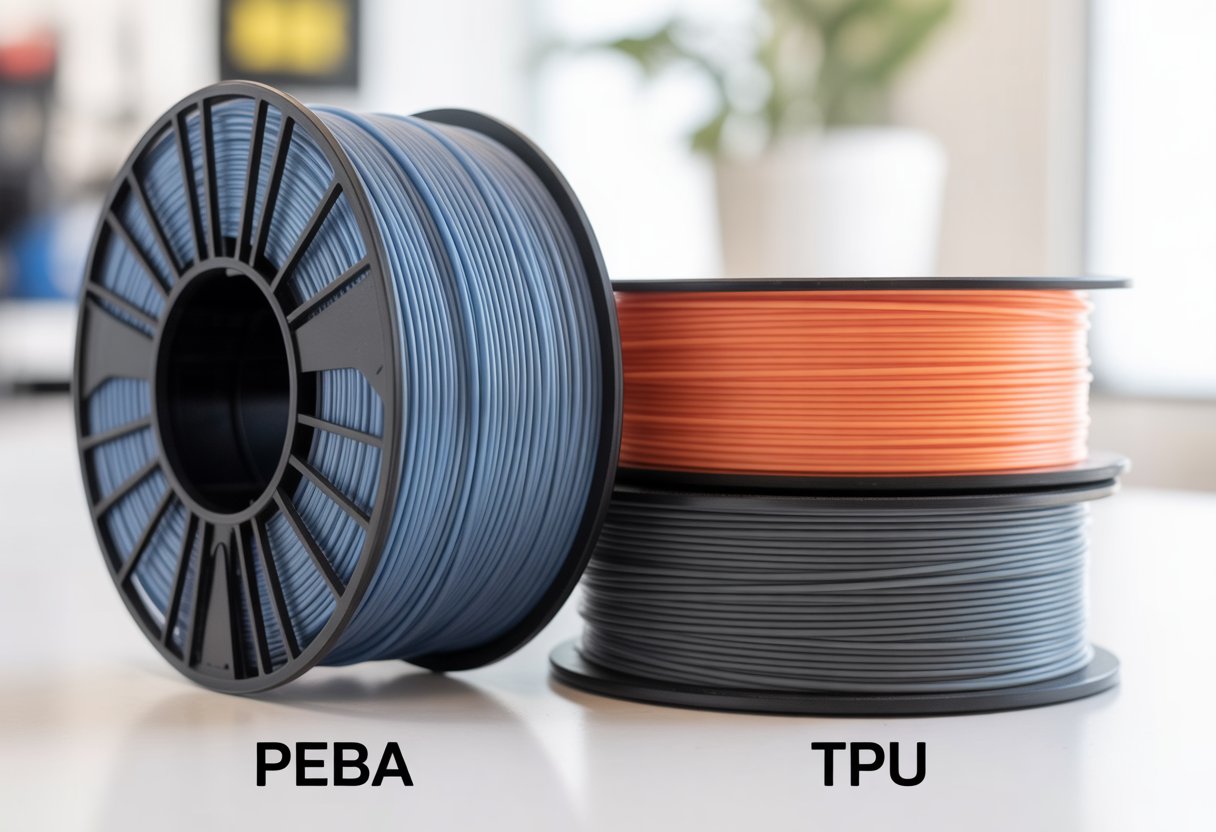
PEBA and TPU filament are both bendy materials used in 3D printing, but they work differently. TPU has been the go-to choice for flexible prints for years. PEBA is newer and acts like a super-charged version of TPU. PEBA bounces back better than TPU, prints faster at the same softness level, and handles cold temperatures without breaking down. But it costs more and can be harder to print with for beginners.
Both materials belong to a group called thermoplastic elastomers, which means they can stretch and bend without snapping. TPU is easier to find and works well for most flexible 3D printing projects. PEBA shines when you need extra bounce, toughness, or speed. Think of TPU as the reliable choice and PEBA as the high-performance upgrade.
Key Takeaways
- PEBA offers better bounce and faster printing speeds than TPU but costs more and requires more printing skill
- TPU remains the easier and more affordable option for most flexible 3D printing projects
- Your choice between PEBA and TPU should depend on your project needs, budget, and printer experience level
Finding the right flexible material starts with understanding your options. Browse our Flex TPU Filament for 3D Printing collection to discover reliable TPU filaments perfect for both beginners and experienced makers.
What Are PEBA and TPU Filaments?

PEBA and TPU are both flexible materials that bend and stretch, making them perfect for printing parts that need to move or absorb shock. They belong to a family of plastics called thermoplastic elastomers that act like rubber but melt when heated.
Fundamental Properties of PEBA
PEBA stands for polyether block amide. It's a flexible 3D printing material that combines softness with strength in a unique way.
This material bounces back better than most other flexible filaments. When you press or stretch PEBA, it returns to its original shape quickly. Tests show it can give you up to 78% energy return, which means it keeps most of its spring after being compressed.
PEBA works great in cold weather. It stays flexible even when temperatures drop, unlike some other materials that get stiff and brittle. This makes it useful for outdoor gear and winter sports equipment.
The material also resists chemicals well. Oils, fuels, and cleaning products won't break it down easily. You can use PEBA parts in tough environments where other plastics might fail.
Core Characteristics of TPU
TPU is a thermoplastic elastomer that's been around longer than PEBA. It's easier to print and costs less, which is why many people start with it.
This flexible 3d printing material comes in different hardness levels. The most common types are 85A and 95A. The 85A version is softer and bends more easily. The 95A type is firmer and holds its shape better under pressure.
TPU prints at moderate speeds and doesn't need special equipment. Most standard 3D printers can handle it with just a few setting changes. It sticks well to print beds and doesn't warp as much as PEBA can.
The material works for phone cases, shoe insoles, and seals. It's durable enough for everyday use and can handle repeated bending without breaking down.
How Thermoplastic Elastomers Work
Thermoplastic elastomers like PEBA and TPU have a special structure. They contain hard segments and soft segments mixed together at a tiny level.
The hard parts act like anchor points. They give the material strength and help it keep its shape. The soft parts between them let the material stretch and bend.
When you heat these materials, the hard segments soften. This lets you melt and shape the material through your printer's nozzle. After it cools down, the hard segments firm up again and the material becomes flexible but stable.
This structure is why both materials can stretch like rubber but still print like plastic. The balance between hard and soft segments determines how stretchy or firm the final print will be.
Getting the most from flexible filaments requires some technique. Master advanced printing methods in our guide Mastering Flexible Filament Printing on Creality K1, K1C for better results with bendable materials.
Key Differences Between PEBA and TPU Filament

PEBA and TPU both bend and stretch, but they act differently when you print with them and use them. PEBA bounces back better and weighs less, while TPU is easier to print and costs less.
Elasticity and Energy Return
PEBA beats TPU when it comes to bounce and snap-back. It can return up to 78% of the energy when you compress it or stretch it. This means objects made from PEBA spring back to their original shape much faster and more completely than TPU parts.
TPU is still flexible and stretchy, but it doesn't bounce back as quickly. When you squeeze a TPU part, it takes longer to return to its normal shape. This matters if you're making things like phone cases, shoe insoles, or toys that need to bounce.
The polyether block structure in PEBA gives it this special springy quality. Think of it like a super ball compared to a foam ball. Both are soft, but one bounces way better than the other.
Weight and Density Variations
PEBA filament weighs less than TPU for the same size print. This makes it great for projects where you want something flexible but light. Parts printed in PEBA feel noticeably lighter in your hand.
TPU is denser and heavier. Sometimes you want a bit more weight for stability or to make something feel more solid.
The weight difference becomes obvious on larger prints. A PEBA phone case or drone part will weigh less than the same design in TPU.
Hardness and Flexibility Spectrum
Both materials come in different hardness levels, usually measured on the Shore A scale. TPU is commonly available in 85A (very soft) and 95A (medium soft) hardness. PEBA also comes in similar hardness ranges.
At the same hardness level, PEBA and TPU feel different. PEBA tends to be more elastic and springy, while TPU feels more rubber-like. You can bend both materials easily, but PEBA snaps back faster.
PEBA also has better fatigue resistance. This means it can bend back and forth many more times before it wears out or breaks. TPU will eventually stay bent or crack after repeated bending, but PEBA holds up longer.
Temperature and Chemical Resistance
PEBA works better in cold weather than TPU does. It stays flexible even at low temperatures where TPU might get stiff or brittle. This makes PEBA perfect for outdoor gear or car parts that face winter conditions.
Both materials resist chemicals well, but PEBA has an edge. It stands up better to oils, fuels, and harsh cleaning products. TPU also offers good chemical resistance, but it can break down faster when exposed to certain substances.
PEBA also handles abrasion resistance and durability better over time. Parts that rub against other surfaces or get used a lot will last longer when printed in PEBA. TPU is still durable, but it wears down faster under heavy use.
Need materials that can handle demanding applications? Explore our Flexible Filaments collection to find bendable options engineered for strength, durability, and consistent printing performance.
Performance and Printability in 3D Printing

PEBA prints faster than TPU but needs more careful setup, while TPU offers easier layer bonding and more forgiving settings for beginners.
Layer Adhesion and Print Settings
TPU filament sticks to itself well between layers. This makes it easier to print without worrying too much about your settings. You can get good results even if your printer isn't perfectly tuned.
PEBA is pickier about layer adhesion. You need to dial in your settings more carefully to get layers that bond strongly. The bed temperature and first layer height matter more with PEBA than TPU.
Key settings to watch:
- Bed temperature: PEBA works at lower temps (50-60°C) while TPU needs 60-70°C
- Nozzle temperature: PEBA prints at 210-230°C, TPU at 220-250°C
- Print bed: Both need a clean, slightly textured surface
PEBA has less shrinkage when it cools down. This means you'll deal with fewer warping problems during flexible 3D printing projects.
Print Speed Comparison
Print speed is where PEBA really shines. You can print PEBA at speeds over three times faster than TPU when they're the same hardness. This makes a big difference on bigger projects.
TPU filament usually needs slow speeds around 15-30 mm/s to print well. Going faster often causes problems with stringing or poor quality.
PEBA handles speeds of 50-80 mm/s without major issues. Some high-speed versions can go even faster. This cuts your print time by hours on large parts.
The catch is that PEBA needs a well-tuned printer to hit these speeds. Your extruder must handle flexible filament smoothly, and your hotend needs good heat control.
Surface Finish and Precision
TPU gives you a smooth, matte surface finish right off the printer. It's forgiving if your settings aren't perfect. Small dimensional errors don't show up as much.
PEBA produces sharper details and better dimensional accuracy. Your printed parts will match your design measurements more closely. But you'll see surface defects more easily if something goes wrong during printing.
Surface quality factors:
- PEBA shows layer lines more clearly
- TPU hides small printing mistakes better
- PEBA keeps its shape better over time
Both materials can achieve good results, but PEBA demands more printer skill and patience to get there.
Choosing between materials can be confusing without solid information. Check out our detailed comparison PETG vs PLA: Which Filament Is Best for 3D Printing? to understand how different materials stack up for various projects.
Applications and Use Cases
PEBA and TPU filaments work well for different projects because of how they bounce, bend, and handle wear. PEBA shines when you need high energy return and better performance in tough conditions, while TPU remains the go-to choice for everyday flexible prints that are easier to make.
Sports Equipment and Athletic Gear
PEBA filament is changing how people make sports gear at home. You can print insoles that give better bounce with each step, which helps your feet feel less tired during long runs. The material returns up to 78% of the energy when compressed, making it perfect for shoe parts and cushioning.
TPU works great for protective gear like shin guards and helmet padding. It absorbs impact well and costs less than PEBA. If you need basic protection without the extra bounce, TPU is your best bet.
PEBA handles cold weather better than TPU. Your printed sports equipment won't get stiff when temperatures drop. This makes PEBA ideal for winter sports accessories and outdoor activities in cold places.
Wearables and Comfort Products
TPU dominates the wearables market because it's easier to print and cheaper. You can make flexible watch bands, fitness tracker straps, and comfortable grips without much trouble. The material bends thousands of times without breaking or losing shape.
PEBA works better when you need something that stays springy over time. It keeps its shape and bounce even after years of use. Medical braces and prosthetic components benefit from PEBA's superior shape retention and fatigue resistance.
Both materials are safe for skin contact, but PEBA feels softer against your body. The lightweight strength of PEBA makes it comfortable for all-day wear without adding bulk.
Phone Cases and Everyday Accessories
TPU is the clear winner for phone cases and daily items. It prints reliably and gives you good grip and protection at a lower cost. You can print cases in any color and they'll cushion your phone when it drops.
The material is flexible enough to slip on and off your phone easily but firm enough to protect it. TPU phone cases handle scratches and daily wear without showing damage quickly.
PEBA isn't worth the extra cost or printing hassle for basic phone cases. Save PEBA for projects that need its special bouncy properties instead.
Industrial and Drone Components
PEBA excels in industrial settings where parts face constant vibration and impacts. Drone bumpers and landing gear printed with PEBA absorb hard landings better and last longer. The material bounces back to shape after crashes that would damage TPU parts.
You can use PEBA for robot joints and flexible couplings that need to move millions of times. It resists chemicals and oils better than TPU, making it useful in factory equipment.
TPU works for less demanding industrial parts. It's easier to print large batches and costs less for prototypes. Use TPU when you need basic flexibility without the extreme performance that PEBA offers.
Standard filament diameter matters for consistent extrusion. Check out our 1.75mm Filament collection featuring flexible and rigid materials with tight diameter control for smooth, reliable printing.
Pros and Cons of PEBA vs TPU Filament
Both materials bring unique strengths to 3D printing, but they also have different weak spots. PEBA offers better bounce and energy return, while TPU is easier to print and costs less.
Advantages of PEBA Filament
PEBA filament stands out for its bounce-back ability. It can return up to 78% of its energy, making it perfect for things that need to spring back into shape, like balls, flexible shoe soles, or protective cases.
This material works well in cold weather. TPU can get stiff when temperatures drop, but PEBA stays flexible even when it's cold. That makes it a good choice for outdoor gear or winter accessories.
PEBA filament has better shape memory than regular TPU. When you bend or squeeze something made with PEBA, it bounces back to its original form faster. It also handles repeated bending and stretching without wearing out quickly.
Benefits of Using TPU Filament
TPU filament is much easier to print with than PEBA. You don't need special settings or equipment to get good results. Most standard 3D printers can handle TPU without major problems.
The cost difference matters too. TPU costs much less than PEBA, which helps when you're making multiple prints or working on a tight budget. You can find TPU in different hardness levels like 85A or 95A, giving you options for your project.
TPU offers solid abrasion resistance for everyday use. It holds up well against rubbing and scraping, making it reliable for phone cases, wheels, and grips. The material is also less picky about printing conditions, so you'll waste less filament on failed prints.
Potential Drawbacks and Limitations
PEBA filament is tricky to print. It needs more patience and the right printer setup to work correctly. You might deal with stringing, oozing, or other printing issues if your settings aren't right.
The price tag for PEBA is much higher than TPU. This makes it less practical for simple projects where TPU would work fine. You also can't find PEBA in as many colors or varieties as TPU.
TPU filament doesn't bounce back as well as PEBA. If you need high energy return, TPU falls short. It also gets stiffer in cold temperatures, which limits where you can use your finished prints.
TPU stands as one of the most popular flexible options available. Learn everything about this versatile material by reading our complete guide What Is TPU Filament: An Easy Guide For Smart 3D Printing.
Wrap Up
Both PEBA and TPU filament offer unique advantages for flexible 3D printing projects. TPU remains the practical choice for most makers thanks to its easier printability, lower cost, and reliable performance. PEBA delivers superior bounce, energy return, and cold-weather flexibility when your project demands peak performance. Your choice depends on your specific needs, budget, and printer experience level.
Ready to explore quality flexible filaments? Siraya offers a range of high-performance materials designed for consistent results and dependable printing. Whether you need everyday flexibility or advanced elasticity, Siraya's carefully engineered filaments help you achieve professional-quality prints with less hassle and better outcomes every time.
Understanding different material options helps you make smarter choices. Discover how flexible materials compare to other popular types in our article 3D Filament Types: Complete Guide for Every 3D Project.
Frequently Asked Questions
What's the scoop on durability—PEBA or TPU, which one holds up better?
PEBA wins when it comes to lasting a long time. It can handle being bent and stretched over and over without wearing out as fast as TPU. PEBA keeps its shape better after lots of use.
TPU is still tough and works for most projects. It holds up well to daily wear and tear. But if you need something that will bounce back perfectly thousands of times, PEBA is your better choice.
Can you break down the flexibility vibe of PEBA compared to TPU?
Both materials are flexible, but they flex differently. TPU bends smoothly and feels softer in your hands. It's easier to squeeze and compress.
PEBA is more elastic and springy. It bounces back faster and stronger than TPU. Think of PEBA like a rubber band that snaps back into place, while TPU is more like a soft cushion.
PEBA gives you up to 78% energy return, which means it stores energy when you squish it and releases it back. TPU doesn't bounce back with as much force.
Printing tips, anyone? What should I know about printing with PEBA versus TPU?
TPU is much easier to print with if you're just starting out. It works on most 3D printers without too many problems. You can use basic settings and get good results.
PEBA is harder to print and needs more attention. You'll need patience and might need to change your printer setup. It's pickier about temperature and speed settings.
Your printer needs to handle flexible filaments well for PEBA to work right. A direct drive extruder helps a lot. Be ready to do some testing before you get perfect prints.
Cost talk—how do PEBA and TPU filaments stack up price-wise?
PEBA costs more than TPU. You'll pay extra for its special bouncy properties and better performance. The price difference can be big.
TPU is more budget-friendly and easier to find. Most filament brands sell TPU at regular prices. If cost matters for your project, TPU makes more sense.
Only pick PEBA when you really need its unique features. For basic flexible prints, TPU saves you money without giving up too much quality.
Let's talk environmental impact. Are PEBA or TPU filaments more eco-friendly?
Neither PEBA nor TPU breaks down naturally in the environment. Both are plastics that stick around for a long time. They don't compost or disappear on their own.
TPU is slightly more common in recycling programs, but finding places that take it is still hard. PEBA recycling is even rarer because fewer people use it.
The best eco choice is to use less material overall. Print only what you need and pick the right material so it lasts longer.
Got a project with some crazy temp needs—will PEBA or TPU handle the heat better?
PEBA handles cold temperatures better than TPU. It stays flexible even when it gets really cold outside. TPU can get stiff and crack in freezing weather.
For heat resistance, TPU does better. It can handle warmer temperatures without losing its shape. PEBA starts to get soft and bendy when things heat up.
Cold weather gear works better with PEBA. Parts that sit in warm spots work better with TPU.