
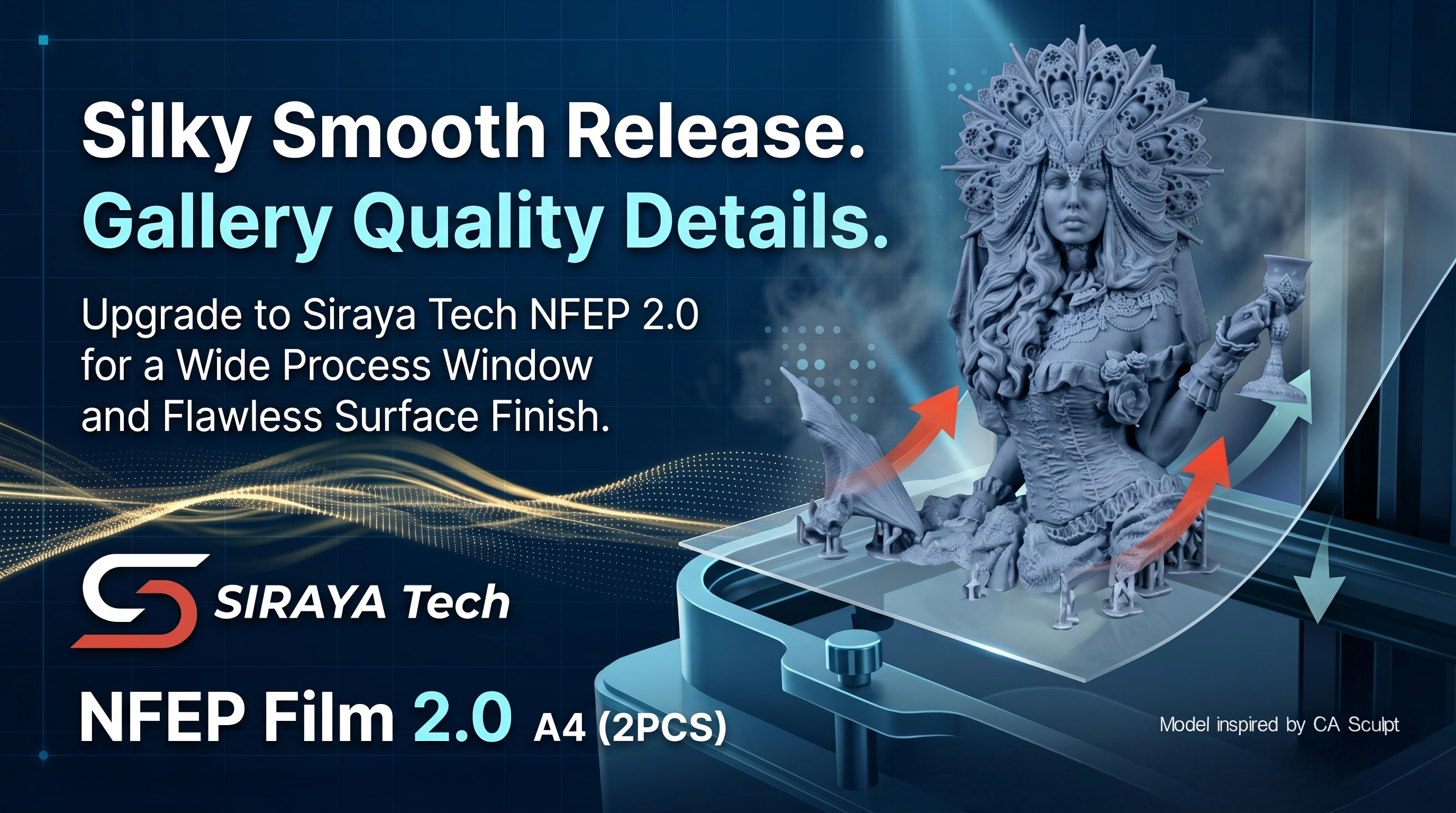
If you have been resin 3D printing for a while, you know the sound. That distinct "thwack" or "pop" as the build plate lifts and your cured resin peels away from the vat film. While a little bit of sound is normal, excessive peel force is the number one enemy of print success. It causes torn supports, warped models, and the dreaded pancaked print stuck to the bottom of your vat.
For years, standard FEP (Fluorinated Ethylene Propylene) has been the default release film for SLA, DLP, and LCD printers. But as printers get larger and print speeds get faster, the limitations of FEP have become clear.
Enter PFA (Perfluoroalkoxy)
PFA is often referred to in the 3D printing community as nFEP.
In this guide, we are breaking down the ultimate PFA vs FEP debate, explaining the science behind the materials, and introducing you to Siraya Tech NFEP 2.0—our all-new release film engineered from an enhanced PFA formula to give you the highest print success rate possible.
What is FEP Film? (The Industry Standard)
FEP is a transparent, non-stick fluoropolymer film. It is the factory default on almost every consumer resin 3D printer because it is relatively inexpensive to produce, has excellent UV transparency (allowing the screen’s light to cure the resin), and offers decent non-stick properties.
The Problem with FEP: While FEP works fine for small, simple prints, it has a high surface energy compared to premium alternatives. This means cured resin sticks to it more aggressively. Over time, the repeated high-stress pulling stretches the FEP, causing it to lose tension, cloud up, and ultimately tear. If you are printing large, heavy models or extremely delicate miniatures, the high peel force of FEP is often the root cause of your failures.

What is PFA Film? (The Premium Upgrade)
PFA (often marketed in 3D printing as nFEP or "non-FEP") is a chemically similar but structurally superior fluoropolymer. In the industrial world, PFA is prized for its extreme chemical resistance and high-temperature stability.
In the world of resin 3D printing, PFA is prized for one massive advantage: Incredibly low surface friction.

PFA vs FEP: The Head-to-Head Comparison
If you are debating whether to upgrade your vat film, here is how PFA directly compares to standard FEP:
1. Peel Force (Adhesion)
FEP: Higher suction. Grips the cured resin tightly, requiring heavier supports to prevent models from tearing off the build plate.
PFA: Ultra-low surface tension. Cured resin releases effortlessly, significantly reducing the "suction cup" effect. This allows you to print with thinner, easier-to-remove supports.

2. Durability and Flex Life
FEP: Prone to stretching and denting. The constant heavy pulling wears out the elasticity of the film relatively quickly.
PFA: Vastly superior tensile strength and flex life. PFA can endure thousands of high-stress lift cycles without permanently stretching or losing its tautness.
3. Surface Quality of Prints
FEP: High peel force can cause microscopic shifting during the lift sequence, leading to visible layer lines or "Z-banding."
PFA: The smooth release eliminates mechanical pulling stress, resulting in flawlessly smooth surface finishes and crisp, gallery-quality details.

Introducing Siraya Tech NFEP 2.0 (Enhanced PFA)
At Siraya Tech, we are constantly formulating ways to make resin printing more reliable. Our original NFEP 1.0 film was a massive hit—it was built on a heavily modified FEP base that outperformed standard factory films.
But we knew we could push the boundaries further. That is why NFEP 2.0 is a complete material overhaul. We have moved away from FEP entirely. The all-new Siraya Tech NFEP 2.0 is engineered from an exclusive, Enhanced PFA formula. We didn't just use off-the-shelf PFA; we optimized the blend specifically for the unique demands of modern mid-to-large format resin 3D printers.
Why Choose NFEP 2.0?
-
Next-Gen Consistency: By utilizing Enhanced PFA, NFEP 2.0 provides an incredibly wide process window. Whether you are printing with flexible resins, tough engineering resins, or standard model resins, it delivers consistent, failure-free peeling.
-
Unrivaled Lifespan: Because our Enhanced PFA resists stretching and chemical degradation, you will spend less time emptying your vat to change films and more time actually printing.
-
Universal A4 Fit: Our 2-piece A4 size packs (210 x 297mm) are perfectly sized for printers with 5.5" up to 10.1" screens. Just cut it to size, install it like normal, and instantly upgrade your machine.
When Should You Upgrade to PFA?
You should consider swapping your standard FEP for Siraya Tech NFEP 2.0 if:
-
You are printing large, solid, or heavy models that create strong suction forces.
-
You are printing highly detailed miniatures with very fine, fragile supports.
-
You are tired of replacing your FEP film every few weeks due to stretching, clouding, or denting.
-
You want to reduce visible layer lines and improve the overall surface finish of your prints.
Ready to Experience the PFA Difference?
Don't let a cheap sheet of standard FEP stand between you and a perfect print. Upgrading your vat film is the single most cost-effective hardware modification you can make to improve your 3D printing success rate.
Find the Right FEP for Your Next Print
Upgrade to Siraya Tech NFEP 2.0 (Enhanced PFA) and start printing with absolute confidence!
Upgrade to Siraya Tech NFEP 2.0 Now