
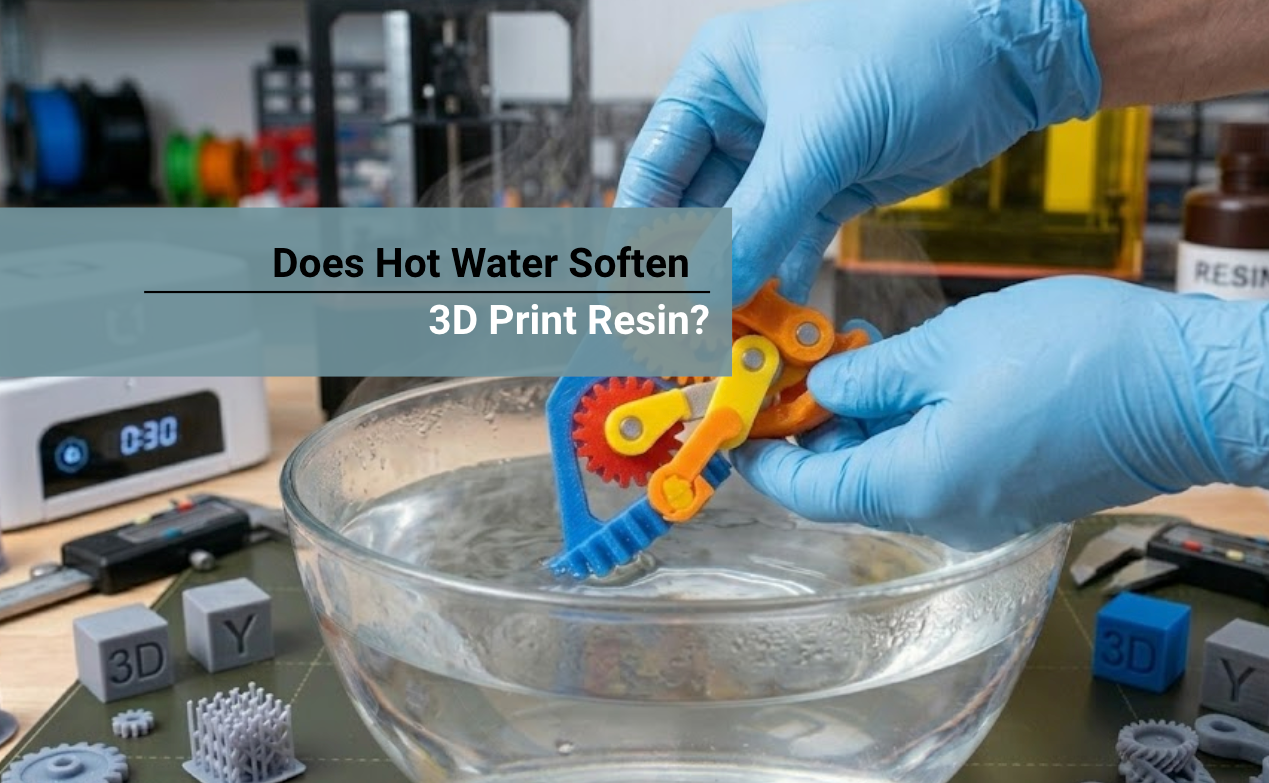
Does hot water soften 3d print resin? It is a common one for makers looking to improve their post-processing. Unlike filaments, 3D printing resins are thermoset polymers.
They do not melt when heated, but they do reach a state called the Glass Transition Temperature (Tg). At this point, the resin becomes flexible or "rubbery."
Hot water is often used intentionally to facilitate support removal or to slightly reshape warped parts.
However, excessive heat can lead to permanent deformation, loss of fine detail, or chemical leaching if the part is not fully cured.
This guide explores the science of resin softening, how to use heat safely in your workshop, and the thermal limits of different resin types.
Heat Deflection and Photopolymer Resin
To understand why this post-processing trick works, you must recognize the chemical state of your 3D print immediately after it leaves the build plate.
- When an LCD or SLA printer finishes a job, the resin is only partially cured. The UV light was strong enough to solidify the liquid, but the internal polymer chains are not fully cross-linked.
- Because the plastic is uncured, it is highly sensitive to external environmental factors, particularly heat.
- Heat Deflection Temperature (HDT): HDT refers to the exact temperature at which a polymer begins to soften and bend under a specific load. While fully cured engineering materials possess a high HDT, uncured resin has a significantly lower thermal resistance.
- Thermal Manipulation: Introducing warm water intentionally approaches the material's softening point. This changes the plastic from a brittle, glass-like state into a slightly elastic, rubbery state, allowing you to manipulate supports without fracturing the main body.
Why You Should Use Warm Water for Support Removal

Mechanically ripping supports off a cold, freshly washed print is the leading cause of surface blemishes. Utilizing a heated water bath solves several mechanical issues:
- Softer Support Tips: The contact points touching your model are engineered to be microscopic (often less than 0.3mm). Hot water penetrates these tiny tips rapidly, making them highly pliable.
- Reduced Pitting and Craters: When a rigid support snaps off, it often takes a micro-chunk of the main model with it. Softening the resin forces the support to yield and tear cleanly at the seam, preserving your surface.
- Protecting Delicate Features: The force required to clip a hard support can accidentally snap fragile parts, like swords on miniatures or jewelry prongs. The warm water method reduces the required removal force to almost zero.
Table 1: Water Temperature Guide for Resin Post-Processing
| Water Temperature | Effect on Uncured 3D Print Resin | Recommended Use Case |
|---|---|---|
| Cold Water (< 20°C) | Makes resin highly rigid, brittle, and prone to cracking under stress . | Avoid for support removal. Useful for forcing cured resin to contract off a metal build plate . |
| Warm Water (40°C - 50°C) | Softens contact points perfectly; plastic becomes slightly flexible and yielding . | The ideal, safe range for clean support removal without causing structural warping . |
| Boiling Water (100°C) | Causes severe softening, thermal expansion, and potential structural collapse . | Never use for uncured parts. Extreme heat destroys fine details and warps thin walls . |
Step-by-Step Guide to Removing Supports with Hot Water
Executing this process correctly requires strict control of timing and temperature. Follow these exact steps to achieve an unblemished finish.
Step 1: Initial Washing and Preparation
- Never place a dripping, resin-covered print directly into hot water. This contaminates the water and cures raw resin into a sticky sludge.
- Wash your print thoroughly in your preferred solvent (such as 90%+ Isopropyl Alcohol) to remove all unreacted liquid resin.
- Use a soft, natural-hair brush to clean fine crevices.
Step 2: Heat the Water Safely
- Prepare a separate container—ideally a dedicated plastic or metal tub for 3D printing tasks.
- Heat your water to a lukewarm temperature of 40°C to 50°C (104°F to 122°F).
- If you lack a thermometer, ensure the water feels like a comfortably hot bath. If it burns your hand, it will warp your print.
Step 3: The Short Immersion Phase
- Carefully submerge the 3D print into the warm water bath.
- Leave the print in the water for only 2 to 4 minutes.
- The goal is to heat the thin exterior support struts without allowing the dense core of the model to absorb heat. Prolonged soaking causes dimensional inaccuracy.
Step 4: Gentle Support Removal
- Remove the print from the water; the supports will immediately feel softer.
- Start from the outer edges and gently peel the supports inward. They should detach like a rubbery mesh.
- For thick base rafts or dense support forests, use flush cutters to snip the softened plastic without exerting extreme force.
- If a section hardens before you finish, simply dip that specific area back into the warm water for 30 seconds.
Step 5: Complete Drying and Post-Curing
- This is the most critical step: You must dry the print completely before placing it in a UV curing station.
- Use an air compressor, a blow dryer on a cool setting, or air dry it on a lint-free cloth for 15 minutes.
- Curing a wet print causes water droplets to act as microscopic magnifying glasses, which burns the resin and leaves ugly, cloudy spots across the model.
Which Resins Benefit Most from the Hot Water Method?

Understanding your material's specific properties dictates how you handle post-processing.
- Standard Resins: Formulated for extreme detail, standard resins are notoriously brittle in their green state. They benefit massively from the hot water method, as heat neutralizes their tendency to shatter.
- ABS-Like Resins: Engineered for impact resistance, these resins feature incredibly strong support structures that are tough to break by hand. Warm water softens these thick contact points, speeding up removal and preventing accidental cuts to your hands.
- High-Temperature Resins: Materials designed for extreme heat resistance require aggressive post-processing. While a standard resin softens at 40°C, a high-HDT engineering resin might shrug off warm water entirely, requiring mechanical cutting.
💡 Pro Tip for Cold Workshops: Temperature management begins before printing. If your resin is too cold, it thickens and becomes viscous, causing print failures. Always pre-warm your resin by letting the sealed bottle sit in a warm water bath for 10–15 minutes before pouring it into the vat.
Common Post-Processing Mistakes to Avoid
When combining heat, water, and raw chemicals, small errors can ruin hours of work. Avoid these common pitfalls:
- Using Boiling Water: Never pour boiling water onto an uncured print. It triggers severe thermal expansion, causing thin walls to immediately warp, curl, and deform.
- Extended Soaking Times: Soaking a print for 20 to 30 minutes allows water to deeply penetrate the polymer matrix. This weakens structural integrity and causes "swelling," permanently ruining dimensional accuracy.
- Attempting to Melt Cured Resin: The hot water trick only works on uncured, "green" prints. Once fully post-cured under UV light, the polymer chains are permanently locked. Cured resin does not melt or dissolve in hot water.
Table 2: Alternative Support Removal Methods
| Support Removal Method | Pros | Cons | Best Suited For |
|---|---|---|---|
| Warm Water Bath | Eliminates pitting; supports peel away smoothly; highly accessible . | Traps moisture if not dried properly before curing . | Highly detailed miniatures, thin walls, and complex geometries. |
| Flush Cutters (Clippers) | Precise mechanical control; no heat or water is introduced to the plastic. | Time-consuming; often leaves small nubs that require heavy sanding. | Thick, structural supports and industrial engineering parts. |
| Heat Gun / Hair Dryer | Quick, targeted heating; keeps the model completely dry. | Uneven heating can easily melt or permanently warp thin sections . | Spot-treating stubborn, isolated support brackets. |
Recommended High-Performance Resins
To spend less time fighting with support structures, upgrade your raw materials. High-quality resins are formulated to print with finer contact points that break away cleanly without excessive thermal manipulation.
- For Durability and Clean Peels: Explore the Siraya Tech Fast ABS-Like Resin Collection. Engineered for an optimal balance of toughness and printability, its supports are robust during printing but yield beautifully during post-processing.
- For Everyday Modeling: The Siraya Tech Engineering Resin Collection offers unparalleled detail capture. When paired with a 40°C warm water bath, supports slip away effortlessly, leaving a pristine finish ready for primer.
Conclusion
Mastering the post-processing phase is what separates amateur prints from professional, retail-ready models.
Using hot water to soften 3D print resin is an incredibly effective, highly accessible technique that dramatically reduces surface damage and pitting.
By strictly managing your temperatures (40°C–50°C) and ensuring parts are completely dry before UV curing, you guarantee consistently flawless results.
Pair this technique with premium materials, and your workflow will become faster, cleaner, and far more reliable.
FAQs: Does Hot Water Soften 3D Print Resin?
Does hot water soften 3D print resin permanently?
No, the softening effect is strictly temporary. Warm water lowers the material's structural rigidity through thermal transfer. Once removed from the water and cooled to room temperature, the uncured resin returns to its original rigid state.
Will hot water cloud clear 3D resin prints?
Yes, it is highly likely. Clear resins are extremely sensitive to temperature fluctuations and moisture. Submerging them in hot water can leave a permanent milky haze on the surface. Use room-temperature mechanical removal for transparent materials to maintain optical clarity.
Can I use hot water on models that are already cured?
You can, but it is highly ineffective. Once the photopolymer resin is fully cured under UV light, its chemical structure is locked permanently. While extreme heat may make it slightly pliable, it will not soften supports enough for easy removal, and forcing it will likely crack the model.
How long should I soak my resin print in warm water?
Limit your soaking time to exactly 2 to 4 minutes. This provides enough time for heat to penetrate the thin support tips without warming the core of the main model. Extended soaking causes the resin to swell and permanently lose dimensional accuracy.
Can I use a hair dryer instead of hot water to soften resin?
While technically possible, it is highly discouraged. Hair dryers and heat guns blast concentrated, uneven dry heat. This intense localized heating can quickly warp thin areas, melt fine details, and cause thermal stress cracking. A warm water bath provides gentle, even heating across the entire model.