Pet-GF Filament
1 製品
1 製品の1 - 1を表示しています。
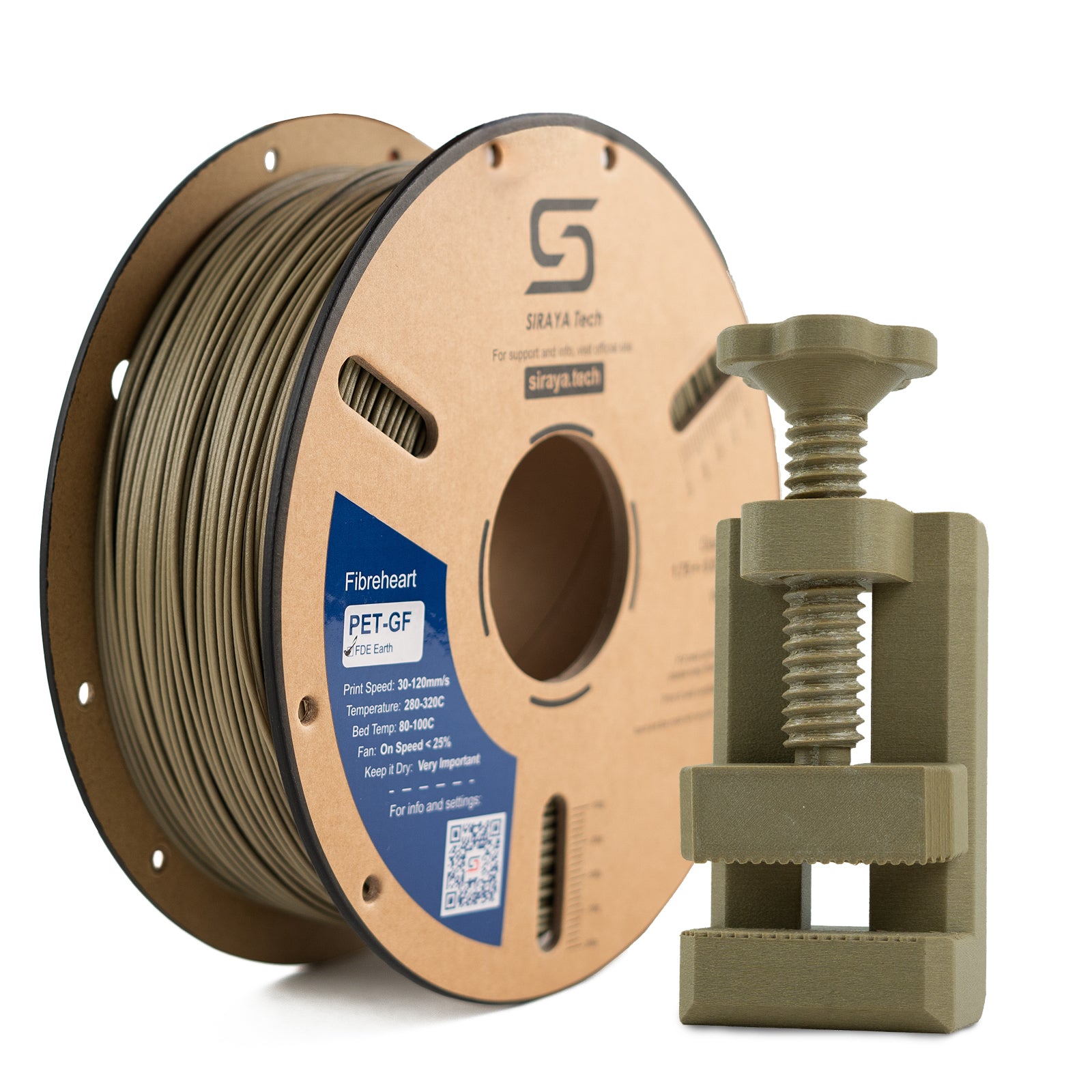
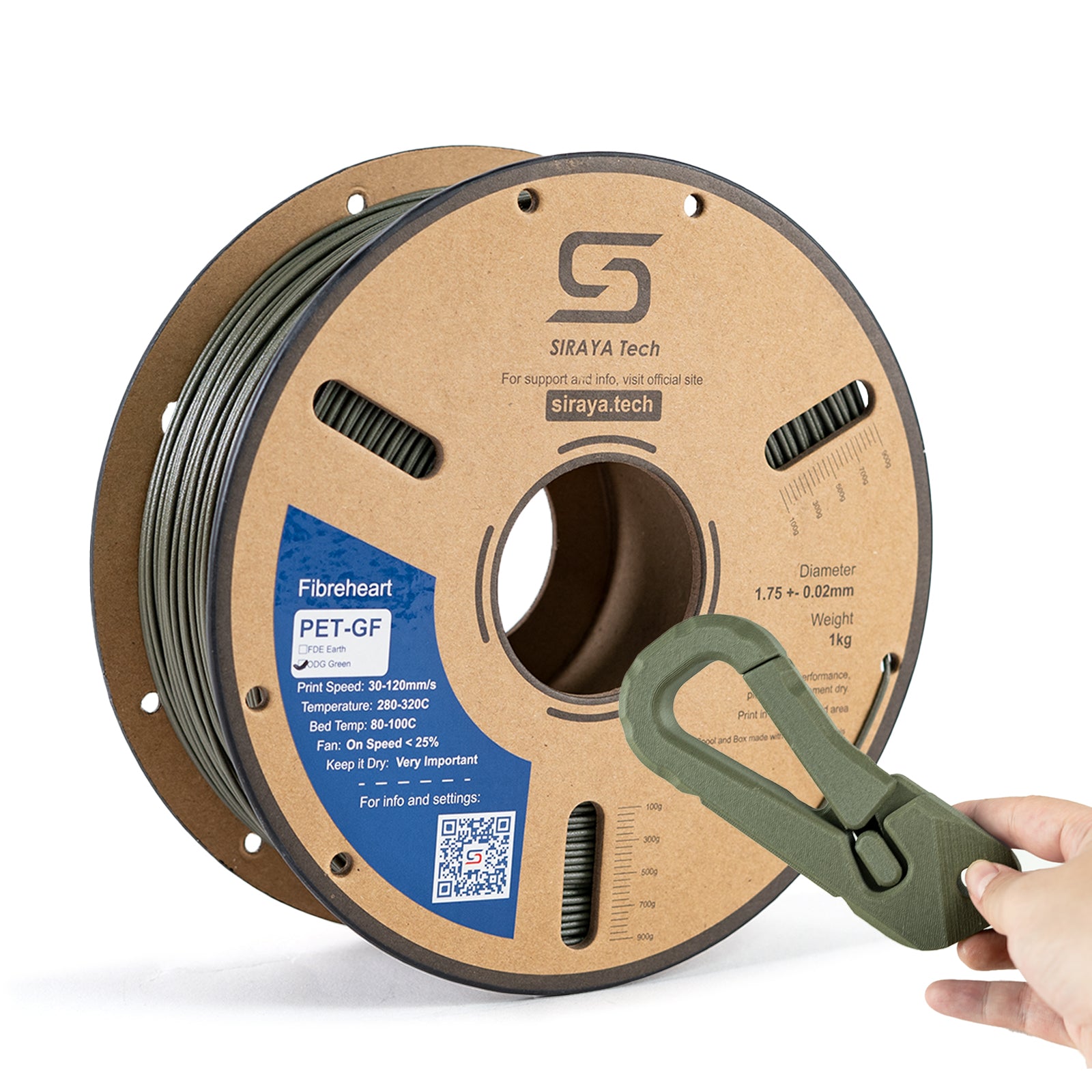
PET-GF filament is a glass fiber reinforced polyethylene terephthalate formulation that delivers significantly higher strength, stiffness, and thermal resistance than standard PETG. The 15% glass fiber content reduces warping, improves dimensional stability, and provides meaningful UV resistance for outdoor applications.
Siraya Tech Fibreheart PET-GF is engineered for printers capable of reaching 300 degree Celsius nozzle temperatures, with print profiles available for Bambu Lab, Qidi Tech, and Creality systems.
What Is PET-GF Filament?
PET-GF is polyethylene terephthalate glycol-modified and reinforced with 15% glass fibers. The glycol modification improves toughness and reduces brittleness compared to standard PET. The glass fiber reinforcement raises tensile strength, flexural modulus, and heat deflection temperature while reducing thermal expansion and warping during cooling.
Standard PETG is easy to print and offers good toughness and chemical resistance, but it has limited thermal resistance and can deform under load at moderate temperatures. PET-GF handles higher service temperatures, maintains dimensional accuracy better across temperature cycles, and resists UV degradation that causes standard PETG to yellow and embrittle outdoors.
The trade-off is higher printing temperatures (300°C vs. 240-260°C for standard PETG) and the need for a hardened steel nozzle since glass fiber is abrasive. View Fibreheart PET-GF specifications.
Technical Properties
- 15% Glass Fiber Reinforcement Significantly higher tensile strength and flexural modulus than standard PETG. The fiber content adds stiffness and reduces softening under load.
- Heat Deflection Temperature Higher than standard PETG. Annealing after printing can push HDT higher, making PET-GF suitable for parts that see elevated operating temperatures.
- Low Moisture Absorption PET-GF prints absorb less moisture than standard PETG, ensuring consistent quality across humid conditions and better shelf life.
- UV Resistance The reinforced formulation resists UV degradation better than standard PETG, maintaining mechanical properties over time under sun exposure.
- Dimensional Stability Glass fiber reduces thermal contraction, making PET-GF more predictable for large functional assemblies and reducing warping issues.
Applications and Use Cases
- Industrial Prototypes Produces parts that hold tight tolerances and resist deformation under mechanical load, behaving like production parts.
- Outdoor Equipment UV resistance and low moisture absorption make this practical for drone frames, sensor housings, and field equipment.
- Automotive Components Higher heat resistance allows PET-GF to perform better in elevated temperature environments than standard PETG.
- Robotics The combination of strength, stiffness, and dimensional accuracy makes it reliable for structural brackets and enclosures.
- Marine Parts Low moisture absorption and UV resistance suit PET-GF for components on watercraft exposed to sunlight and water.
Print Settings & Requirements
Download print profiles for Bambu Lab, Qidi Tech, and Creality.
Color Options
- Flat Dark Earth (FDE) Military-grade coating color, suited to outdoor gear and tactical equipment.
- Olive Green Field-appropriate color for agricultural, military, and outdoor applications.
- White High visibility option for equipment that needs to be seen in the field or workplace.
- Black Standard technical color for general-purpose industrial applications.
Storage and Handling
While PET-GF prints have very low moisture absorption, the raw filament is still sensitive to humidity. Store unused filament in sealed packaging with desiccant. Keep filament in a dry box or dehumidified storage when not in use to extend its useful life.
PET-GF Comparisons
- Vs. PETG PET-GF is stronger, stiffer, and more heat resistant. Standard PETG is easier to print at lower temperatures and offers better layer adhesion for simple parts.
- Vs. ABS CF PET-GF prints at similar temperatures but absorbs less moisture. ABS CF requires an enclosure and is more prone to delamination if cooled too quickly.
- Vs. ASA GF Both offer UV resistance. PET-GF has lower moisture absorption, while ASA GF offers better surface finish and chemical resistance in some cases.