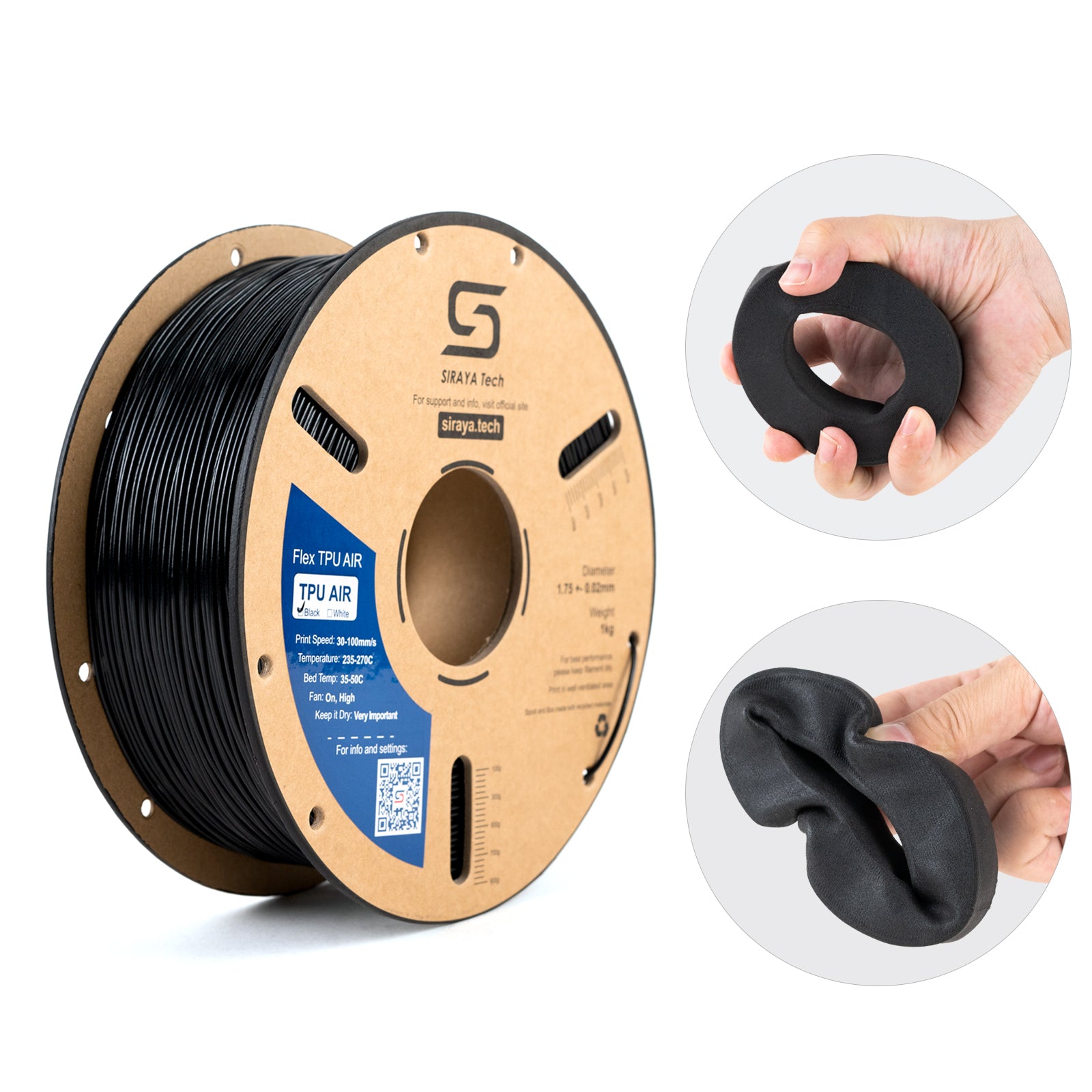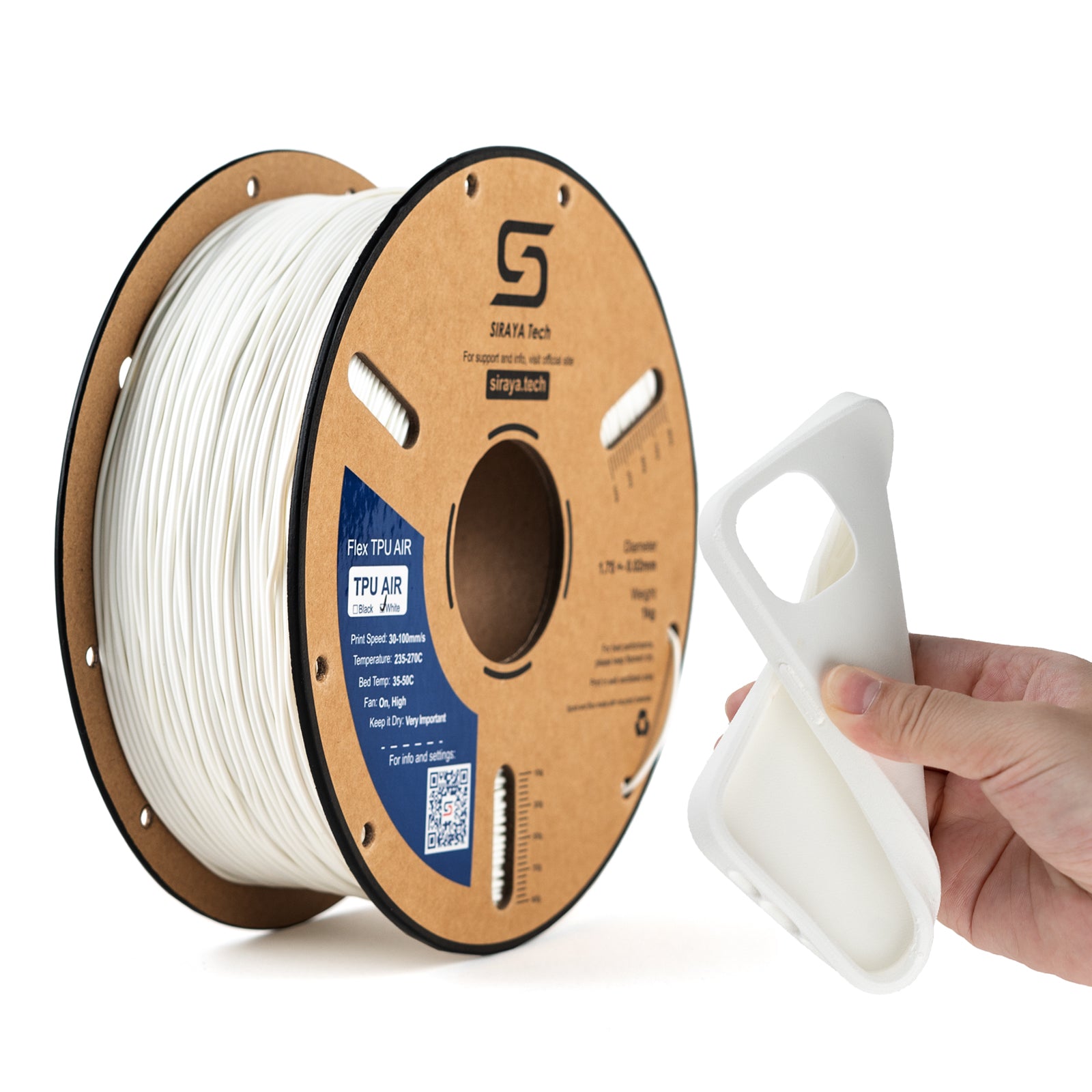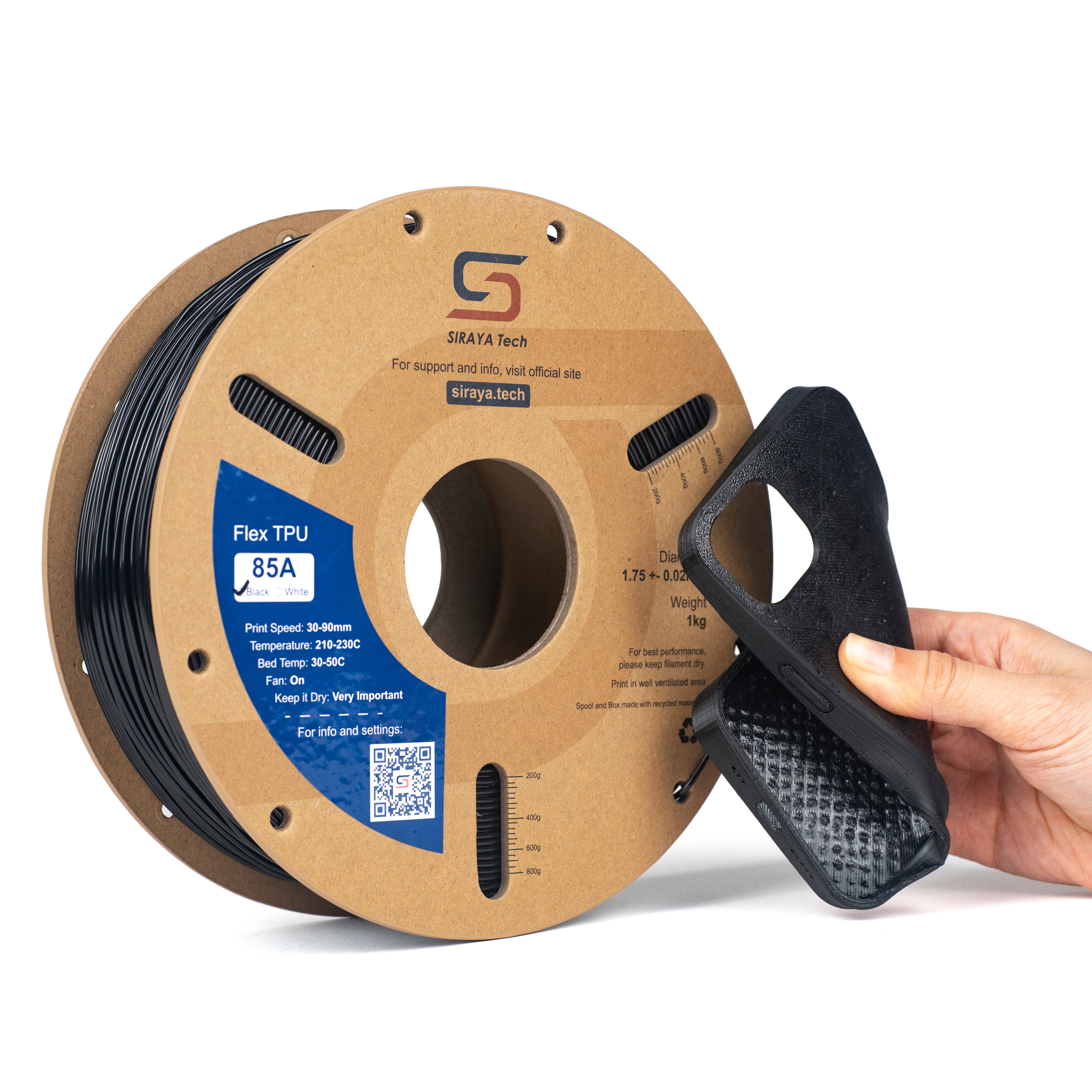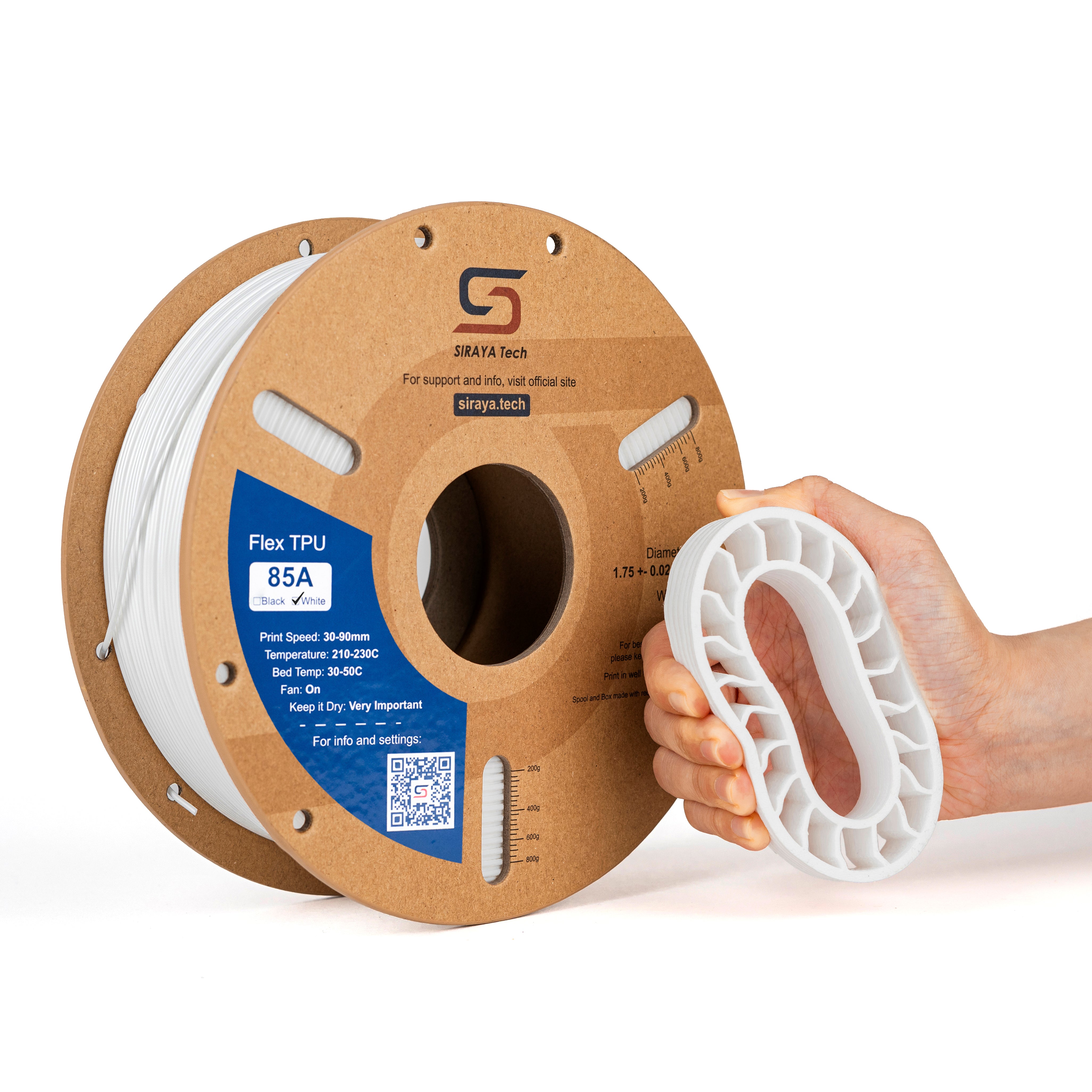
TPU Filament 1.75mm
7 製品
7 製品の1 - 7を表示しています。
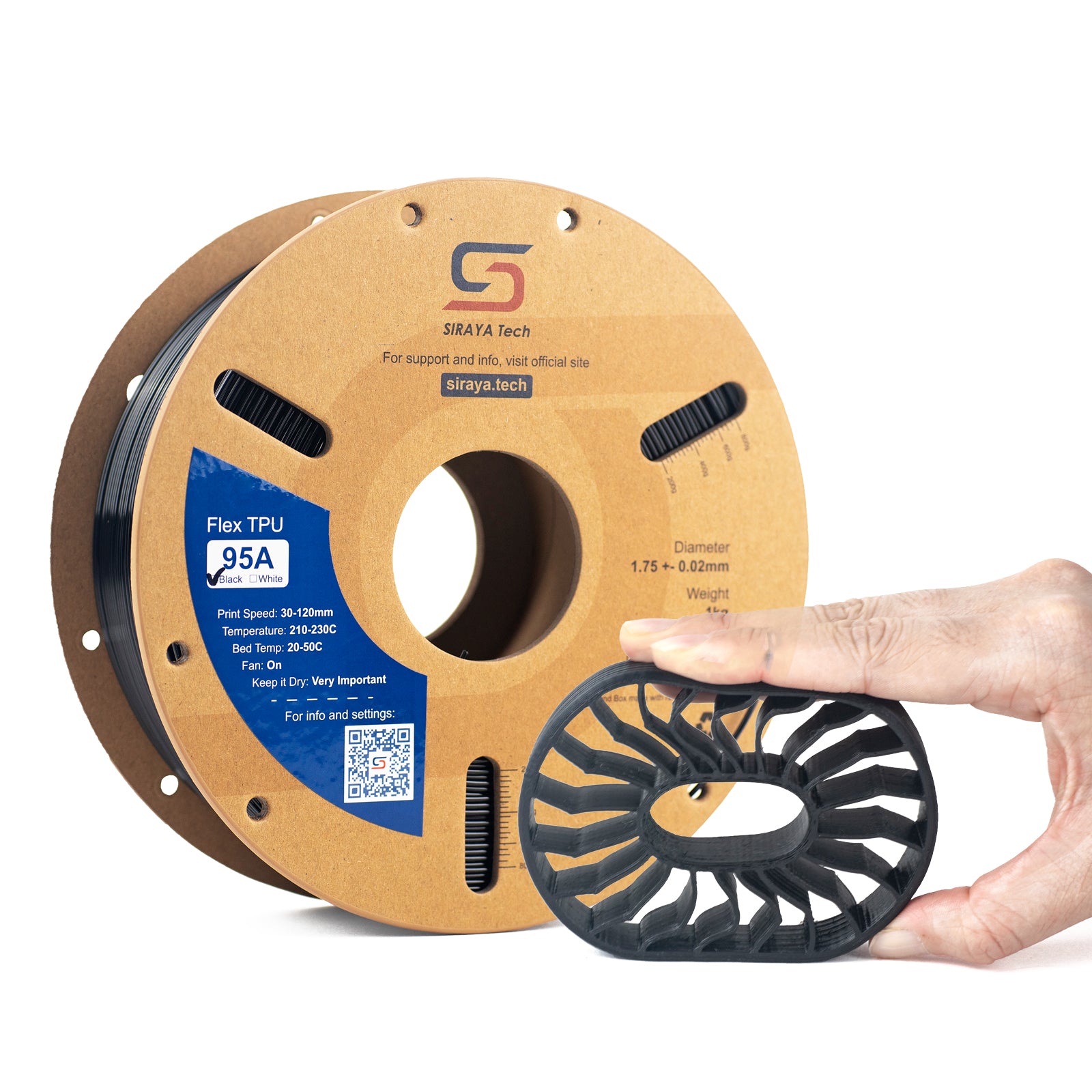
TPU filament 1.75mm is the standard flexible material for FDM 3D printing. It prints rubber-like parts that bend, compress, and snap back without cracking. Siraya Tech's Flex Family covers every hardness from ultra-soft 65A foaming materials to semi-rigid 64D, so you can match the exact feel and function your project demands.
What Is TPU Filament?
Thermoplastic Polyurethane (TPU) is a class of elastic polymer that behaves like rubber at room temperature but melts and flows like a thermoplastic when heated. In 1.75mm FDM printing, TPU filament is the go-to choice whenever a part needs to:
- Absorb repeated impact without fracturing
- Flex or compress and return to its original shape
- Grip a surface without slipping
- Withstand abrasion, oil, UV, or outdoor exposure
- Feel soft and comfortable against skin
Unlike PLA or ABS, TPU has an elongation at break typically ranging from 400% to 700%, meaning a part can stretch to several times its original length before tearing. Hardness is measured on the Shore A scale: lower numbers are softer and more rubber-like, higher numbers are stiffer and more plastic-like.
Shore Hardness Guide: 65A to 64D Explained
The Shore A number printed on every spool determines three things: how the finished part feels, whether your printer can push it reliably, and how fast you can print it. Use the table below to find the right hardness for your printer and project.
| Shore Hardness | Feel (Real-World Reference) | Best For | Extruder Requirement |
|---|---|---|---|
| 65A to 82A (TPU Air) | Squishy foam / memory foam insole | Cushioning, lightweight footwear midsoles, shock pads | Direct drive only |
| 85A (Flex) | Soft shoe insole / pencil eraser | Watch bands, grips, gaskets, wearables | Direct drive strongly recommended |
| 95A (Flex) | Shopping cart wheel / hard rubber heel | Phone cases, drone guards, cable strain reliefs, living hinges | Direct drive or Bowden (careful tuning) |
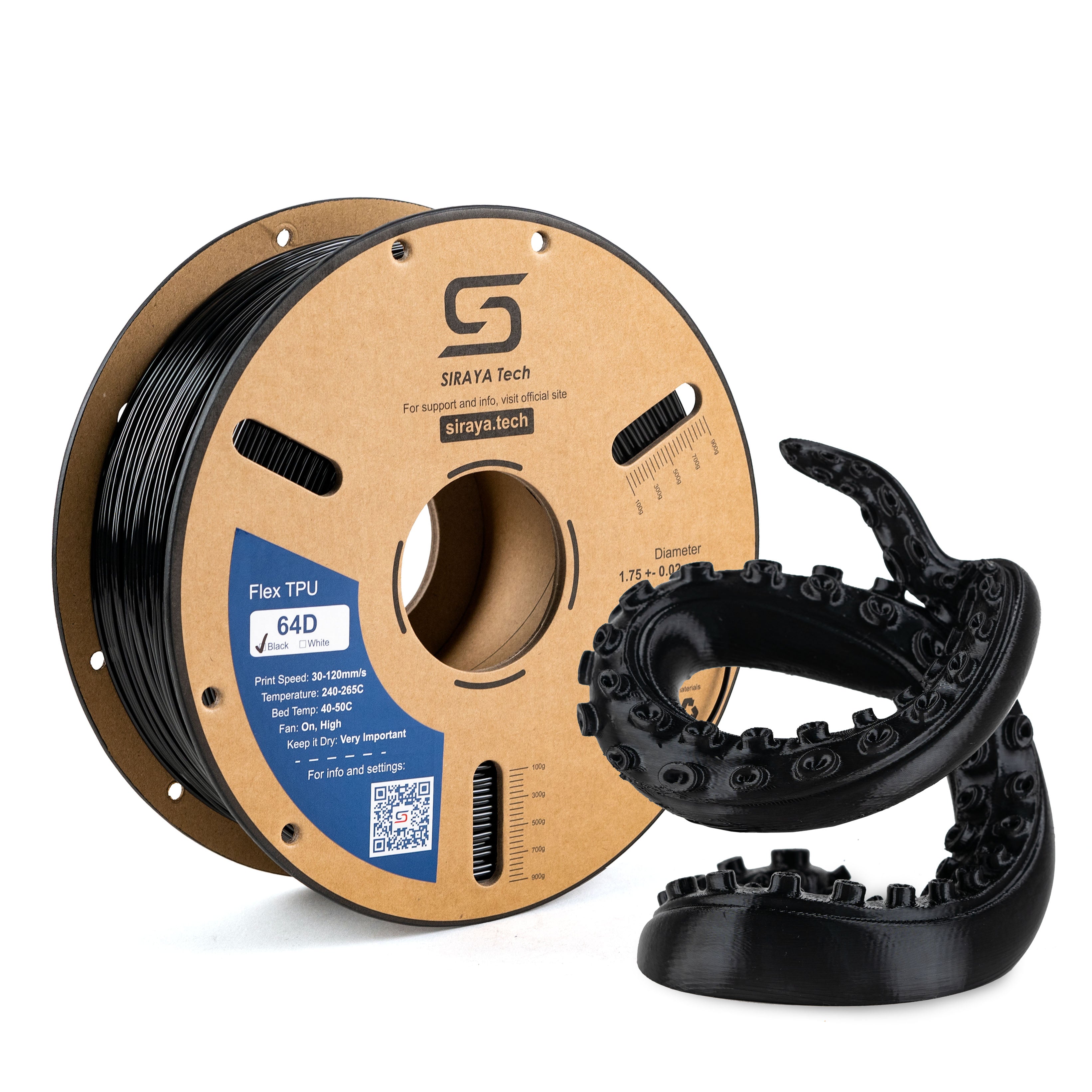
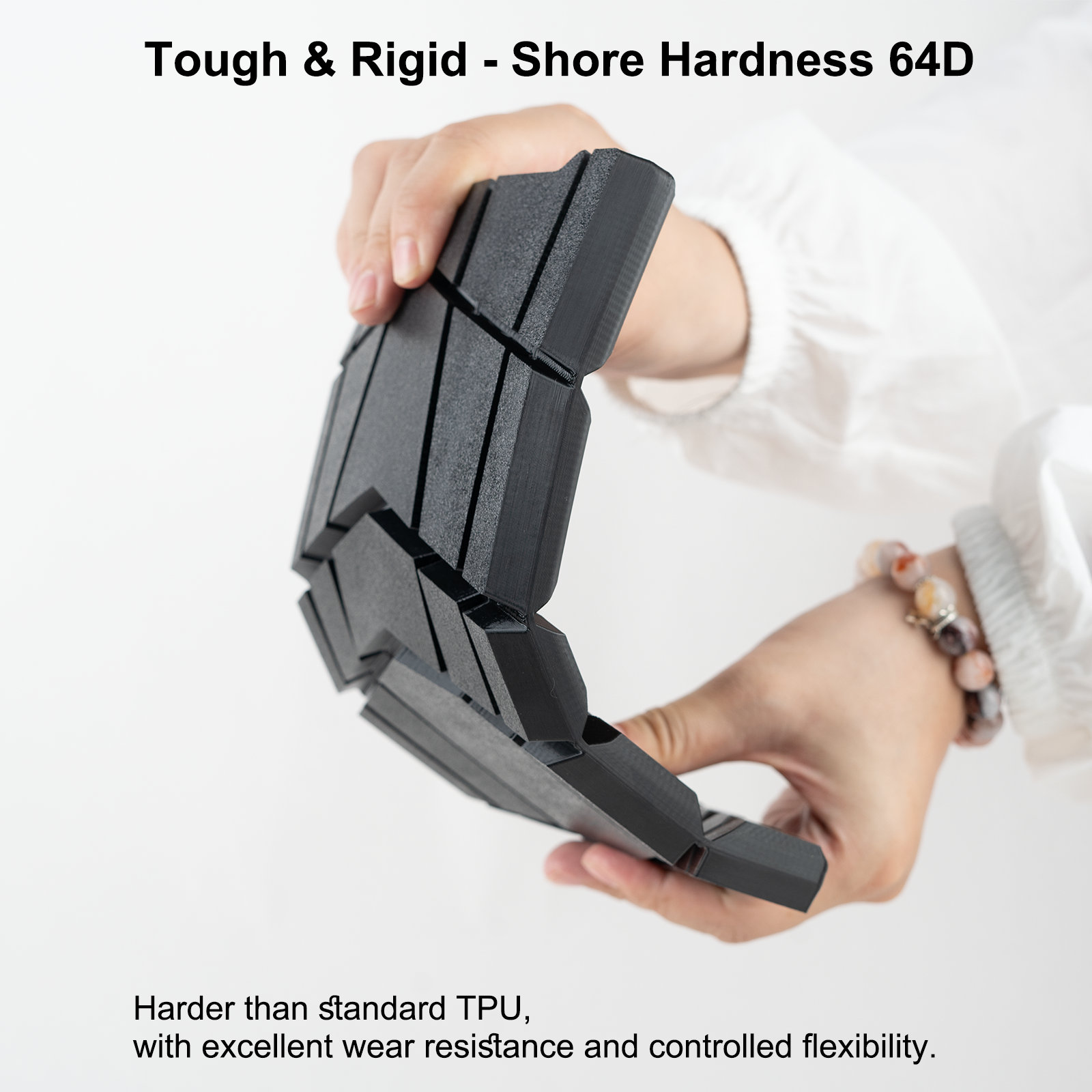
| 64D (Flex) | Dense hard rubber / nylon feel | Functional brackets, semi-rigid hinges, wear-resistant parts | Works like standard rigid filament |
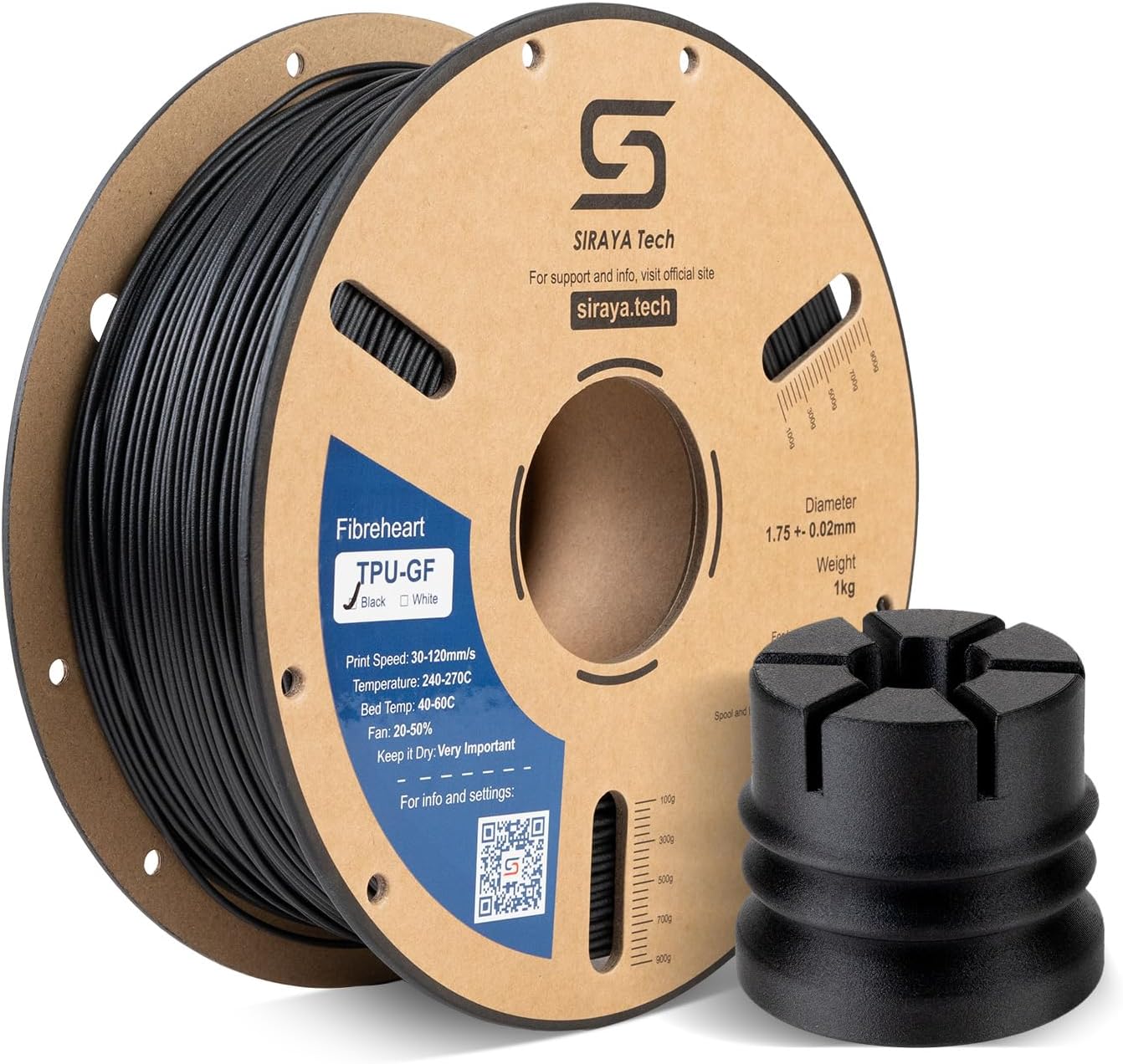
| TPU-GF (Glass Fiber) | Stiff flexible with high rigidity | Structural flexible parts that need dimensional stability | Hardened nozzle recommended |
Quick rule: Start with 95A if you are new to flexible filaments. It feeds through most printers with minimal tuning. Move to 85A or lower only once you are comfortable with TPU printing, and ideally with a direct drive extruder installed.
Printer Compatibility: Direct Drive vs Bowden vs AMS
Flexible filament behavior during printing is heavily influenced by how far the filament has to travel from the extruder motor to the nozzle. The softer the material, the more it resists being pushed through a long path.
| Setup Type | TPU 95A | TPU 85A | TPU Air 65A to 82A | TPU 64D |
|---|---|---|---|---|
| Direct Drive (Bambu, Prusa MK4, Voron) | Yes | Yes | Yes | Yes |
| Bowden (Ender 3, CR-10) | Careful tuning | Not recommended | Not recommended | Yes |
| AMS / Multi-filament Hub | Not recommended | Not recommended | Not recommended | Check hub specs |
| 3D Pen | Yes | Yes | Not recommended | Yes |
For Bowden setups printing 95A, lower retraction to 1 to 2 mm and reduce print speed to 20 to 30 mm/s. Disabling retraction entirely and printing with minimum 0% infill or vase mode can help prevent buckling in the tube.
Print Settings: Recommended Parameters by Grade
All Siraya Tech TPU filaments are pre-dried and vacuum-sealed in moisture-barrier aluminum bags before shipping. The settings below are starting points. Fine-tune nozzle temperature in 5°C increments if you observe stringing (reduce) or under-extrusion (increase).
| Product | Nozzle Temp | Bed Temp | Print Speed | Diameter Tolerance |
|---|---|---|---|---|
| Flex TPU 95A | 210 to 230°C | 40 to 60°C | 20 to 50 mm/s | ±0.05 mm |
| Flex TPU 85A | 210 to 230°C | 40 to 60°C | 15 to 30 mm/s | ±0.05 mm |
| Flex TPU 64D | 220 to 240°C | 40 to 60°C | 30 to 60 mm/s | ±0.05 mm |
| TPU Air 65A to 82A | 210 to 235°C | 30 to 55°C | 20 to 40 mm/s | ±0.05 mm |
| TPU-GF 15% | 220 to 240°C | 40 to 60°C | 20 to 40 mm/s | ±0.05 mm |
Moisture matters. TPU absorbs humidity quickly once opened. If you notice bubbling, popping sounds, or rough surface finish, dry your spool at 55°C for 6 to 8 hours before printing. Store open spools in a sealed container with desiccant at under 20% relative humidity.
Buyer's Guide: Which TPU Grade Is Right for Your Project?
Use this guide to quickly match your application to the right Siraya Tech product.
The all-around workhorse. Works on nearly every FDM printer. Excellent for phone cases, cable strain reliefs, drone bumpers, gaskets, and living hinges that flex thousands of times.
Shop 95ATrue rubber feel. Best for watch bands, shoe insoles, ergonomic grips, and wearable parts that need skin-friendly softness and grip. Requires direct drive.
Shop 85ABridges the gap between rigid and flexible. Ideal for wear-resistant mechanical parts, structural brackets with some give, and high-impact protection covers.
Shop 64DFoaming TPU that is up to 30% lighter than solid grades. Perfect for cushioning layers, padding, lightweight insoles, and parts that need controlled compression.
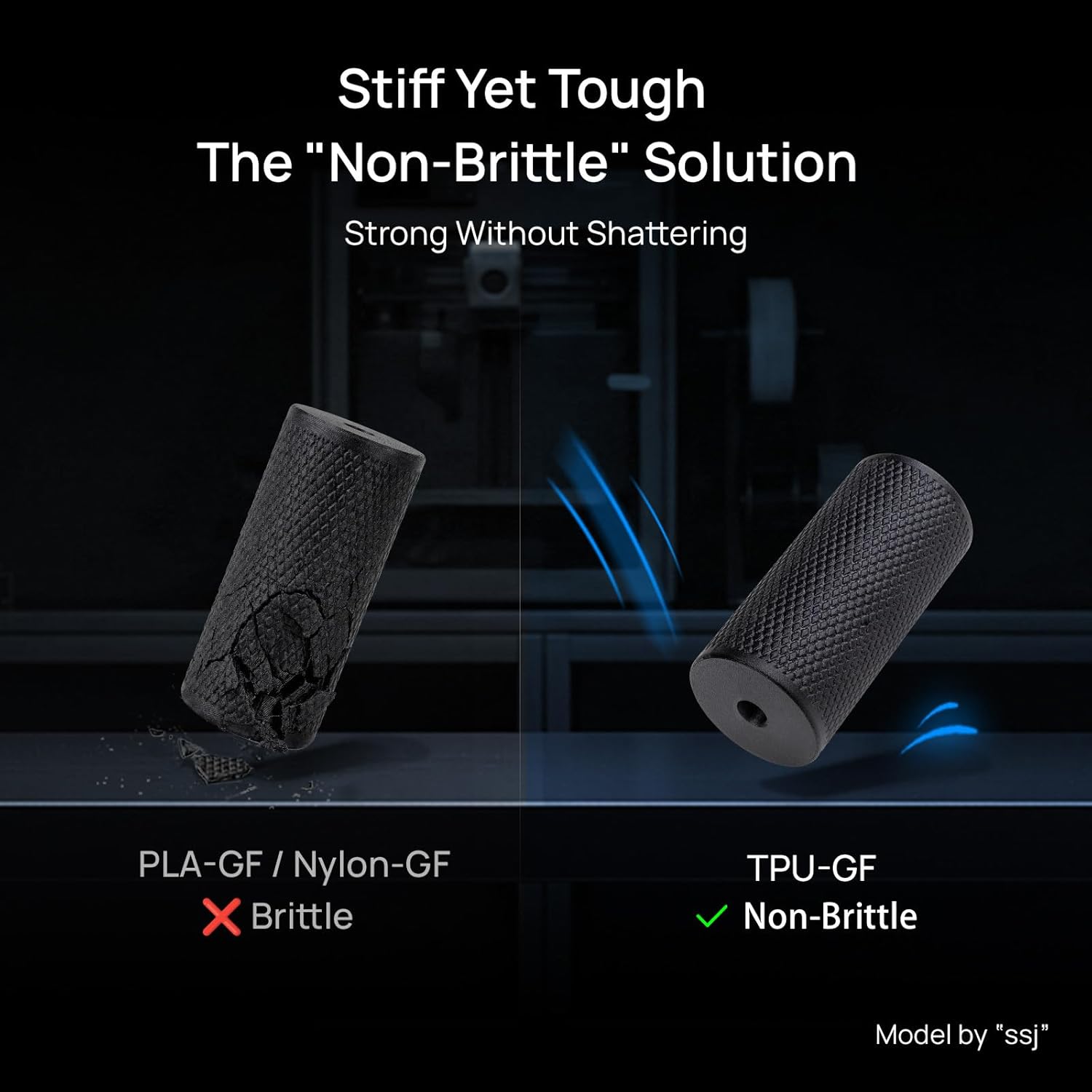
Shop TPU AirGlass-fiber reinforced TPU for flexible parts that also need dimensional stability under load. Reduced elongation compared to standard TPU with improved stiffness.
Shop TPU-GFHigh-rebound foaming TPU developed specifically for 3D-printed footwear. Available in 80A and 85A. Engineered for midsole energy return in athletic shoes.
Shop RoamrWhat Can You Print with TPU Filament 1.75mm?
TPU's rubber-like behavior makes it the default material for any part that needs flexibility, grip, or impact protection. Common applications include:
- Phone and tablet cases: Drop protection with a soft-touch finish. 95A gives structural rigidity; 85A gives a grippier feel.
- Drone motor guards and bumpers: Absorb crash impact without shattering, protecting frames and components.
- Cable strain reliefs and cord organizers: Prevents cable fatigue at bending points.
- Custom gaskets and seals: Oil-resistant and weather-resistant with good compression set.
- Watch bands and wearables: Skin-safe, flexible, and sweat-resistant.
- Shoe insoles and orthotic inserts: Custom-fit cushioning with 85A or foamed TPU Air.
- Vibration-dampening mounts: Isolates vibration in camera rigs, RC vehicles, and industrial equipment.
- Flexible joints and living hinges: Functional hinges that can be bent hundreds of thousands of times without fatigue failure.
- RC car tires and tracks: Abrasion-resistant and grippy on varied surfaces.
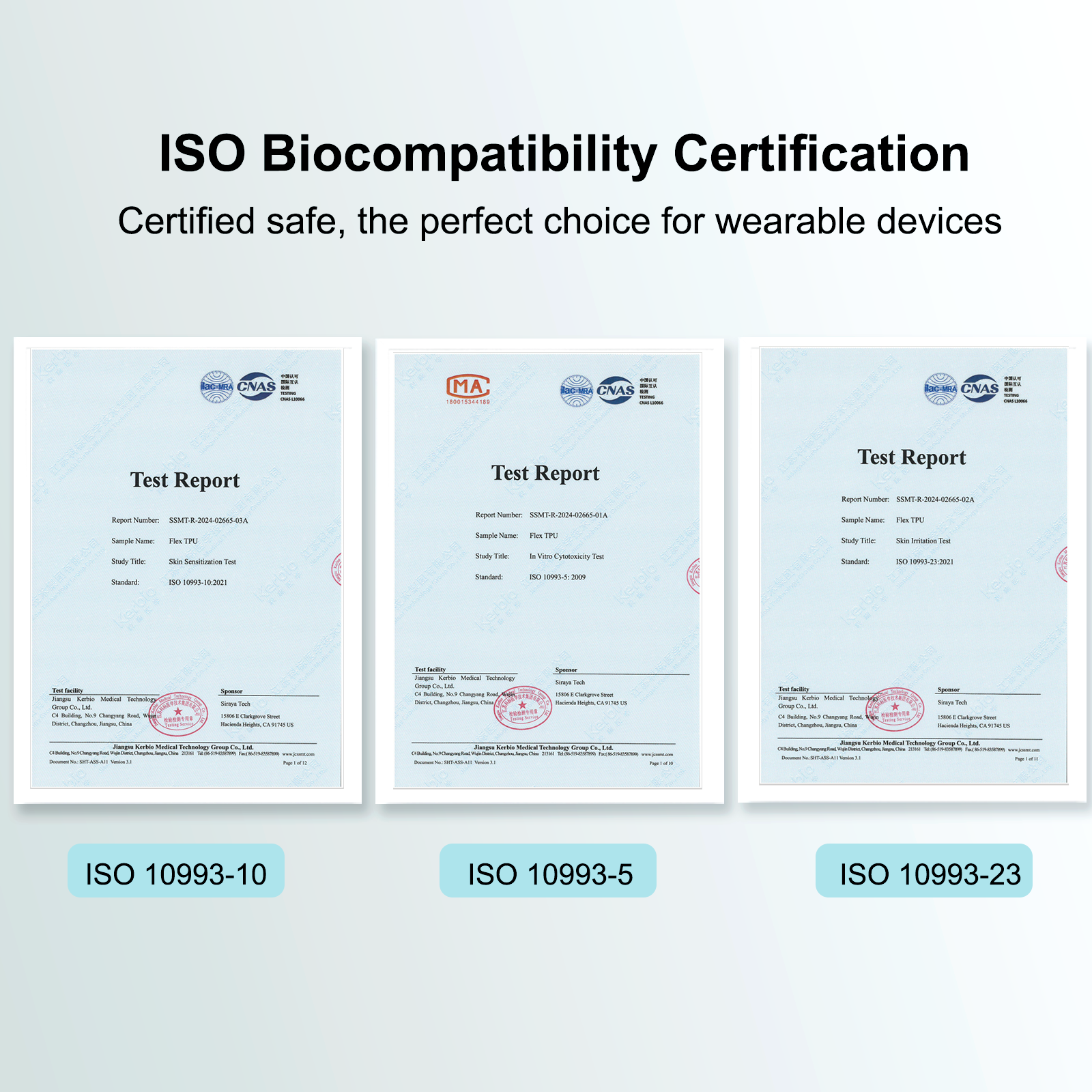
- Medical and prosthetics prototyping: Soft, biocompatible-friendly interfaces for prosthetic liners and orthotic components (confirm biocompatibility for your specific application).
Why Siraya Tech for TPU Filament?
Siraya Tech started as a UV resin specialist, engineering materials used in professional dental, jewelry, and engineering applications. When the company entered the FDM filament market, the same formulation discipline carried over into every spool. What that means for TPU buyers:
- Vacuum-sealed aluminum packaging: Every spool ships moisture-protected. Wet TPU causes bubbles and surface defects. Siraya Tech's packaging standard ensures the filament is dry from day one.
- Tight diameter tolerance (±0.05 mm): Consistent diameter means consistent extrusion. No unexpected under-extrusion mid-print from a spool with varying diameter.
- Comprehensive hardness range: From ultra-soft 65A foaming grades to glass-fiber reinforced TPU-GF, Siraya Tech covers the full spectrum. You do not need to switch suppliers as your projects grow more demanding.
- Dedicated print profiles: Free slicer profiles for Bambu Studio, PrusaSlicer, Cura, and Orca Slicer are available on the Print Settings Download page.
- Technical documentation: Safety Data Sheets (SDS) and Technical Data Sheets (TDS) are publicly available for every product. Useful for compliance, medical, or food-contact evaluation.
- Direct support: Reach the team by phone at +1 (323) 412-8788 or email at [email protected].
Explore Related Collections
Related Articles
Frequently Asked Questions
What is TPU filament used for in 3D printing?
- Phone cases and protective covers
- Shoe insoles and orthotic inserts
- Drone guards and bumpers
- Cable strain reliefs
- Custom gaskets and seals
- Watch bands and wearable accessories
- Vibration-dampening mounts
What does 95A or 85A mean on a TPU filament spool?
- 65A to 82A: Very soft, foam-like, like a memory foam insole
- 85A: Soft rubber, like a shoe insole or pencil eraser
- 95A: Medium rubber, like a shopping cart wheel or dense eraser
- 64D (Shore D scale): Semi-rigid, prints and feels closer to a hard nylon
Can I print TPU on a Bowden extruder like the Ender 3?
- Reduce print speed to 20 to 30 mm/s
- Lower retraction to 1 to 2 mm or disable it entirely
- Ensure there are no gaps in the Bowden tube connection at the hotend
- Use direct flow with no AMS or filament hub
Does TPU filament need to be dried before printing?
What print temperature should I use for TPU filament 1.75mm?
- If you see stringing or oozing, lower the nozzle temperature by 5°C
- If you see under-extrusion or rough surface texture, raise it by 5°C
Is TPU filament compatible with Bambu Lab printers?
What is the difference between TPU and PEBA filament?
- TPU (Thermoplastic Polyurethane): More affordable, widely compatible, excellent abrasion resistance, good general-purpose flexibility. Best for most everyday flexible prints.
- PEBA (Polyether Block Amide): Higher energy return (better rebound), lighter weight, stays flexible at lower temperatures. Best for athletic footwear midsoles, cold-weather gear, and applications where spring-back performance matters.