
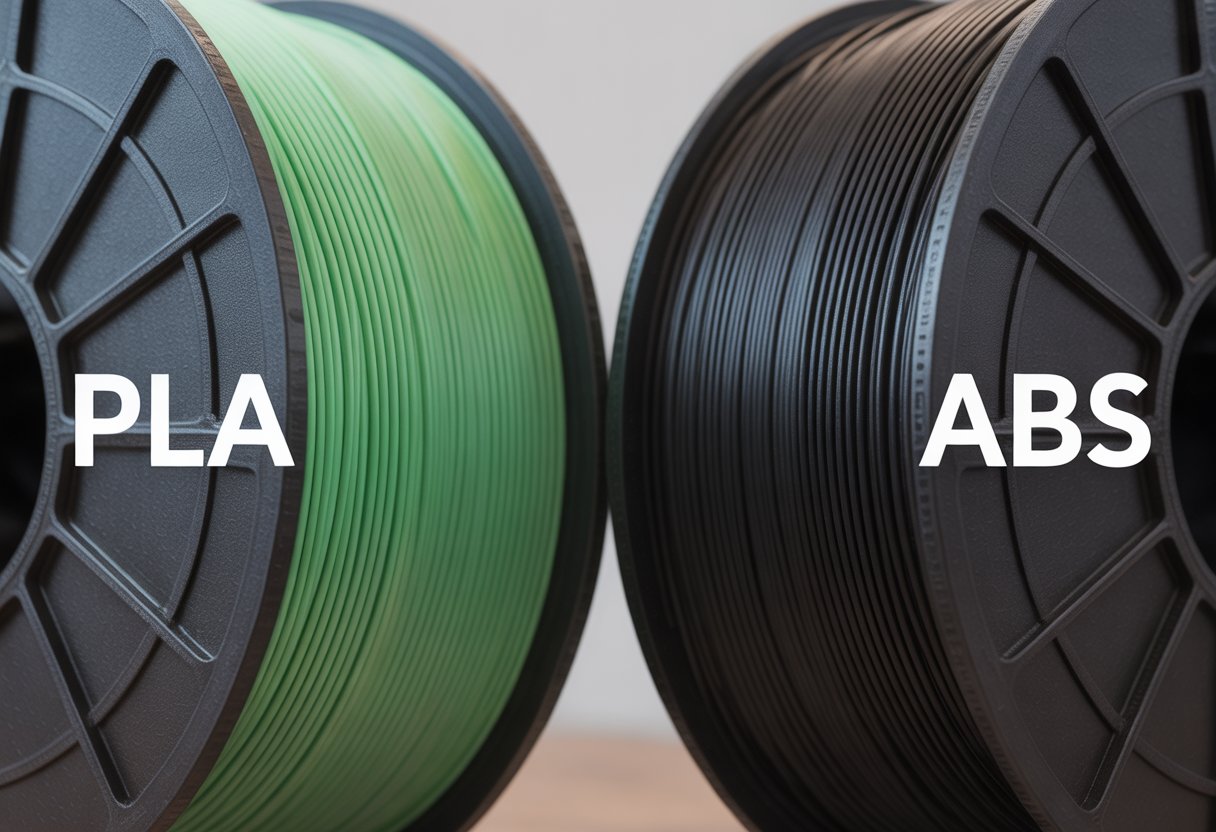
When you get into 3D printing, picking the right filament really matters. PLA vs ABS is a big debate since both plastics work for different things. PLA (Polylactic Acid) is simple to print, eco-friendly, and works best for hobby projects or decorative items. ABS (Acrylonitrile Butadiene Styrene), on the other hand, is tougher, more durable, and heat-resistant, making it a better choice for functional parts and rapid prototypes.
PLA is more brittle and has a lower heat tolerance, while ABS demands an enclosed printer and good ventilation since it can release fumes during printing. In short, PLA is ideal for ease and aesthetics, while ABS is better suited for strength and performance.
Both filaments work on most FDM 3D printers. The one you pick changes how your print turns out and where you can use it. Understanding what each filament does helps you make a smarter pick for your 3D print.
Key Takeaways
- PLA is simpler to print and better for basic models, decorations, and prototypes.
- ABS is tougher, more heat-resistant, and works well for functional parts that need to survive stress.
- PLA prints at 180-220°C and rarely warps. ABS needs 220-250°C, a heated bed, and an enclosure.
- ABS can be smoothed with acetone vapor. PLA cannot.
- For even better performance than standard ABS, fiber-reinforced filaments like ABS-CF and ABS-GF reduce warping and increase strength.
- Choosing the right filament saves time and improves your print results.
Discover endless possibilities for your projects. Explore our collection of filaments today.
PLA vs ABS: Key Differences at a Glance

When you're stuck between PLA and ABS, you want to look at cost, strength, and how easy they are to print. Using the right one can really help your prints come out better.
Full Comparison Table
| Feature | PLA | ABS |
|---|---|---|
| Cost | Usually cheaper | Slightly more expensive |
| Tensile Strength | ~60 MPa | ~40 MPa |
| Impact Resistance | Low (brittle) | High (tough, flexible) |
| Heat Resistance (Glass Transition) | ~60°C (140°F) | ~105°C (221°F) |
| Print Temperature (Nozzle) | 180-220°C | 220-250°C |
| Bed Temperature | 50-60°C (optional) | 90-110°C (required) |
| Heated Bed Required? | No | Yes |
| Enclosure Required? | No | Recommended |
| Warping | Minimal | Significant |
| Odor | Mild, slightly sweet | Strong, unpleasant |
| Biodegradable | Yes (industrial composting) | No |
| Acetone Smoothing | No | Yes |
| UV Resistance | Poor | Moderate |
| Best For | Models, decor, prototypes | Tools, enclosures, functional parts |
Quick Guide on When to Use PLA vs ABS
Go with PLA if you want low-cost, easy-to-print stuff. It's perfect for toys, decorations, and simple prototypes.
Pick ABS when you need something strong and that can handle heat. It's solid for tools, car parts, or anything that needs to survive outside or under stress.
If you care about speed and ease, PLA wins. If you need strength and don't mind a challenge, ABS is your friend.
Looking for strength and reliability? Browse our selection of ABS filaments in the collection.
PLA Filament Basics

PLA filament, or polylactic acid, is a popular 3D printing plastic made from plants like corn or sugar cane. It's easy to print and better for the environment.
You won't get much smell, and you can use it indoors without worrying about bad air.
Pros of PLA (Easy, Cheap, Eco-Friendly)
- Melts at a low temperature, so you don't need a fancy printer.
- Usually cheaper than other plastics, so you can print more without spending a ton.
- Biodegradable under industrial composting conditions.
- Doesn't stink while printing, so you can work inside without fans or filters.
- Higher stiffness than ABS, which means it holds shape and detail well.
Cons of PLA (Brittle, Low Heat Resistance)
- Brittle and can snap or break if you try to bend or drop it.
- Starts to soften at around 60°C (140°F), so don't leave prints in a hot car or near a heater.
- Poor UV resistance. Degrades faster when exposed to direct sunlight.
- Cannot be acetone-smoothed like ABS.
PLA is good for models, figures, or decorations, but not for anything that needs to be tough or flexible.
ABS Filament Basics
ABS, or acrylonitrile butadiene styrene, is a strong plastic that's popular in 3D printing. It's the same material used in LEGO bricks and car bumpers. It handles heat and wear, but it's a bit picky when you print with it.
Pros of ABS (Durable, Strong, Heat-Resistant)
- Tough and handles bumps and drops better than most plastics.
- Stands up to heat (glass transition around 105°C), so it won't melt or bend easily.
- Can be smoothed with acetone vapor, which gives a shiny, sealed finish.
- More ductile than PLA, meaning it bends before it breaks.
- Better UV resistance than PLA, making it more suitable for outdoor parts.
Cons of ABS (Harder to Print, Fumes, Warping)
- Needs a heated bed (90-110°C) and a hot nozzle (220-250°C) to print properly.
- Warps easily if it cools too fast, especially on large flat surfaces.
- Produces strong, unpleasant fumes. Requires a ventilated room or an air filter.
- Enclosed printer strongly recommended to maintain consistent temperature.
If you want the durability of ABS without as many printing headaches, consider our Siraya Tech ABS-CF, ABS-GF, and ABS-CF Core filaments. These reinforced materials keep ABS's heat resistance and toughness but add major benefits:

- ABS-CF: Carbon fiber reinforcement for higher stiffness and reduced warping.
- ABS-GF: Glass fiber reinforcement for superior toughness and impact resistance.
- ABS-CF Core: A concentrated carbon fiber formula with exceptional layer adhesion and dimensional stability.
Together, they outperform standard ABS in strength, reliability, and ease of printing.
PLA vs ABS Strength and Durability
When you're picking between PLA and ABS, strength and how long your part lasts really matter. Each has its ups and downs for durability.
Tensile Strength and Impact Resistance
Tensile strength means how much you can pull a part before it snaps. PLA actually has a slightly higher tensile strength (~60 MPa vs ~40 MPa for ABS), but that number is misleading on its own.
ABS is more ductile, meaning it bends and flexes before breaking. PLA is more rigid, so it snaps under stress without warning. If you want parts that survive drops and impacts, ABS is usually the better choice.
Heat Resistance and Outdoor Use
ABS can handle more heat, with a glass transition temperature around 105°C (221°F). It doesn't soften or deform easily in warm environments.
PLA gets soft at about 60°C (140°F), so it's not good for hot places or outdoor use. A PLA print left in a car on a sunny day can warp beyond recognition.
ABS also resists UV light better than PLA, making it a stronger choice for car parts, outdoor enclosures, or garden tools. PLA is better for indoor decorations and display models.
Long-Term Durability
PLA objects can last 5 years or more under proper indoor conditions. But PLA is biodegradable, which means it will slowly degrade over time, especially when exposed to moisture, heat, or sunlight.
ABS is petroleum-based and does not break down easily. Parts made from ABS can last decades in normal conditions, making it the better choice for long-life functional parts.
For even higher performance, Siraya Tech's ABS-CF, ABS-GF, and ABS-CF Core filaments deliver the same heat resistance as ABS but with added benefits like reduced warping, greater strength, and better dimensional stability.

If higher performance is what you need, don't miss our guide: Decoding High-Temperature Nylon: Why Your FDM Prints Deserve More Than Just "PAHT".
PLA vs ABS Printability
Printing with PLA or ABS feels different. Each one needs its own printer settings and a bit of care.
Printer Settings and Temperature Needs
PLA prints at lower temps, usually 180-220°C. You don't always need a heated bed, but setting it to 50-60°C helps.
ABS needs higher temps, around 220-250°C for the nozzle and 90-110°C for the bed. This stops warping and helps it stick. An enclosed printer is strongly recommended.
PLA can print faster, but ABS likes a slower speed to keep cracks and warping away. Getting these settings right helps your prints look better.
Warping, Odors, and Ventilation Issues
ABS warps a lot. As it cools, it can shrink and curl off the bed. Using a heated bed and an enclosed printer helps, but it's still tricky.
PLA doesn't warp much and sticks better, so you can print detailed stuff without worrying about curling.
ABS smells strong when printing, and the fumes aren't great for you. PLA smells mild and sweet, so it's easier to use at home. It's always smart to use good ventilation, especially with ABS.
Surface Finish and Post-Processing
PLA comes out with a slightly glossy finish right off the printer. It's easy to sand or paint if you want to finish it up.
ABS has a more matte finish and can sometimes show tiny cracks. You can fix this with acetone vapor smoothing, which dissolves the outer layer and creates a shiny, sealed surface. This is a major advantage of ABS that PLA cannot match.
Both filaments can be sanded and painted. For detailed sanding techniques, check out our guide on sanding 3D prints.
PLA vs ABS: Environmental Impact
If sustainability matters to you, the environmental differences between PLA and ABS are significant.
PLA: Plant-Based and Biodegradable
PLA is made from renewable resources like corn starch or sugarcane. It's biodegradable under industrial composting conditions, which means it can break down in a commercial composting facility.
However, PLA will not break down quickly in a regular landfill or backyard compost pile. It needs sustained high temperatures (around 60°C) to decompose.
ABS: Petroleum-Based and Non-Biodegradable
ABS is made from petroleum. It does not decompose easily in natural environments and can take hundreds of years to break down. For eco-conscious makers, PLA is the preferred choice.
That said, ABS prints last much longer, which means less frequent reprinting and less total material waste for long-life parts.
What About PETG? The Third Option
Many makers stuck between PLA and ABS end up choosing PETG as a middle ground. PETG (Polyethylene Terephthalate Glycol) offers some advantages of both materials.
- Easier to print than ABS: Less warping, lower odor, and no enclosure required.
- Stronger than PLA: Better impact resistance and more flexibility.
- Better heat resistance than PLA: Glass transition around 80°C, midway between PLA and ABS.
- Good chemical resistance: Handles moisture and mild chemicals better than PLA.
PETG is not as strong or heat-resistant as ABS, and it can be stringy during printing. But for many projects, it hits a sweet spot between ease and performance.
For more on PETG options, check out What Is PETG Filament: Buyer's Guide or browse the PETG filament collection.
PLA vs ABS Cost
When you're choosing PLA or ABS, the price of the filament matters, but so do hidden costs like failed prints or extra gear.
Price per Spool and Hidden Costs
PLA and ABS spools both cost around $40 to $75 per kilogram. ABS is sometimes a bit cheaper by weight.
ABS needs a heated bed and good ventilation, which can add to your setup price. It also warps more, so you might waste more plastic on failed prints.
PLA is easier to print, so you'll probably waste less and not need as much extra gear.
Long-Term Value for Hobbyists vs Pros
If you're printing for fun, PLA can save you money since it's less likely to fail and doesn't need special equipment.
For pros, ABS might be worth the extra cost if you need strong, heat-resistant parts. If your projects need to last, the extra setup can pay off.
When flexibility matters more than rigidity, you'll want to read our article: Mastering Flexible Filaments on Creality K2 Plus: A Siraya Tech Guide.
PLA vs ABS Applications
When you're picking between PLA and ABS, look at what your project really needs.
Best Uses for PLA (Models, Decor, Prototypes)
- Concept models and visual prototypes
- Decorative items, figurines, and display pieces
- Educational projects and classroom prints
- Cosplay props (non-structural)
- Quick test prints where strength doesn't matter
PLA prints fast and gives a smooth, clean finish. Just keep in mind it isn't heat-resistant or very durable.
Best Uses for ABS (Toys, Enclosures, Functional Parts)
- Mechanical parts, gears, and brackets
- Phone cases, controller shells, and enclosures
- Automotive parts and under-hood components
- Outdoor items that face sun and weather
- Parts that need acetone vapor smoothing for a polished finish

Want to take ABS-based printing further? Our ABS-CF, ABS-GF, and ABS-CF Core filaments offer all the benefits of ABS with fewer downsides: more strength, less warping, and better performance for demanding applications.
Bottomline: PLA vs ABS — Which Should You Choose?
Choose PLA If...
- You're new to 3D printing
- You print decorations, models, or prototypes
- You print indoors without an enclosure
- You want low odor and minimal warping
- Eco-friendliness matters to you
Choose ABS If...
- You need heat-resistant, durable parts
- You print mechanical parts or enclosures
- You want acetone vapor smoothing
- You have an enclosed, ventilated printer
- Your prints will be used outdoors
If you're new to 3D printing, PLA is the safest starting point. It melts at a lower temperature, sticks well, and rarely warps. It's made from plant materials, releases less odor, and doesn't require an enclosed printer.
If you need strong, heat-resistant parts, ABS is usually better. It handles higher temperatures, survives physical stress, and can be vapor-smoothed for a professional finish. The extra effort in printing pays off when you need parts that last.
Need flexibility in your designs? Don't miss our collection featuring flex TPU filament.
Frequently Asked Questions
Does ABS look better than PLA?
ABS has a matte finish and can be smoothed with acetone for a shiny, professional look. PLA has a slightly glossy finish off the printer and holds fine details well. For raw prints, PLA often looks cleaner. For post-processed parts, ABS can look better after acetone smoothing.
Is ABS more brittle than PLA?
No, ABS is tougher and more flexible than PLA. PLA has higher tensile strength on paper but is more rigid and snaps under impact. ABS bends and absorbs force before breaking, making it better for parts that face physical stress.
Can you use PLA and ABS on the same 3D printer?
Yes, most FDM printers that accept 1.75mm filament can handle both PLA and ABS. However, ABS requires a heated bed (90-110°C) and benefits from an enclosed printing area. If your printer doesn't have these features, stick with PLA.
Can you mix PLA and ABS in the same print?
Mixing PLA and ABS in one print is not recommended. They need different temperatures to melt and don't bond well together. Using both in the same print can cause layers to separate or parts to break. Stick with one material per print.
What about the smell when printing with ABS?
ABS releases strong, unpleasant fumes when heated. These fumes contain styrene, which can irritate your eyes and respiratory system. Always print ABS in a well-ventilated area or use a printer with an activated carbon filter. PLA produces only a mild, slightly sweet odor.
Which material should I pick for my first 3D printing project?
Most beginners should start with PLA. It melts at a lower temperature, rarely warps, doesn't need an enclosed printer, and produces minimal odor. ABS takes more experience. Save it for later when you're comfortable with temperature management and bed adhesion.
Is PLA safe for food contact?
PLA is theoretically food-safe, but most FDM-printed PLA parts are not suitable for food contact. Layer lines create tiny grooves that can trap bacteria. Additives and colorants in most commercial filaments are not food-certified. For food use, apply a food-safe coating or use only certified materials.
📌 If you're curious about stronger alternatives, go beyond basic plastics by reading our guide: Siraya Tech Blu Lava Grey: Ultra-Fast Printing and PC-like Strength Resin for Engineering Prints.
📌 For a broader look at materials, check out 3D Printing Materials: Complete Guide.